
 E-Paper



Monday Musings: Maharashtra’s competitive populism
The Ladki Bahin scheme, seen as fiscally unsustainable to win votes in state elections, is modelled after a similar one introduced by the BJP in Madhya Pradesh, which played a crucial role in securing its re-election

 Prefer HTon Google


Maharashtra’s politics is now deeply caught in a race of competitive populism. The recent announcement of the Ladki Bahin scheme by the Mahayuti government, comprising the Bharatiya Janata Party (BJP), Shiv Sena, and the Nationalist Congress Party (NCP), is a clear example of this trend.
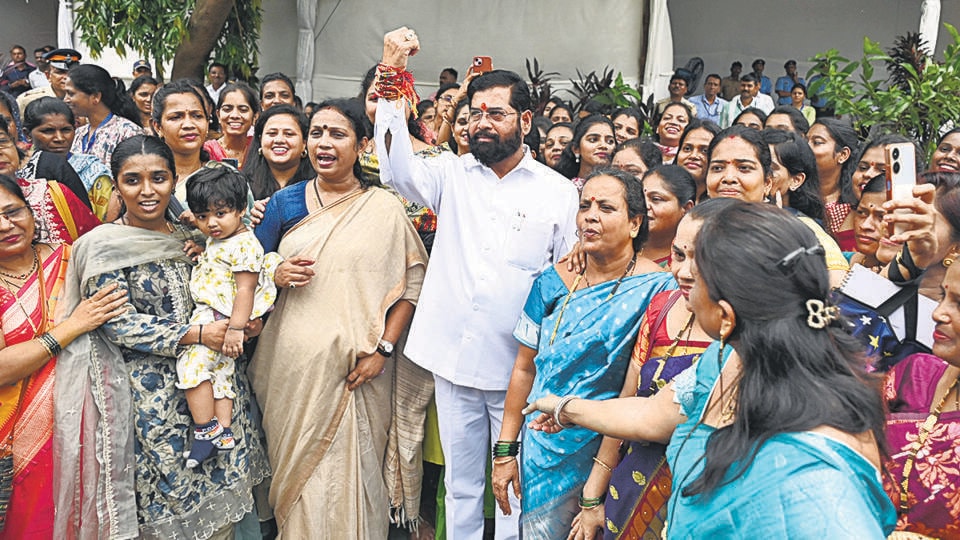
On Saturday, when the Mahayuti government in Maharashtra officially rolled out the scheme, chief minister Eknath Shinde said the monthly financial assistance to eligible women could be doubled from ₹1,500 to ₹3,000 if the alliance is re-elected. The remarks came barely within hours after Sanjay Raut, Shiv Sena (UBT) leader and a key figure in Maha Vikas Aghadi (MVA) alliance, promised to increase the monthly stipend under the scheme from ₹1,500 to ₹ 3,000 if the Opposition comes to power in assembly elections, due in October-November.
The scheme, seen as fiscally unsustainable to win votes in state elections, is modelled after a similar one introduced by the Bharatiya Janata Party in Madhya Pradesh, which played a crucial role in securing its re-election. However, the cost of this initiative—around ₹46,000 crore annually—comes when Maharashtra is already burdened with a massive debt of ₹7.8 lakh crore, the second highest in India after Tamil Nadu.
Even though the Ladki Bahin scheme, under which the government is offering financial assistance of ₹1,500 to every eligible woman in the state, puts an enormous financial burden, it has received a strong response. The Maharashtra government has already approved 1.8 crore applications to date with money already being credited into the bank accounts of 1.03 crore women. This has caused even the opposition parties to refrain from criticism. This underlines an already on-display shift where political parties, in their bid to outdo each other, increasingly resort to costly welfare measures, sidelining long-term economic stability.
Maharashtra has seen similar patterns before. The farm loan waiver, announced by the previous government, sparked a wave of populist measures, with parties offering more and more freebies.
Just before the 2004 assembly elections, Shiv Sena leader Bal Thackeray declared that if the Sena-BJP alliance came to power, they would offer free electricity to the agricultural sector. Since the elections hadn’t been announced yet, the model code of conduct was not in effect.
In a move to counter Thackeray, the then Congress chief minister Sushilkumar Shinde declared free electricity for agriculture. As a symbolic gesture, bills were sent to farmers showing zero charges.
However, after the Congress-NCP government retained power, Shinde was replaced by Vilasrao Deshmukh as chief minister, who then reversed the decision.
The Ladki Bahin scheme continues this trend, reflecting how the promise of immediate benefits is overshadowing the need for sustainable policies. If there has been any criticism of the scheme from the Opposition, it is about the scheme’s execution or how the government is trying to buy votes. However, at no point, did MVA leaders have said they will reverse it if they come to power to bring fiscal discipline to the state.
The announcement of the scheme and its response among women has helped the Shiv Sena-BJP-NCP government to set a fresh narrative at a time when the ruling alliance faces a tough assembly polls battle in the coming months. It is to be seen how much the scheme will help the Mahayuti partners.
As the state gears up for upcoming elections, it is likely that most party manifestoes will feature even larger commitments to freebies, further straining the state’s finances. The focus on short-term electoral gains, driven by schemes like Ladki Bahin, risks pushing Maharashtra deeper into debt, with long-term consequences for its economic stability. The silence of the opposition and the public’s embrace of such schemes indicate a worrying shift in priorities, where fiscal responsibility is taking a back seat to immediate political rewards.


