
 E-Paper



Monday Musings: October rain should be reference point for Pune’s development here on
Building consensus around future growth and development, with a focus on changing climate pattern is crucial. Such a participatory process is what will help build a Pune more liveable


For the past few years, weather patterns seem to be changing in Pune and other parts of Maharashtra, especially rainy season. As reported by HT, October has come to be known for receiving rainfall like July. The rains have grown intense with shorter time span.
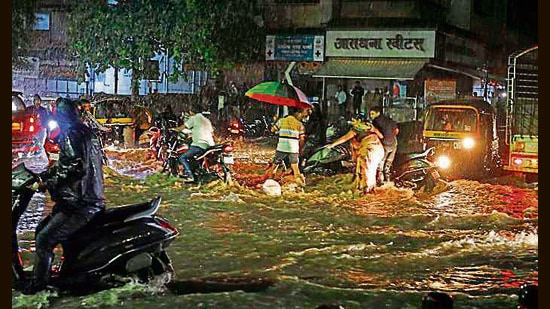
Pune has been a victim of this downpour, not just this year but throughout the decade. This time, Pune received 1,094 mm rainfall between June 1 and October 23 with 303 mm recorded in the three weeks of October, which is not known as a monsoon month.
Since 2010, there have been four occasions in October when Pune has reported more than 100 mm rainfall within 24 hours, the latest being the previous week when rains battered Pune and caused waterlogging at many places on October 17 and October 7. Shivajinagar weather station, representative of Pune, received 105 mm rainfall within a few hours of which 81 mm rainfall was reported within 120 minutes.
However, during the monsoon months of June, July, August and September such intense and heavy rainfall spells were not observed.
With intense rainfall, many areas were waterlogged, increasing the travel time of many residents. Housing societies reported flooding, vehicles washed away, and in one case a food delivery executive too was swept away in Kondhwa while completing his order. As is the case in the city during heavy rainfall, most areas went without power supply for many hours.
Deccan, the central part of Pune, bore maximum brunt as people were stuck in jam for hours.
The HT report published on October 19 explains using data furnished by IMD that it’s becoming normal to have 100 mm rainfall, the highest in the past 100 years was in 2010, when the city received as much as 181.1 mm rainfall. During the past decade, 112.1 mm was reported in 2020. After that, 105.1 mm was reported in 2011 and 101.3 mm was reported in 2017. This year on Monday (October 17), the city reported 105 mm rainfall in 24 hours as well.
The rainfall data, that reflects climate change, should force policy makers to rethink the way infrastructure projects are being planned and executed. Pune is witnessing one of the largest urban growth spurt in history and keeping in mind this, some major projects are being executed. Once completed, these projects can either make or mar Pune’s future. No one can afford to stall the development, though we cannot also prefer development that is not sustainable in our climate crisis-risked times.
At the same time, infrastructure that is already created also needs rethink. The change in climate patterns should force civic agencies to quickly act and take necessary steps in replacing stormwater systems, which are designed and laid as per old data, that is outdated. For Pune, as PMC chief said last week, the stormwater systems are laid considering the maximum capacity of carrying water accumulated through 65mm rainfall within 24 hours. Here, we are witnessing 80mm to 100mm rainfall within few hours. As pointed through another HT report, piers installed for Metro rail at some places also further minimised the carrying capacity of stormwater systems. PMC had communicated Maha-Metro to make necessary changes though the latter did not act, and, as a result, many parts of Deccan witnessed flood-like situation.
Plans are about people and not just physical spaces. Building consensus around future growth and development, with a focus on changing climate pattern is crucial. Such a participatory process is what will help build a Pune more liveable than what currently it is.
Yogesh Joshi can be contacted at yogesh.joshi@htlive.com


