
 E-Paper



Monday Musings: The new economics of Ganeshotsav
Last week, prominent Pune child psychiatrist Dr Bhooshan Shukla made an interesting observation on X about this changing model

 Prefer HTon Google


There was a time when the economics of a neighbourhood Ganeshotsav was simple, with few volunteers going door to door collecting vargani (donation). Someone would contribute ₹101, another ₹501, and those who could afford more would give more. The scale of the celebration was largely determined by what the neighbourhood could collectively raise.
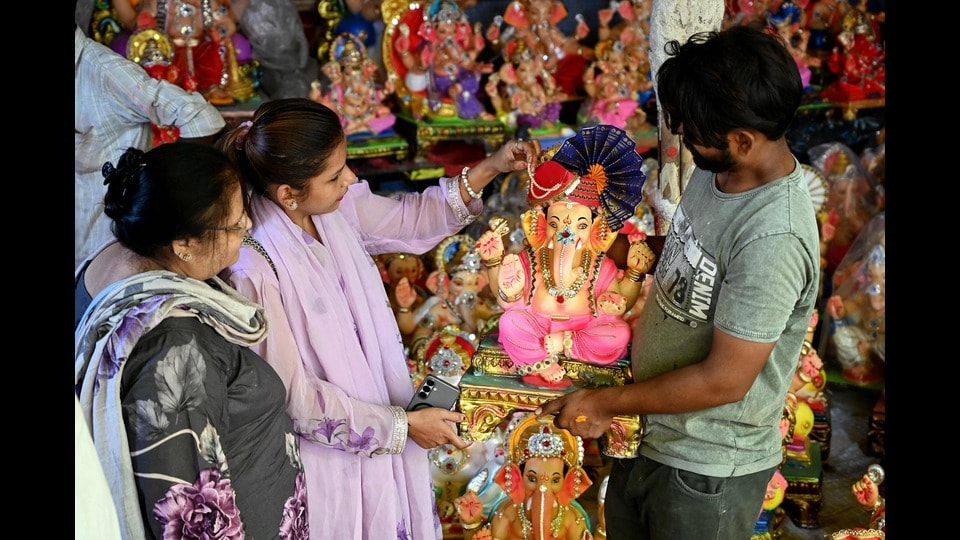
That equation has changed dramatically, particularly over the past decade and a half.
Ganeshotsav today is increasingly funded not by ordinary citizens but through politicians, local leaders, businessmen, traders, shopkeepers, advertisers and sponsors. Vargani has not disappeared, but it is no longer central to the finances of many public celebrations.
Last week, prominent Pune child psychiatrist Dr Bhooshan Shukla made an interesting observation on X about this changing model. His point was simple: Ganesh mandals are no longer dependent on collections from ordinary citizens as they once were. Sponsorships and other sources of funding have changed the economics of the festival.
Follow the money, and much of what Ganeshotsav has become begins to make sense.
It explains why celebrations have become bigger, louder and, increasingly, competitive.
A large part of the expenditure is concentrated at the two ends of the festival — the day the idol arrives and the day it leaves. The arrival procession is no longer just about bringing the idol to the mandal. There are dhol-tasha troupes, bands, sound systems, lighting and elaborate arrangements. Then comes the final day. For many mandals, the immersion procession is the biggest show of their financial and organisational strength.
In Pune, even relatively small mandals spend ₹5 lakh to ₹6 lakh on sound systems alone through the 10 day festival. A similar amount can go towards decorations. Then there is the cost of the mandap, idol, lighting, mahaprasad, puja and several other arrangements. The final bill can add up quickly.
When a festival depends largely on ₹100 and ₹500 contributions from residents, there is a natural financial limit. That limit disappears when politicians, businessmen and sponsors enter the picture.
The economics then shifts from community collection to patronage. And patronage comes with its own expectations.
A politician seeks goodwill and visibility. A local trader wants to keep the neighbourhood happy and, equally importantly, wants peace during the festival so that business is not affected. Local leaders want to demonstrate their influence and organisational strength.
The Ganesh mandal, therefore, becomes a meeting point of religion, commerce, politics and local power.
This is quite a change from the origins of the modern public Ganeshotsav.
Ganesh worship had existed for centuries, but the sarvajanik Ganeshotsav emerged in Pune in the 1890s and was popularised by Lokmanya Bal Gangadhar Tilak in 1893. Tilak helped turn what was largely a private religious celebration into a public festival. At a time when the British restricted political gatherings, Ganeshotsav provided a platform for people to come together. Cultural programmes, speeches, music and public participation gave the festival a larger social and political purpose.
More than 130 years later, the crowds are bigger than ever, and the economics of the festival have changed beyond recognition.
Pune’s biggest celebrations show the scale that public Ganeshotsav can now achieve. Shreemant Dagdusheth Halwai Ganpati attracts lakhs of devotees and receives substantial donations. Backed by a well-established trust, it has grown into a major religious and social institution, far removed from the modest neighbourhood collection model.
Mumbai demonstrates the economics of Ganeshotsav on an even bigger scale.
Lalbaugcha Raja, among the country’s best-known Ganesh celebrations, receives crores of rupees in donations during the festival. Publicly reported figures in recent years have put its cash collections and other offerings together at several crores. The mandal also generates income through offerings and auctions.
These are no longer merely neighbourhood celebrations. Some public Ganesh mandals have become large economic institutions in their own right.
The festival has also created a substantial seasonal economy. Idol-makers, decorators, flower sellers, electricians, tent-house operators, caterers, transporters, musicians, lighting companies and sound-system operators all depend on Ganeshotsav for business.
There is nothing inherently wrong with that as it shows how festivals create employment. They support small businesses and sustain traditional occupations. The issue is not how much money is spent. The more important question is whether the source of that money changes the nature of the celebration.
When citizens fund a festival through vargani, they are stakeholders. When finances increasingly come from political patronage, businesses and sponsors, the incentives are different.
Bigger becomes better. Louder becomes more visible. Grandness becomes a measure of prestige.
And somewhere along the way, competition can begin to take precedence over celebration.
That perhaps explains why the debate around excessive noise, road blockages and extravagant processions has become sharper this year.
The emergence of voices such as Vidyanand Bapat must also be seen against this backdrop. Bapat’s campaign against excessive noise during Ganeshotsav has found support beyond the usual circle of activists. His experience has also exposed the tension between those demanding adherence to noise rules and those who see any questioning of established practices as an attack on tradition.
Yet the support for such voices is significant.
It suggests that public expectations are changing even as Ganeshotsav becomes financially stronger.
Many citizens participate enthusiastically in the festival. They have no objection to celebration or devotion. But an increasing number are unwilling to accept that devotion gives organisers an unrestricted right to violate noise norms or inconvenience entire neighbourhoods.
That is the contradiction of the modern Ganeshotsav.
It is financially bigger than ever before. But the ordinary citizen who once funded it through vargani may no longer be its most important financial stakeholder.


