
 E-Paper



Pune: PCMC, ITDP redesign streets; make them safer, more inclusive
The pilot work on most of these stretches is nearing completion and is said to be already helping citizens, especially pedestrians and cyclists, to safely access the streets


In a push for safer, more inclusive streets, the Pimpri-Chinchwad Municipal Corporation (PCMC) along with the Institute for Transportation and Development Policy (ITDP) has redesigned multiple streets across the twin city including major stretches in Nigadi, Dapodi, and Pradhikaran. The pilot work on most of these stretches is nearing completion and is said to be already helping citizens, especially pedestrians and cyclists, to safely access the streets. Bapusaheb Gaikwad, joint city engineer, Urban Mobility Department, PCMC, said, “These users have as much right to safe streets as those in private vehicles, which is why this new infrastructure is critical.”
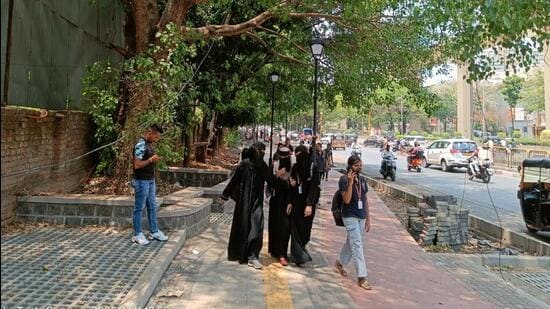
These upgrades are part of the ongoing ‘Urban Streetscapes Programme’ and are in keeping with the Supreme Court (SC) order dated May 14 directing states and union territories to ensure safe, accessible and obstruction-free footpaths for citizens.
For example, the old Mumbai-Pune highway corridor is undergoing one of the most notable transformations. A key pedestrian corridor with high footfalls, it had little to no usable footpaths previously. The redesigned stretch however includes continuous footpaths, dedicated cycle tracks, street furniture, green buffers, and junction safety improvements – all without compromising on effective street space for motor vehicles.
Whereas the upgrades have also been receiving their fair share of criticism in terms of reduction of carriageway space. However, Gaikwad clarified, “We are not reducing capacity; we are reallocating the previously unusable space by streamlining the parking and motor vehicles’ lane so as to avoid bottlenecks and ensure smooth flow of traffic.” He further explained that the street already has two lanes in the service corridor along with high-speed corridor lanes which is sufficient to meet the traffic needs of commuters. Adding more lanes would only temporarily solve traffic congestion, he said.
Besides, with private vehicle ownership in the city nearing 90 vehicles per 100 people, experts emphasise that continuing to widen roads is unsustainable. “More road space attracts more vehicles and quickly brings back congestion. The relief from congestion is temporary. There is only so much widening a city can do,” executive engineer Sunil Pawar said. The only way to decongest stretches in the long run is to encourage more commuters to choose walking, cycling or public transport. “And hence, the PCMC is prioritising its ‘Urban Streetscapes Programme’ that aims to reduce long-term traffic pressure by encouraging walking, cycling, and public transport – all core goals of the city’s non-motorised transport policy,” Pawar added.
Not only private vehicle ownership but also vehicle speed continues to be a major concern. The average speed recorded is around 50 kmph with peak speeds reaching 81 kmph. Fifty-nine per cent of the respondents surveyed identified speeding vehicles as a critical hazard.
Pranjal Kulkarni, programme manager at ITDP India, said, “Much of the opposition we hear is from vehicle users. But the reality is that a large part of our city walks or cycles. This survey was a way to amplify their needs and not just the loudest voices. Before the design interventions, only 45% of the streets had adequately walkable footpaths.”
Regarding concerns that these upgrades are merely for beautification, the PCMC clarified that the works include stormwater drains, improved lighting, junction redesign, and structural upgrades. All interventions follow the Indian Roads Congress (IRC) standards.
Prasanna Desai, architect-urban designer, said, “The streets are being designed based on the adjoining land-use and the available space while taking into account all stakeholders and elements such as motorised vehicles, parking, pedestrians, cyclists, hawkers, trees, seating, and services and utilities. While doing this, it is important to ensure safe, seamless and uninterrupted movement for pedestrians and cyclists along with motor vehicles. Streets designed under the ‘Urban Streetscapes Programme’ are not just street beautification projects but street transformations that enhance the overall experience with shade, safety, and inclusivity.”
Officials also noted that these upgrades have been shaped through extensive stakeholder consultations involving residents, RWAs, vendors, shopkeepers and the traffic police. Citizen inputs have been integrated throughout the planning and design process.


