E-Paper



Pune researchers develop four wheat varieties for timely & delayed sowing
The new varieties — MACS 4135 (MACS Mahabal), MACS 6830 (MACS Shivneri), MACS 6837 (MACS Vindhya) and MACS 6854 (MACS Tamhini) — have been identified by the Variety Identification Committee (VIC)

 Prefer HTon Google


Researchers at the Agharkar Research Institute (MACS-ARI) have developed four new wheat varieties aimed at maintaining productivity under different growing conditions, including delayed sowing in Maharashtra’s sugarcane belt. The researchers said that short-duration varieties are needed to allow wheat to mature within a compressed window whilst maintaining yields despite late sowing and temperature fluctuations.
The new varieties — MACS 4135 (MACS Mahabal), MACS 6830 (MACS Shivneri), MACS 6837 (MACS Vindhya) and MACS 6854 (MACS Tamhini) — have been identified by the Variety Identification Committee (VIC) under the All India Coordinated Research Project on Wheat and Barley Improvement. The research was led by Yashwantkumar K J, lead breeder at MACS-ARI; with rust pathologist Sudhir Navathe, agronomist Vijendra Baviskar and quality scientist Manoj Oak contributing to the development and evaluation of the varieties. The proposals have now been submitted to the Central Variety Release Committee (CVRC) for official notification after which, they will be available for commercial cultivation.
Among the four varieties, MACS Shivneri, has been developed specifically for late sowing conditions in the peninsular zone (PZ) which covers parts of Maharashtra and other peninsular regions. This variety matures in about 102 days and retains a yield of 35.58 quintals per hectare under very late sowing conditions. This bread wheat variety recorded an average yield of 47 quintals per hectare, and a maximum of 65.4 quintals per hectare in the trials. Furthermore, it recorded 12.9% protein, 40.9 parts per million (ppm) zinc and 44.5 ppm iron, along with a chapati quality score of 7.4.
MACS Tamhini has been developed for PZ and CZ (central zone). It matures in 103 to 106 days and recorded average yields of 47.4 quintals per hectare in the PZ and 48.7 quintals per hectare in the CZ with maximum yields of 69.5 and 69.9 quintals, respectively. According to the researchers, yield reduction under late and very late sowing conditions was limited to 10.6% to 18.4% in the trials. The variety also showed resistance to leaf and stem rust, and recorded protein levels of 12.3% to 13.3%.
For timely-sown conditions, MACS Mahabal is a durum wheat variety recommended for both the PZ and CZ. It recorded average yields of 52.5 quintals per hectare in the PZ and 59.6 quintals per hectare in the CZ, with maximum yields of 78.2 and 84.2 quintals, respectively. The variety matures in 105 days in the PZ and 119 days in the CZ. It’s hard, amber-coloured grains are suited to products such as pasta, semolina and vermicelli. It recorded protein content of 11.3%-11.4%, zinc of 40-41.2 ppm and iron of 38.7-41.3 ppm.
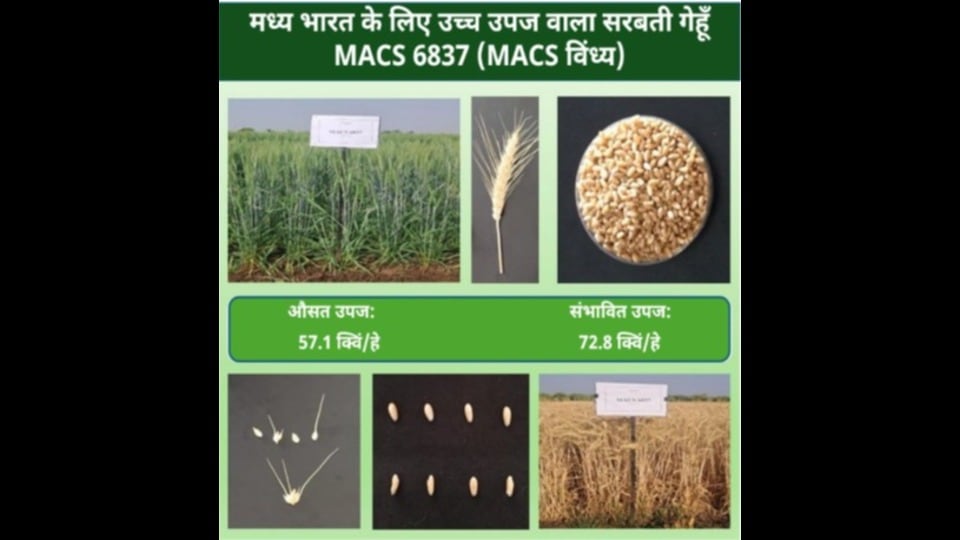
Whereas MACS Vindhya, is a bread wheat variety developed for timely sowing under irrigated conditions in the CZ. It recorded an average yield of 57.1 quintals per hectare and a maximum of 72.8 quintals per hectare. In the trials, it produced 3.7% higher yield than the GW 322 check variety. The variety recorded 12% protein, 35.5 ppm zinc and 35.6 ppm iron, while its chapati quality score was 7.7. Researchers also reported resistance to major pathotypes of stem and leaf rust.
“Our wheat improvement programme at MACS-ARI has been running since 1974 and is one of the few programmes that breeds all three types of wheat — Khapli (Emmer), Durum (Bansi/Pasta) and Bread (Sarbati) — under one roof,” Navathe said.
“With the development of four new high-yielding, rust-resistant varieties — MACS 4135 Mahabal, MACS 6830 Shivneri, MACS 6837 Vindhya and MACS 6854 Tamhini — we reaffirm our commitment to strengthening farmers and nutritional security. These varieties are specifically bred for climate resilience, both for timely sowing and late sowing in the sugarcane belt, as well as for superior nutrition through higher protein, zinc and iron,” he said.