
 E-Paper



Several areas in Pune, Pimpri-Chinchwad record AQI above 300
According to data on the Sameer app, managed by the Central Pollution Control Board (CPCB), Pune’s overall AQI stood at 293 at 5.05 pm on Monday

 Prefer HTon Google


Air quality remained poor across Pune and Pimpri-Chinchwad on Monday, a day after Lakshmi Pooja, with several monitoring stations recording Air Quality Index (AQI) levels above 300, placing them in the ‘very poor’ category.
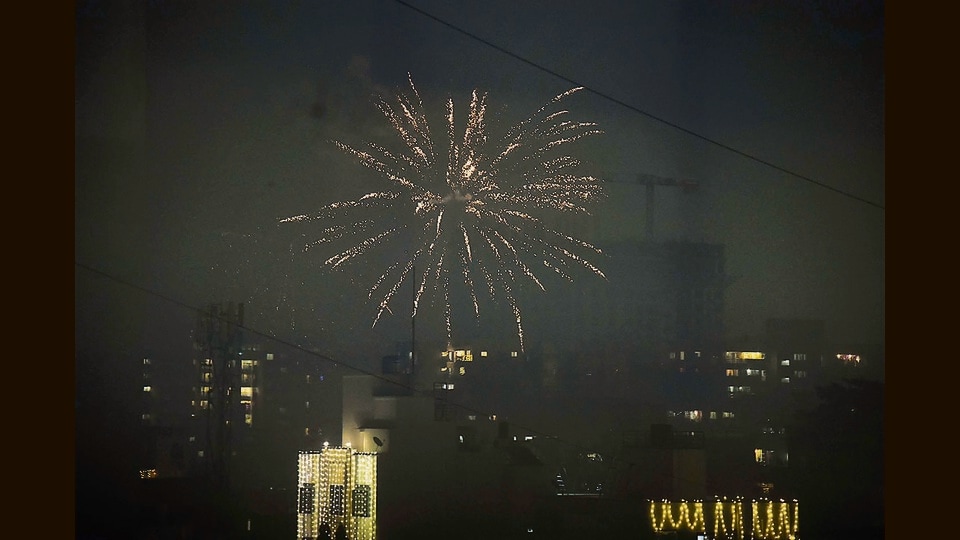
According to data on the Sameer app, managed by the Central Pollution Control Board (CPCB), Pune’s overall AQI stood at 293 at 5.05 pm on Monday, in the ‘poor’ category. This was higher than the morning reading of 265 recorded around 10 am, indicating a deterioration in air quality through the day.
In Pune, Dhankawadi recorded the highest AQI of 316 among the six active monitoring stations, followed by Hadapsar (311) and MHADA Colony (307). Panchawati-Pashan recorded 294, while Katraj Dairy and Savitribai Phule Pune University registered 276 and 254, respectively. Of the nine monitoring stations in the city, six were active.
Pune’s daily AQI trend also showed a steady deterioration over the past four days. The reading rose from 134 on November 6 to 157 on November 7 and 163 on November 8, before climbing sharply to 293 on Monday evening.
The situation was worse in Pimpri-Chinchwad, where Bhosari recorded the highest AQI of 330, followed by Savta Mali Nagar (324), Transport Nagar-Nigdi (317) and Bhumkar Nagar (312). Park Street in Wakad recorded 300, while Thergaon and Gavalinagar registered 267 and 260, respectively. Seven of the eight monitoring stations in the industrial city were active at the time.
The spike follows extensive firecracker use during Diwali celebrations, which releases particulate matter and other pollutants into the atmosphere. Their accumulation, coupled with prevailing weather conditions, can impede the dispersion of pollutants and prolong exposure.
An AQI between 201 and 300 falls in the ‘poor’ category, while readings between 301 and 400 are classified as ‘very poor’. Prolonged exposure to such conditions can cause breathing discomfort, particularly among children, senior citizens and people with respiratory ailments.
Despite several localities recording very poor air quality, neither the Pune Municipal Corporation (PMC) nor the Pimpri Chinchwad Municipal Corporation (PCMC) had announced any specific immediate measures to address the situation, raising questions about the civic bodies’ response to the post-Diwali pollution spike.
Ganesh Sonune, environment officer, Pune Municipal Corporation (PMC), said, “On November 9, the air quality displayed on Indian Institute of Tropical Meteorology’s (IITM) AIRWise app is largely in the ‘satisfactory’ category, although some localised pockets are experiencing pollution.”
“Vehicular movement and construction-related activities have either been reduced or completely suspended over the past two to three days. At present, water-cannon vehicles are being deployed along designated routes and at fixed timings to control dust pollution,” he said.
The IITM scientist requesting anonymity also clarified that there was no difference between the air quality data displayed on the CPCB’s SAMEER app and IITM’s AIRWise app, stating that both platforms reflected the same data.
“IITM’s website, which hosts air quality monitoring data, was currently facing a virus attack and was therefore not functioning properly. However, the data could still be accessed through either the SAMEER or AIRWise app,” he said.


