
 E-Paper



Sutradhara’s Tales: Sarasbaug and Hirabaug remind us of visages of 18th century Pune
The purpose of public recreation and leisure continued through various regimes from Peshwas to British to present-day administrators as both the gardens became more public friendly. Though, both Sarasbaug and Hirabaug may not retain their original forms they continue to remind us of the gorgeous visages of what 18th century Pune once was!

 Prefer HTon Google


To an average outsider, Pune may seem to be a city of paradoxes and irony! A bridge called “Lakdi Pul” is not made up of wood; a god called “Khunya Murlidhar” or murderous Murlidhar but is an innocent-looking idol. A “Talyatla Ganpati” (Ganesha situated in a lake) but actually sits within a garden, today. And most confusing is the bustling peth area named as gardens such as Tulshibaug, Belbaug but not a plant in sight.
All the above names referred to the quintessential Peshwa period Pune which was developed in the 18th century under the able vision of Peshwas such as Nanasaheb Peshwa. Today, the true nature of these places is lost under subsequent changes and alterations but the names have stayed and essence lingers through historical memories.
Parvati lake was created near Pune city as an alternative to the Katraj lake which was the primary supply of water through the aqua ducts. Thus, the lake of approximately 25 square kilometres (550 yards into 220 yards) was built in the year 1751-52. An island of 25 square feet was kept at the centre of the lake which was subsequently developed into a striking garden. Tall trees were planted on the banks of the lake to create a natural ambience. With the availability of water, vegetation and food, a variety of birds flocked the lake making for a lively scene. Another garden, Lotanbaug was created to the west of the lake.
Construction of the lake was an activity close to Nanasaheb’s heart. Legend informs us that once as Nanasaheb’s palanquin passed by the construction site, he was enraged by the apparent lax attitude of workers who were delaying the work indefinitely. In order to teach them a lesson by example, he got down the palanquin and personally started digging the grounds with a spade. Site workers were ashamed and assured him that work would complete within the promised duration.
Ambil stream flew near the lake and arrangement was made such that excess water from Katraj aqua duct would drain in Ambil stream which in turn would drain into river Mutha. A small stone dam wall was built along the Parvati lake which would regulate the flow of water in the Ambil stream throughout the year. Thus, excess water coming to Parvati lake due to flooding of the Ambil stream was regulated, too. British gazetteer mentions that the Parvati lake was used to be full of lotus flowers. Sawai Madhavrao Peshwa later installed a Ganesha idol in an open temple on the island of Sarasbaug, naming it as Siddhi Vinayak in 1774. Saras cranes were brought to the garden to reside in the lake waters, by Sawai Madhavrao Peshwa, thus, giving it the name “Sarasbaug”.
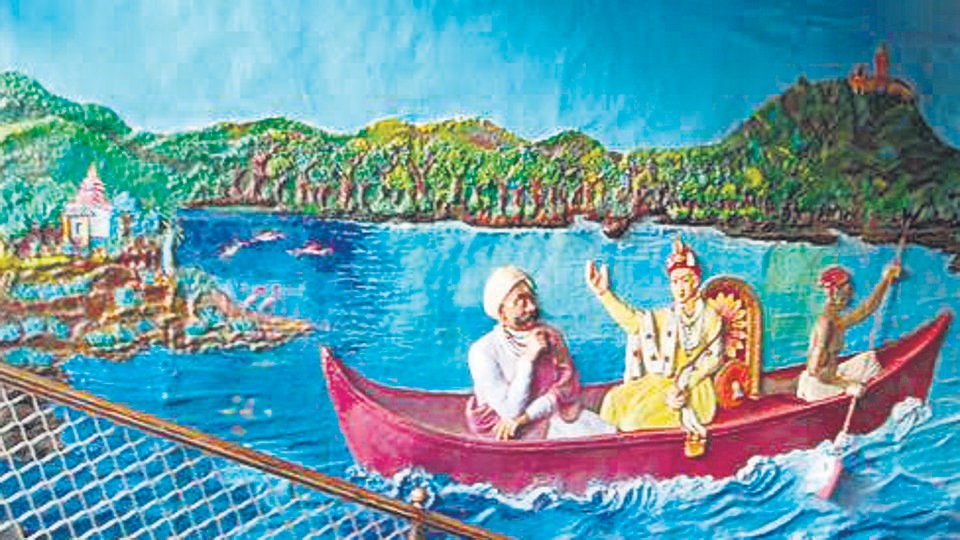
During the Peshwa period, the lake provided a great spot for boating aka “Nauka vihar”. Many important strategies were discussed between Sawai Madhavrao Peshwa, Mahadji Shinde and Nana Phadnavis while they took the boat ride around Parvati lake.
Today, this Siddhi Vinayak at Sarasbaug is a popular destination and place of worship flocked by Punekars. It is known by various names such as “Sarasbaug Ganpati”, “Talyatlya Ganpati” and so on. The original temple was built in the Maratha style of architecture, but it has been renovated later in 1969. The idol of Ganesh was replaced three times to date due to damage caused by ageing, in 1882 and 1990.
The lake suffered heavy neglect during colonial times and most of the land except the island was handed over by the British to the Pune Municipal Corporation (PMC) for repairs. In order to reduce the maintenance cost and prevent epidemics due to mosquitoes, the corporation filled the lake with debris to make way for an extended garden.
Today, the temple houses a fascinating exhibition of a number of Ganesh sculptures and is surrounded by lawns and gardens. Shri Devdeveshwar Sansthan Trust, who is in charge of managing various temples of the Peshwa period, oversees the temple maintenance and management.
Similar such garden exists near Tilak road today, called Hirabaug, situated next to Sarasbaug Ganesh temple, as we travel from Bajirao road to Parvati hill.
Some anecdotes inform us that Mastani might have been put under house arrest at Hirabaug by Chimaji Appa, Bajirao’s younger brother, but in all likelihood, it may not be true.
The picturesque garden is called Hirabaug and the bungalow or Peshwai wada within was mostly, commissioned by Nanasaheb Peshwa in 1753. Contemporary British records mention it by the names” Pleasure house” or “Diamond palace’. The palace faced east direction and was equipped with a fountain, paved courtyard and the view of Parvati lake. A “Khajina buruj” (water tower) was erected to source water for the fountain and water was fed to the tower using a Persian wheel.
The first mention of the Hirabaug bungalow is seen with reference to a feast arranged for fulfilling the vows to Brahmins by Nanasaheb Peshwa. The venue was utilised yet again for the wedding feast during Madhavrao Peshwa I’s marriage ceremony.
The bungalow and the garden suffered substantial damage due to fire during Nizam’s attack on Pune in 1763. Later, the elder Madhavrao Peshwa resurrected the garden by ordering fresh plantations. Nana Phadnavis the able minister under Madhvrao Peshwa, then personally issued orders to remove the debris, repair and rebuild the bungalow at Hirabaug in 1764.
Young Sawai Madhavrao Peshwa is known to practise his hobby of rearing the silk moths in the gardens of Hirabaug for a while as per his personal diaries. It was frequently used as a lodging for guests of Peshwas as seen during Sawai Madhavrao’s elaborate wedding festivities. Nizam of Hyderabad was housed in Hirabaug and treated with characteristic Peshwai feasts in gold and silver dining sets. Peshwa records are filled with the description of extravagant affluence that was seen and celebrated in Hirabaug on multiple occasions.
The British guests were hosted at Hirabaug after the famous Vasai treaty of 1803 who describe the Hirabaug and Parvati lake surroundings in great detail. It indeed served as a royal pleasure house for important occasions.
After the fall of the Maratha empire in 1818, the Hirabaug came under the possession of the British government, but it was then occupied by a Parsi individual named Sorabjishet Rustamji who occupied it till 1865. Later the property exchanged many hands to finally be purchased by Rajaram Bhau Mhaske and Mahadev Kunte in 1866 at the cost of ₹15,050. The property was bought to establish “The Hirabaug town hall committee” in 1877. Mahadeo Govind Ranade was instrumental in raising the contribution to buy the property for the establishment of the “Hirabaug town hall committee”. The committee was to be used as a public platform to host lectures, discussions and debates and the garden was to be used for the purpose of a sports club. Later, in the year 1891, the Deccan club was established at Hirabaug.
The purpose of public recreation and leisure continued through various regimes from Peshwas to British to present-day administrators as both the gardens became more public friendly. Though, both Sarasbaug and Hirabaug may not retain their original forms they continue to remind us of the gorgeous visages of what 18th century Pune once was!


