
 E-Paper



Taste of life: Poona bazaar shopping trip with an Anglo-Indian twist
According to Gordon’s list, “knolkhols”, turnips, beetroots, celery, lettuces, radishes, carrots, tomatoes, onions, green peas, French beans, artichokes, parsley, brinjals, math, chawali, fenugreek, ghole, mayaloo, chandanbatwa, and kapi-chawali were supplied to Bombay, from Poona, throughout the year


Lady Constance E Gordon published the first edition of her cookbook “Anglo – Indian Cuisine (Khana Kitab)” in 1904. It took her 10 more years to publish the second edition of the cookbook. The first edition of the cookbook featured “Bazaar lists” of Poona (Camp), Bombay, and Calcutta. The second edition had another list added to it – that of Poona city. This was the only Anglo-Indian cookbook to have lists for both Poona Camp and the city.
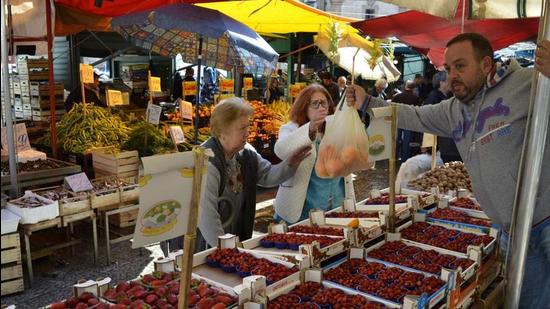
Most Europeans found the bazaars overcrowded and, because of lack of toilets, and ailments like typhoid, cholera, and malaria, they tended to avoid going out to buy groceries. The bazaars were particularly viewed as places that could contaminate food and water and where prostitution and venereal diseases were rampant. This fear was greater than another fear, that the food might be contaminated by native cooks.
JK Stanford wrote in “Ladies in the Sun: The Memsahib’s India”, that “no lady should ever demean herself to visit the bazaar and buy her own food. She should leave that entirely to her native cook, for to enter and bargain in the meat or fish stall, quite apart from the smell, is bad for prestige. Nor should she ever enter their back premises, the ‘cookhouses’ in which their viands are prepared… people are satisfied if the cook produced, unwatched, edible food on a tiny charcoal fire and with a minimum of fuss.”
Gordon clearly ignored this advice. She and her husband would often travel to Khandala and Mahabaleshwar on Sundays and during summer. The travelogues were often droll and recorded mishaps and quirky European characters. They would appear with some regularity in “Bombay Chronicle” and “The Times of India”. They never mentioned any recipes or her cookbook, but did mention meat, vegetables, and fruits they would find in the bazaars of the villages, towns, and cities they visited. In the write-ups, Gordon would often record the seasons in which certain fruits were available, their prices, and quality. She would note colours, textures, smells, and tastes. Her articles make one believe that she loved visiting Indian bazaars, especially those in Poona, Mahabaleshwar, and Khandala.
Food supplies in the hills were more difficult to source than on the plains. Gordon believed that it was possible to have plain, but sufficient food at Mahabaleshwar and Khandala. These places had hillside estates for the cultivation of European fruits and vegetables to cater to the European population.
Her articles suggest that she preferred buying vegetables from a garden twice or thrice a week to buying from the bazaar. Although the former was more expensive, Gordon wrote that eating vegetables from the bazaar was dangerous if the water used to wash the vegetables and fruits was contaminated.
Gordon might have had a garden in her house in Bombay. One of her travelogues mentions how she would gift parsley, potatoes, and other fruits to her friends. She was especially proud of the “knoll khol” cultivated in her garden. She compared it with the “best quality from Poona”.
According to Gordon’s list, “knolkhols”, turnips, beetroots, celery, lettuces, radishes, carrots, tomatoes, onions, green peas, French beans, artichokes, parsley, brinjals, math, chawali, fenugreek, ghole, mayaloo, chandanbatwa, and kapi-chawali were supplied to Bombay, from Poona, throughout the year. Watercress cultivated in Poona was supplied to Bombay between February and April. Bombay got its potatoes from Italy, Cawnpore, Karachi, Mahabaleshwar, and Talegaon, and some of it was brought to Poona by a few European shopkeepers.
Poona also sent figs, pears, chikoos, jambhool, oranges, custard apples, ramphal, guavas, and papaya to Bombay. Gordon noted that some natives in Poona had built farms where they reared rabbits, grey pigeons, partridges, wild ducks, and quails. These were then sent to the markets in Bombay.
According to Gordon, the prices in the markets of Poona were liable to more fluctuation than those of Bombay, owing to less regularity in the supply. In the season the principal articles of European consumption were generally a little dearer; if a quantity was required it should be ordered a day prior, she suggested.
Gordon’s bazaar list for Poona (Camp) started with Mutton. Grain-fed Mutton, 4 lb., cost a rupee. So did 6 lb. of Saddle. A lamb cost Rs3 while the cost of Mutton Suet was 6 annas. 4 seers of prime pieces of beef cost a rupee. The “Poona Seer” was equal to 1 lb.
“Prime pieces” of beef cost Re 1 for 4 lb. Hump cost 12 annas, while 8 lb. of Brisket cost a rupee. Soup meat and ox-tail were 1 anna per pound, while ox-tongue cost 4 annas. Gordon also provided prices for veal, poultry (these were available plenty in the market and included chicken, ducks, geese, country fowls, pigeons, turkey-cock, and turkey-hen), and “game meat” like quail, partridges, teal, wild duck, and hare.
Gordon noted that since Poona (Camp) was chiefly dependent on Bombay for its supply of fish, whenever a quantity was desired a previous order should be given. Oysters were 6 annas per dozen. Salmon cost 6 annas per pound, while a turtle could be bought for a rupee. Bombay duck, pomfrets, prawns, phatte and murrrell were also available in Poona, “but were dearer than the markets in Bombay”.
Poona (Camp) was “well stocked with various kinds of vegetables”, but “few were available throughout the year”, Gordon wrote. Many vegetables were specially cultivated all through the year to be supplied to Bombay, and if there was an extra demand from Bombay, some vegetables would not be available in Poona for a few weeks. The same was true for fruits.
Gordon’s “bazaar list” for Poona city is testimony to the fact that she did not see the old cities and native bazaars as areas linked with dirt, disease, and prostitution. Her list also clearly shows the contrast between the bazaars of Poona Camp and the city. Only chicken, beef, mutton, and few varieties of fish were available in the markets of the city. Fruits and vegetables cost less than the Camp markets. A rupee could buy 13 seers of potatoes in the city, while the same cost a rupee and 2 annas in Camp. On the other hand, tea and coffee were dearer in the city markets.
Lady Constance E Gordon’s cookbook has long been forgotten, but the recipes, and the “bazaar lists” help us reconstruct the charms of Poona. And the brilliant observation skills, scientific aptitude, and penmanship of Gordon.


