
 E-Paper



Rain and winds help Delhi breathe a little easy
Central Pollution Control Board (CPCB) data shows that the overall air quality index of the national capital on Monday was 221, in the poor category. At 7pm on Monday, Delhi’s AQI had reached the moderate zone, with an AQI value of 199 , according to CPCB.

 Prefer HTon Google


Strong winds and light rains in some parts of the city brought the much needed relief to the Delhi residents with the air quality on Monday settling in at the lower end of poor category -- two days after recording the worst air quality on Diwali in the last five years and a 15-day spell very poor and severe air days.
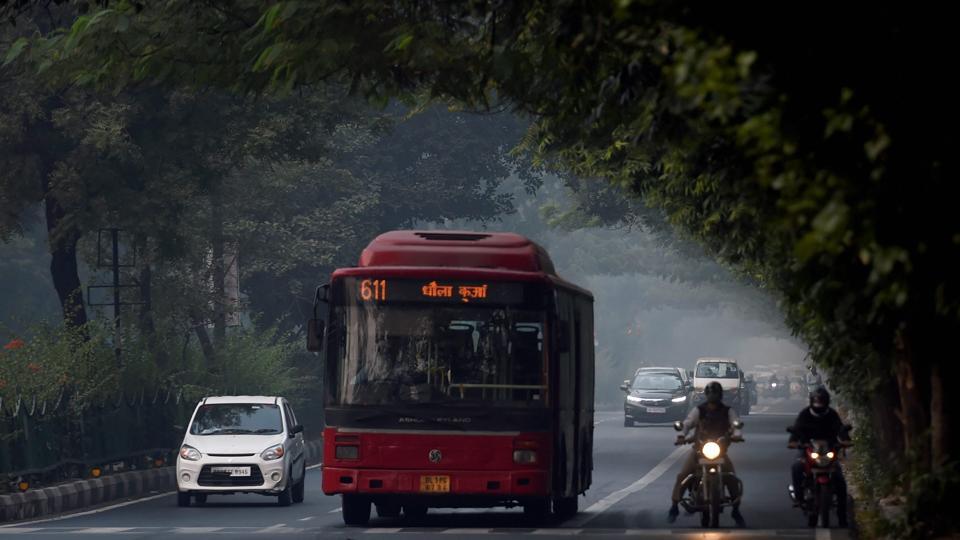
Central Pollution Control Board (CPCB) data shows that the overall air quality index of the national capital on Monday was 221, in the poor category. At 7pm on Monday, Delhi’s AQI had reached the moderate zone, with an AQI value of 199 , according to CPCB. At least 13 out of the total 38 air quality monitoring stations had recorded AQI levels below 200.
The turnaround was clear since morning. At 9am on Monday, Delhi’s AQI was 300 compared to 467 around the same time the previous day.
The neighbouring cities of Faridabad (256), Ghaziabad (292), Greater Noida (302), Gurgaon (314) and Noida (312) recorded their AQI in the poor and very poor categories after suffering severe air quality on Saturday and Sunday.
On Sunday, a western disturbance which started impacting the western Himalayas on Saturday brought widespread and moderate rains to Delhi NCR. Delhi recorded 0.4 mm rainfall till 5.30 pm and wind speed of nearly 40kmph on Sunday.
From recording severe AQIs of 414 and 435 on Saturday and Sunday—Diwali and the day after Diwali—the gusty wind helped in what was the maximum post-Diwali dispersion since 2015.
Unlike previous years when air pollution levels remain very high turning to severe category the day after Diwali, this time air pollution levels gradually reduced due to favourable meteorological conditions, scientists at the India Meteorological Department (IMD) said.
VK Soni, head of IMD’s environment monitoring research centre, said that rain coupled with high wind speed was the reason behind the improvement in the air quality seen in Delhi. “The average wind speed on Monday remained around 18kmph. The impact of the rain and wind on Sunday also showed on Monday’s air. For the past two days Delhi is also receiving easterly winds, which means that the contribution from the stubble fires in Punjab and Haryana has also been negligible,” Soni said.
Also Read: Lower air pollution, noise recorded in Chennai on Diwali compared to earlier years
Analysis of the PM2.5 levels data from Delhi Pollution Control Committee’s (DPCC) monitoring stations shows a steady decline since midnight Monday till late evening. At several stations the PM2.5 levels were well under the safe limit of 60ug/m3.
The average PM2.5 levels at 6pm was 88ug/m3 and average PM10 levels was 135ug/m3. PM10 levels below 100 µg/m3 is considered safe in India and 500 µg/m3 is the emergency threshold. Delhi last recorded such low PM10 levels on September 28, according to DPCC and CPCB data.
Soni said that in the coming week, Delhi’s air is likely to remain in the moderate to poor zone. According to the IMD forecast, the wind direction is expected to change again from easterly to north-westerly on Tuesday, which could result in a marginal deterioration, but because the stubble burning counts over Punjab and Haryana have been reducing now, the impact on Delhi’s air quality will not be severe.

Union ministry of earth science’ air quality monitoring centre, System of Air Quality and Weather Forecasting and Research (Safar), showed that on Monday 282 farm fires were spotted over Punjab and Haryana. Its impact on the PM 2.5 levels (ultrafine particulate matter with diameter less than 2.5 micrometres) was also only 1% on Monday.
“A change in boundary layer wind direction is forecasted by tomorrow (Tuesday) afternoon but since the fire-related emissions have reduced, significant impact is not expected. The AQI is likely to improve. It is forecasted to marginally deteriorate and stay in the very poor category on November 18 and November 19,” the Safar forecast read.
In a special report on Diwali pollution released on Sunday, the Central Pollution Control Board had said that almost all pollutants reported higher values on Diwali day this year as compared to 2019. It could be attributed to bursting of firecrackers, higher share of stubble burning and unfavourable meteorology during the festival season, the CPCB said.


