
 E-Paper



Lower air pollution, noise recorded in Chennai on Diwali compared to earlier years
The considerable reduction of pollution level and the noise level are mainly due to public co-operation following the Supreme Court’s guidelines, a statement from TNPCB said, adding awareness amid the Covid-19 pandemic could also be a factor. Studies have shown a link between poor air quality and lowered ability to recover from the coronavirus.

 Prefer HTon Google


Despite Tamil Nadu not banning firecrackers and restricting bursting of fireworks to 2-hours on Diwali day--which was flouted-- Chennai’s air pollution and noise has declined compared to 2019, according to observations made by the Tamil Nadu Pollution Control Board (TNPCB).
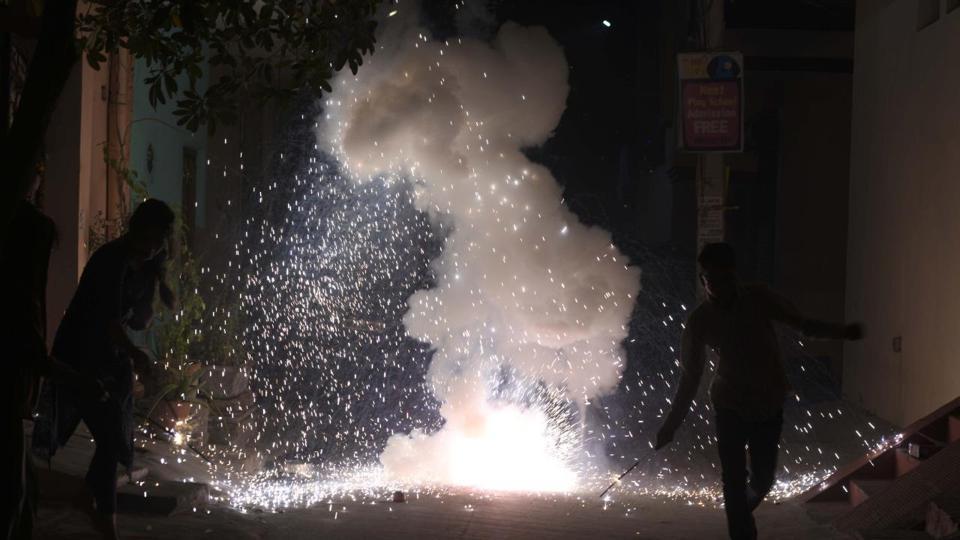
As of November 14, the Central Pollution Control Board (CPCB) labelled Chennai’s air quality as ‘satisfactory’ with prominent pollutants being PM 10, PM 2.5 and CO while Delhi was categorized as ‘severe’.
Four parameters--PM10, PM2.5, SO2, and NO2-- are monitored to assess the air quality index or AQI. To study the ambient air quality and noise pollution levels, TNPCB manually monitored five locations in the city and has reported the AQI at Besant Nagar (62), T Nagar (72), Nungambakkam (59), Triplicane (107) and Sowcarpet (100).
The considerable reduction of pollution level and the noise level are mainly due to the public co-operation following the Supreme Court’s guidelines, said a statement from TNPCB adding that awareness in the time of the Covid-19 pandemic could also be a factor. Studies have shown a link between poor air quality and lowered ability to recover from the coronavirus.
According to their report, PM10 values were observed to be within the limits except in Triplicane and Sowcarpet where it was marginally higher and PM 2.5 were within limits. Gaseous pollutants SO2 and NO2 were also within prescribed standards. The survey was done from 6 am to 6 am in commercial and residential localities.
In 2019, on Diwali which fell on October 27, the AQI was highest in Sowcarpet station at 119 and lowest in Nungambakkam station at 85. CPCB guidelines have also instructed authorities to conduct short term monitoring for 14 days (a week before and after Diwali)
On a regular day on November 9, AQI was observed to be highest in T Nagar (65). In 2019, a week before Diwali on October 20, the highest value was recorded in the same location at 81.
Noise levels which were monitored for 24-hours and measured in dB (A) Leq was reported as (78), T Nagar (78), Nungambakkam (71), Triplicane (75) and Sowcarpet (76). The noise level ranged from 54 dB(A) to 69 dB(A) pre- Diwali on November 9 and ranged from 71dB(A) to 78 dB(A) on Diwali this year which is found to be lower compared to the previous year, said a statement from TNPCB.
On Diwali day on November 14, PM10 results ranged from 52 to 111 ug/m3 during against the prescribed standard of 100 ug/m3. PM2.5. results ranges from 32 to 59 microgram/m3 against the prescribed standard of 60 ug/m3.


