
 E-Paper



Why ban on stubble burning has gone up in smoke in Punjab
Post-Diwali, a sudden spike in stubble burning has raised questions on the efficacy of a raft of steps taken by the Punjab government to curb the menace. As many as 17,672 farm fires — almost 80% of this season so far — have been recorded in last week.

 Prefer HTon Google


On Friday, the sun didn’t shine over Punjab for the second consecutive day, eclipsed as it was by a thick blanket of a toxic smog created by unabated paddy stubble fires across the state. Such was level of air pollution that even the satellite imageries could not record the fire incidents, particularly in the worst-affected southern districts.
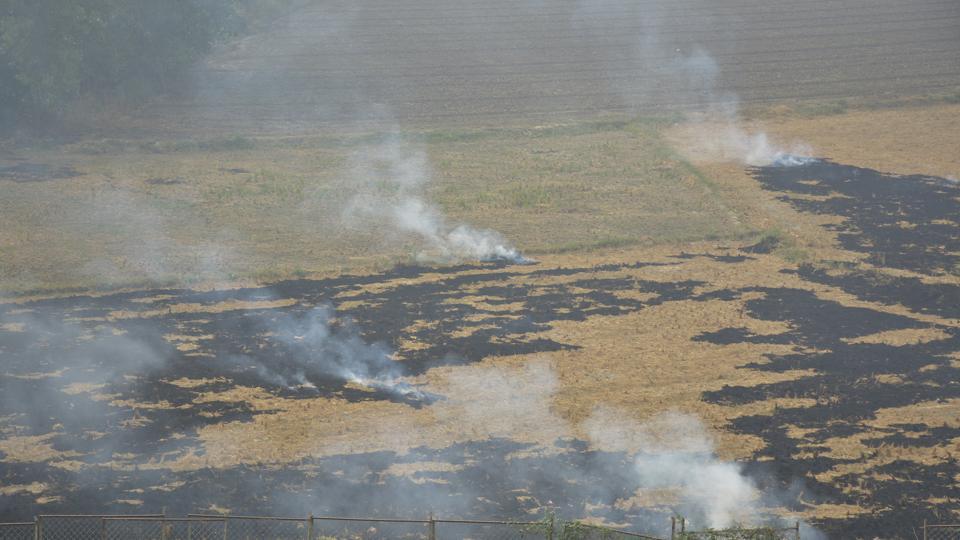
Post-Diwali, a sudden spike in stubble burning has raised questions on the efficacy of a raft of steps taken by the state government to curb the menace. As many as 17,672 farm fires — almost 80% of this season so far — have been recorded in last week.
“Officers from deputy commissioner to peon are working to stop the farm fires, but there is no political support,” says an exasperated senior IAS official, who requested anonymity. “Not a single MLA of any party has opposed stubble burning. Everyone is trying to defend Punjab, saying the state is not responsible for Delhi smog, but what about the smog in Punjab? Do you think the Punjabis are not suffering?”
HT looks at five reasons why the ban on stubble burning has gone up in smoke:
Farmers Blame Late Harvesting
The farmers blame the delayed paddy harvesting as the reason behind paddy straw burning. That left them with a very little time window between harvesting of paddy and sowing of wheat. “We have to sow wheat before November 15. Since handling paddy straw is tedious process, burning it is an easier option to clear the fields for the next crop,” says Mukhtiar Singh, a farmer in Patiala. However, the agricultural department doesn’t buy into this argument, saying the wheat can be sown till end of November.
Tardy Implementation of Central Scheme
Under an ambitious scheme, funded by the central government, Punjab had set a target of distributing 19,000 subsidised machines to farmers for in-situ management of stubble. But due to late tendering, it managed to provide only half of that before harvesting. Non-availability of machines to small farmers left them with little option but to resort to stubble burning.
“I have 2.5 acres of land, and I can’t afford a tractor or machine. If the government is serious, it should come with a bailer and clear my field, otherwise I will clear it by using fire,” said Harjinder Singh of Bhartiya Kisan Union (Ugrahan).
In fact, farmers insist that the straw-handling machines are available at much cheaper price in the market as compared to the subsidised machinery. “Why no direct subsidy to farmers if government is serious about controlling paddy?” asks Gurmej Singh, a farmer leader.
Soft Government, Defiant Farmers
Even as a sizable section of farmers have got access to subsidised stubble-management machines, some of peasants’ unions have been openly exhorting farmers to defy the ban against stubble burning to pressure the government to meet their demand for a bonus of Rs 100 per quintal as an incentive for not burning stubble.
Some farmer unions are even confronting the officials making surprise checks in the fields and imposing fines on farmers found burning stubble. Jagtar Singh, a leader of Bhartiya Kisan Union (Ugrahan), says, “Farmers are already under financial stress. It is the duty of government to pay at least Rs100 per quintal as charges of handling paddy straw.”
What has complicated the matter is the government’s soft approach on cracking the whip against farmers who form an influential vote bank. Farmers’ unions know this too well.
HC Directions on Not Recovering Fines
Even before harvesting season, a major blow to the campaign against stubble burning came last month when the Punjab and Haryana high court stayed the recovery of fines imposed on farmers penalised earlier. But, farmer unions misinterpreted the court directive as a restraint order on the state government for slapping any penalty on farmers for stubble burning. “Prior to the HC order, there were minimal farm fires, but farmer union leaders spread misinformation which led to a large scale violation of the ban,” said an official.
Non-Operational Biomass Units
The Punjab Energy Development Agency (PEDA) had floated tenders for 150 MW biomass plants, which could have handled at least 50 lakh MT of paddy straw. However, despite getting bids, no one came forward as Punjab State Power Corporation Limited is not signing power purchase agreement on tariffs decided by the state power regulator. Due to low tariff, the bidders are not investing in biomass plants, as a 10 MW plant needs Rs 100-crore investment. Even the two existing biomass plants in the state are non-functional.


