


 Live Score
 Cricket Teams
 Cricket Players
After slip-ups, India’s fielding delivers a direct hit
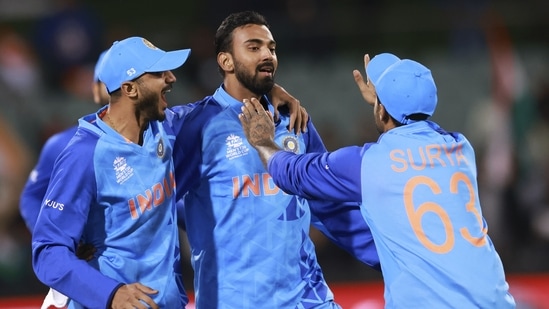
KL Rahul's direct throw that ran out Litton Das underlines fielding turnaround for India.


It was KL Rahul’s day but his fifty won’t be the first thing that comes to mind every time this India-Bangladesh match is recalled. It’s his throw from just beyond midwicket at Litton Das’s end that has actually made the legend’s cut. Till that lucky break for India, Bangladesh were riding the momentum. Das was seeing the ball like a football but a statutory warning should have been served after he slipped twice when Bangladesh resumed their chase. Najmul Hossain Shanto called for a tight second, Das couldn’t get enough traction while running and ultimately he was out by about a metre. The match had turned on its head as Bangladesh lost six wickets for 40 runs in 33 deliveries to hand the edge to India.
Barring Mosaddek Hossain’s dismissal—he was bowled by Hardik Pandya—each of the other five Bangladesh wickets to fall was due to brilliant fielding by India. Direct hits connected and not one catch was dropped, completing a satisfying turnaround from the South Africa game in Perth where Virat Kohli had dropped a sitter from Aiden Markram in the deep and Rohit Sharma had missed at least two close run-out opportunities.
Amid all the fretting over bowling and batting, its permutations and combinations that change according to different match scenarios, fielding somehow doesn’t get as much space. But the defeat to South Africa had suddenly brought to light this aspect of cricket. India’s fielding standards were taken for granted, mostly because of Ravindra Jadeja’s presence. But for the first time did it seem to hurt India. Rahul Dravid however rightly tried to point out the performance against South Africa as a one-off. “I mean, we've been good, and there were a few opportunities that we could have taken in the last game,” he had said before the Bangladesh match.
“It's just the nature of the game. Some days those direct ones hit. You hit those, and they hit from anywhere. Some days they don't, and the ball goes to the best fielder in the park. It can happen. It's a great lesson in humility. This can happen to anyone. Can't read too much into these things. We keep doing our processes, keep working hard and keep doing the things that we need to do.”
The processes Dravid was talking about include regular fielding drills, both close-in and in the outfield, off edges coming off specially designed bats and the centre of the bat. And then there are the run-out drills where fielders are asked to aim at small nets and plastic stumps from afar. The routine is tiring but basic, nothing too different from other teams.
Fortunately for India, everything went their way on the field on Wednesday. Arshdeep Singh was steady, catching Yasir Ali at the deep after a brief fumble. Twice Suryakumar Yadav was summoned to the job to catch skiers at long-on and both times he pulled it off very calmly. Trying to clear the shortest boundary, Shakib Al Hasan swung at Arshdeep Singh and speared the ball high but substitute Deepak Hooda did a great job of running in and taking the swirling catch without faltering. But the moment of the day came at the start, when Rahul almost had one stump to aim at.
Asked about the throw later, Rahul didn’t want to make a big deal out of it. “We all train very hard on our fielding. We work on throwing, on moving quickly and faster. When you keep working hard, sometimes it comes off. Today was one such time when the ball came to me, I threw the ball and it hit the stumps.”


