


 Live Score
 Teams
Teams Players
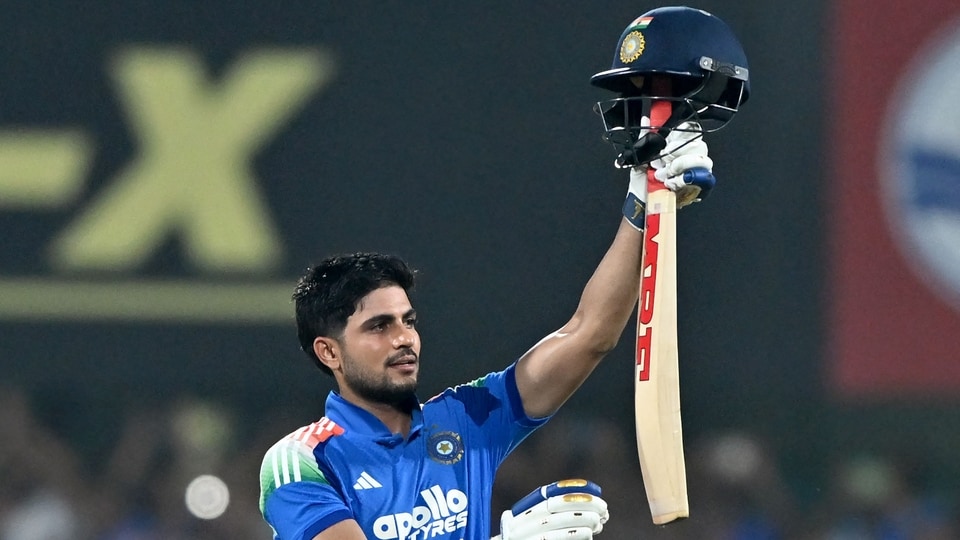
Shubman Gill’s historic double ton, Rohit Sharma’s century pave the way for India’s record chase against West Indies
India cruise to take down 405 to pull off second highest successful chase in ODI history

 Prefer HTon Google


It was a one-day game but you wouldn’t know it from the scoreboard. A run rate of 9.33, hundreds from Shubman Gill and Rohit Sharma, Gill converting his century into the highest ever double by an ODI captain and still turning in a strike rate of 167.66, courtesy 26 boundaries — second most in an ODI innings — and eight towering sixes, all from the comfort of a Guwahati pitch that any flatter would have tempted flight arrival diversion from the nearby airport.
Bowlers were the mass casualty left in the wake of more than 800 runs scored as five batters plundered hundreds in a game where West Indies couldn’t prevent India pull off the second highest chase in ODI history to go 2-0 up in the three-match series.
For a while, 406 looked less like a target than a provocation. West Indies had set India a mountain and then watched, with increasing disbelief, as Gill and Rohit Sharma began to dismantle it. The opening partnership reached 255—the second-highest opening stand in India’s ODI history—before West Indies finally found a way through. More strikingly, it eclipsed Rohit Sharma and Shikhar Dhawan’s 210 against Pakistan in the 2018 Asia Cup as India’s highest opening partnership in a successful chase.
Deep Dive

There was little that resembled a conventional pursuit of a huge total. Gill and Rohit simply went about their work. Rohit, as so often, was the disruptor. Anything short was pulled, anything wide was cut and the occasional error in length disappeared into the stands. West Indies played to his strengths, bowling quicker and getting hit longer. Gill took a little longer to settle, allowing his partner to set the tempo, before accelerating so violently that the distinction between the two innings eventually disappeared.
By the end, both had hundreds. Gill’s came first, from 62 balls—the fastest by an Indian against West Indies, beating Virender Sehwag's 69-ball effort in 2011. It was also his 11th ODI hundred, reached in only 68 innings, putting him behind only Hashim Amla and Quinton de Kock for the number of innings required to reach that mark. Rohit followed, bringing up his hundred from 72 balls. It was his second-fastest ODI century, and on his way also crossed the 12,000-run mark in ODIs, a territory previously occupied by only Sachin Tendulkar and Virat Kohli among Indians.
The partnership had become a kind of running argument between two generations. Rohit, the veteran who has spent much of his career redefining what an ODI opening innings can look like, and Gill, the captain and heir apparent, were not merely surviving the chase. They were setting its terms.
West Indies tried pace, they tried spin. They changed lengths and fields but also conceded a staggering 22 extras. There were moments when West Indies might have wondered whether the game had somehow become detached from its target. India reached 200 in only 21.1 overs, the quickest they had ever done so in an ODI. At 250 after 25 overs, they had reached the milestone faster than any side in an uninterrupted ODI chase.
Eventually Jayden Seales broke through, trapping Rohit leg before on 101, ending an opening stand that had already rewritten the record books. A target of 406 had demanded something extraordinary, but Gill and Rohit supplied it with an ease that made the extraordinary look almost routine.
West Indies were in for more misery though as Gill converted his hundred into a double, reaching the mark in 117 balls and at a strike rate of 171. This is where Gill stamped his class as a batter who wouldn’t leave the job of finishing the game for anyone else. The intense humidity forced cramps but he battled it to stay unbeaten on 223 and ensure India won with 39 balls to spare.
To say the West Indies were left shell shocked would be an understatement, especially after John Campbell (101 off 68 balls), Shai Hope (104 off 94 balls) and Amir Jangoo (114 off 77 balls) helped the tourists put up their highest ever ODI total, also the third highest score conceded by India.
Campbell set the tone of the match with his aggression, using the pace of the quicks, attacking the spinners with sweeps and lofted drives, and repeatedly finding gaps when India changed their fields as Hope anchored the innings brilliantly from the other end. Jangoo initially played the supporting role, scoring 59 off 54 balls, before exploding to his hundred in 16 more balls. But everything paled in comparison to the controlled aggression Gill and Rohit rolled out to leave West Indies completely disoriented.


