No part of ODI cricket has been tinkered with as much as the middle overs. Alterations have kicked in every few years or so but broadly there have been three changes in field restriction rules. At first, only two fielders were allowed outside the 30-yard circle for the first 15 overs, and then five fielders for the rest of the innings. Then in 2005, the fielding restrictions were split into three blocks—the mandatory first 10 overs, followed by two five-over power plays at the discretion of the bowling and batting teams when only three players could be kept outside the circle. From 2015, the overs were broken up as 10-30-10, with a maximum of two, four and five fielders outside the circle in each phase.
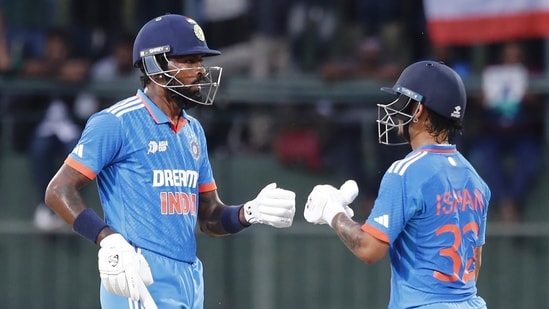
India's Ishan Kishan and Hardik Pandya, left, encourage each other during the Asia Cup cricket match between India and Pakistan at Pallekele (AP)
The middle overs were traditionally used by batters to go into grafting mode, accumulating risk-free runs dissecting a spread-out field. Bowling sides, too, used to concentrate on stemming the boundaries. Not anymore.
To counter the problem of the white ball getting discoloured around the 30 over-mark, the ICC introduced new balls from both ends in 2011. Reverse swing was lost in the process, and many spinners struggled with their grip. More significantly, the ball stayed hard and batters started to find more boundaries. With the advent of T20 cricket, the first and last power plays were already getting maximised but now batters were turning their attention to the middle overs.
A basic comparison of the last three World Cup cycles shows middle-overs (10-40) run rate to be on the rise—it was 4.98 for 2015, 5.23 for 2019 and 5.27 for the current tournament cycle. Overall run rates too have increased as a result, with 300-plus scores becoming more par.
In fact, since the 2011 World Cup, India have scored 300+ scores every 3.7 ODI innings. But they are not the best in this business anymore. Defending champions England have been posting 300+ every 3.5 innings, buoyed especially by an incredible run since 2018 with ten 350+ scores, including the highest ever ODI score of 498 against Netherlands last June. India are just behind, with nine 350+ scores in the same phase but their 7.51 rpo in these nine innings are no patch on England’s 8.1 rpo.
For India, these run rates are not only the construct of the first and last power plays. Like in the ongoing Asia Cup, where India ended up with 266 on a two-paced Pallekele pitch against a top-notch Pakistan bowling attack that had removed Rohit Sharma, Virat Kohli and Shreyas Iyer by the 10th over.
Shubman Gill was also scratchy but India still staged a comeback in the form of a 138-run stand between Ishan Kishan and Hardik Pandya for the fifth wicket. That alone ensured India added 173—almost two thirds of their entire innings—in those middle overs.
A more emphatic example of middle-overs dominance would be the Chattogram ODI last December, where India scored at a rate of 9.8 per over to add 294 runs in the middle overs—till date the second highest in ODI history. They ended up with 409.
What can be gleaned from these two innings in particular is how India are not always making the most of the first 10 and last 10 overs, probably because they tend to start cautiously and don’t have enough batting strength to leverage the last few overs.
Former England captain Nasser Hussain had pointed this out in his Daily Mail column in 2021. “It's not as if they are slouches when it comes to strike rates, but they take their time and soak up pressure,” he had written. “It's old-fashioned, 50-over cricket from five years ago. It's almost as if they are playing a 30-over game initially in which they are intent on keeping wickets in hand, followed by a Twenty20 innings.”
India have tried to tweak their approach since then though, with encouraging results. Since 2021, India’s best year in terms of maximising the middle overs came in 2022, when they were averaging 5.8 RPO.
This was better in comparison to subcontinent teams like Pakistan (5.56 in 2022), Sri Lanka (5.33 in 2022) and Bangladesh (5.40 in 2023). Teams with great World Cup records like Australia (5.51 rpo in 2022) and New Zealand (5.57 rpo in 2023) too have been competitive in this phase but England are clearly pulling ahead with run rates of 6.01 in 2021, 6.11 in 2022 and 5.85 so far this year, easily making them the team to beat once again in this World Cup.
Somshuvra Laha is a sports journalist with over 11 years' experience writing on cricket, football and other sports. He has covered the 2019 ICC Cricket World Cup, the 2016 ICC World Twenty20, cricket tours of South Africa, West Indies and Bangladesh and the 2010 Commonwealth Games for Hindustan Times.Read More


 Live Score
 Cricket Teams
 Cricket Players