


 Live Score
 Cricket Teams
 Cricket Players
Shubman Gill's 223* makes the message unmistakable: This is becoming his era, built on volume, conversion and extraordinary ceiling
Shubman Gill's 223 was more than a record assault; it underlined an ODI career now defined by relentless volume, conversion and towering peaks.

 Prefer HTon Google


There are innings that embellish a career, and then there are innings that alter the scale on which that career must be judged. Shubman Gill's unbeaten 223 in Guwahati belonged emphatically to the second category. West Indies had piled up 405 for seven, and India needed 8.12 an over from the first ball. Gill responded not with desperation, but with command.

He reached his hundred in 62 balls, his double hundred in 117 and walked off unbeaten on 223 from 133 deliveries. India completed 406 for two in 43.3 overs, with 39 balls unused. Gill supplied 54.9 per cent of the chase and struck at 167.67, yet the most revealing feature was how little of it looked improvised.
That matters because Gill's numbers now demand a different conversation. At 27, he is assembling an ODI record whose combination of average, scoring rate, conversion and extreme peaks is increasingly difficult to place within conventional comparisons.
Gill's numbers are beginning to describe an era
Deep Dive

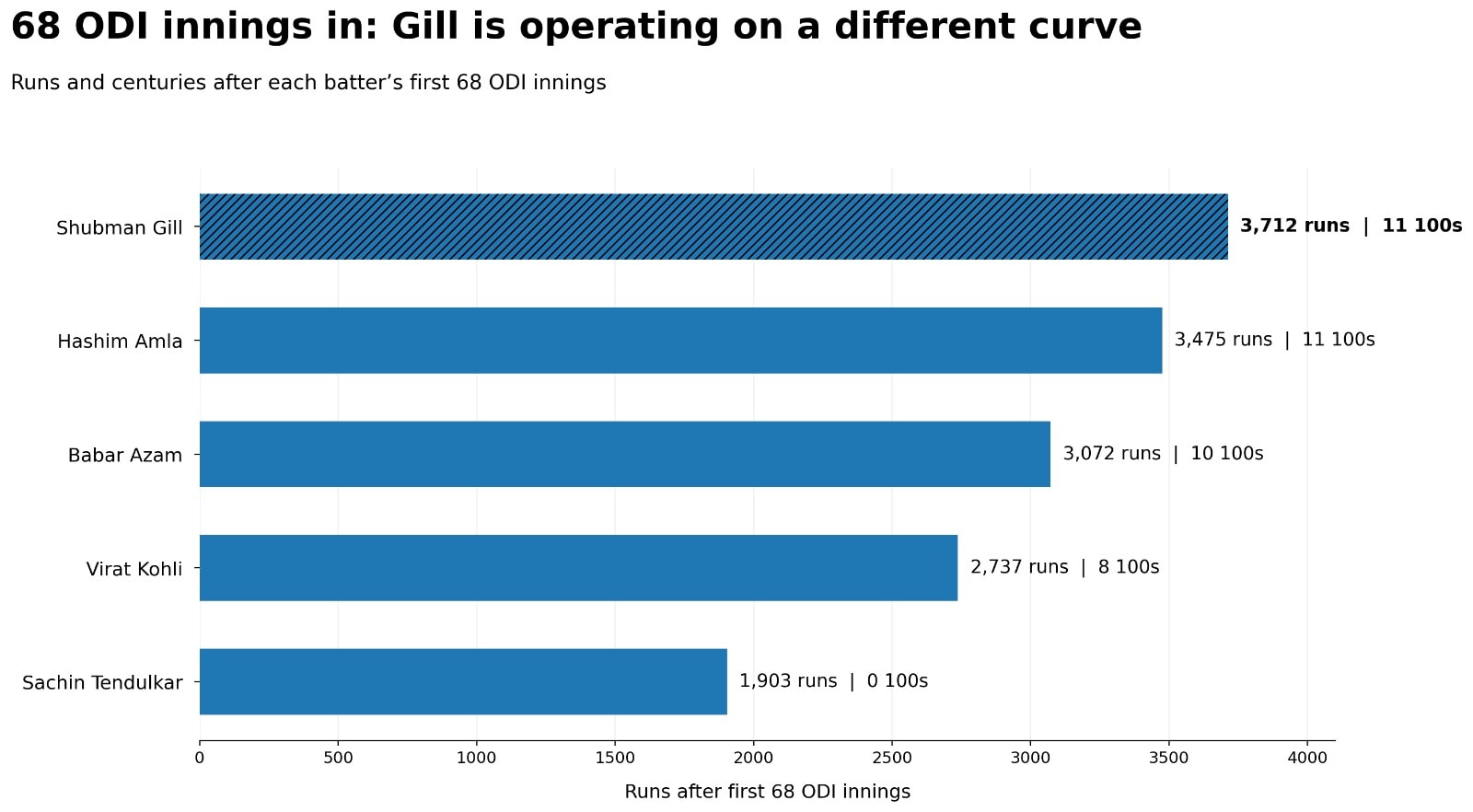
Before Wednesday, Gill had 3,489 ODI runs from 67 innings, 10 hundreds and 20 fifties. The 223 takes him to 3,712 runs from 68 innings, with 11 centuries. Because he was unbeaten, his career average climbs to approximately 65.12; his strike rate rises beyond 103. At this volume, those are extraordinary coordinates: elite accumulation without the usual compromise in scoring speed.
The frequency is more arresting still. Gill has crossed fifty 31 times in 68 innings, meaning 45.6 per cent of his ODI innings have produced at least a half-century. He reaches fifty once every 2.19 innings and a hundred once every 6.18. His 11th ODI hundred arrived in his 68th innings; only Hashim Amla, in 64 innings, and Quinton de Kock, in 65, reached the landmark faster. Virat Kohli required 82.
Then there is the ceiling. Gill's first ODI double hundred, 208 against New Zealand in 2023, showed he could stretch an innings beyond the orthodox dimensions of a century. The 223 has turned that capacity into repetition. Gill is only the second batter, after Rohit Sharma, to score multiple ODI double centuries. He reached 200 in 117 balls, the fastest double hundred in ODI history, eclipsing Ishan Kishan's 126-ball effort.
There is context inside that record, too. Double hundreds are usually constructed while batting first, where a batter can keep expanding an innings without an exact destination. Gill's came in pursuit of 406. He became only the second player, after Glenn Maxwell, to make an ODI double century in a chase, while his 223 is also the highest individual score by an ODI captain.
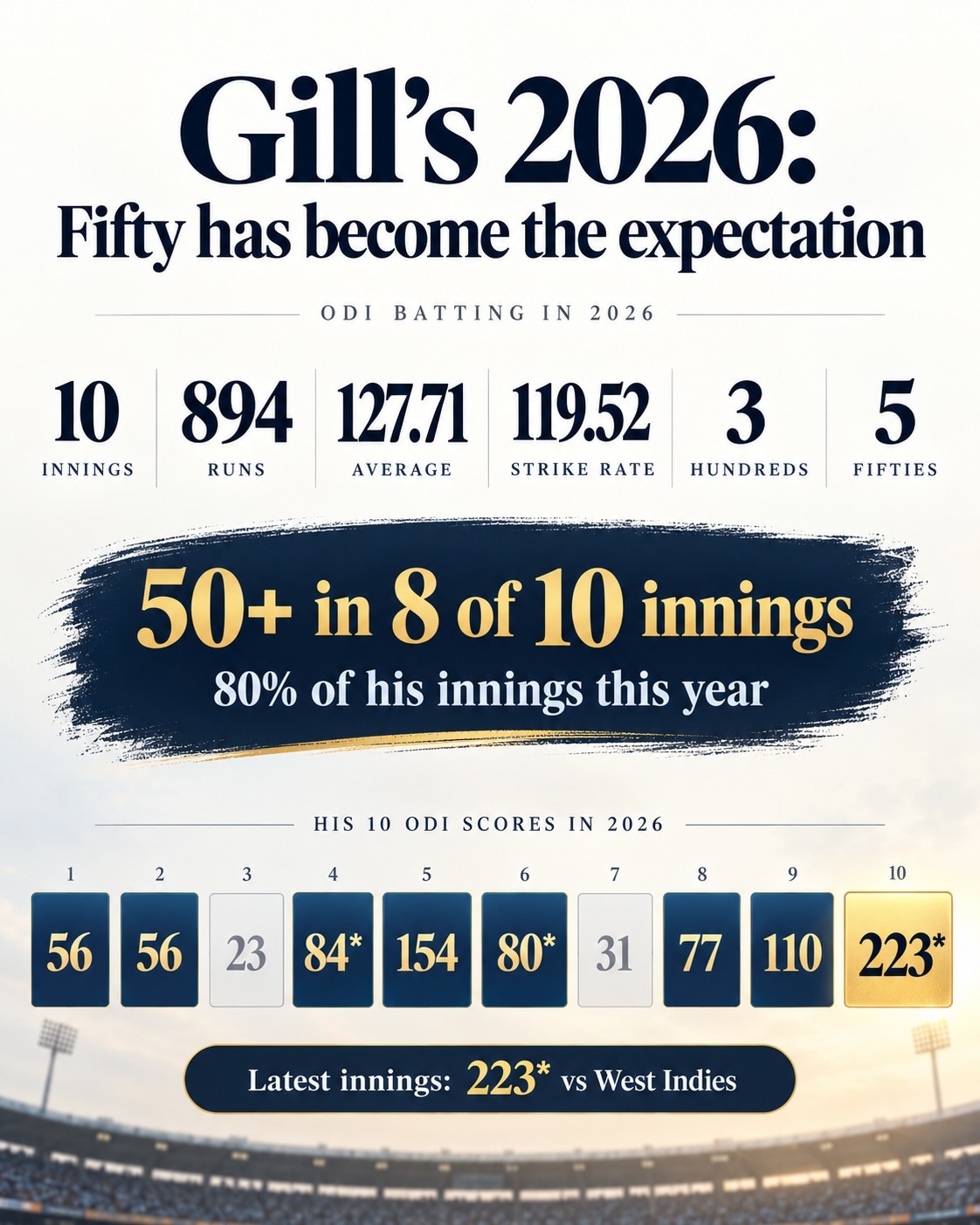
The strongest evidence that this is becoming an era rather than an evening lies in 2026. Gill entered Guwahati with 671 ODI runs from nine innings this year. The 223 lifts that tally to 894 from 10 innings, at an average of approximately 127.71 and a strike rate close to 120. He has three hundreds and five fifties. Eight times out of 10, he has reached fifty.
Extend the lens to the beginning of 2025, and the sample becomes harder to dismiss as a streak. Across 2025 and 2026, Gill has 1,384 ODI runs from 21 innings, averaging above 81. He has five hundreds and seven fifties in that period, reaching fifty in 12 of those 21 innings. That is a sustained occupation of the most valuable portion of an innings.
Nor is the surge confined to white-ball cricket. In his first Test series as India's captain in England in 2025, Gill amassed 754 runs in 10 innings at 75.40, including four hundreds and a 269. Only Sunil Gavaskar has scored more runs for India in a Test series, while Gill's aggregate was the second-highest ever by a captain in a Test series, behind Don Bradman's 810 in 1936-37.
Gill is therefore not reproducing one method across formats; he is solving different batting problems with different gears. England required patience and technical endurance. Guwahati demanded run-rate control, boundary production and the nerve to treat 406 as something calculable rather than mythical.
It is premature to use cumulative career numbers to place Gill alongside Tendulkar, Kohli, or Rohit; longevity is its own achievement. But eras are not recognised only when careers finish. Sometimes they announce themselves while they are being built, through a sustained distortion of what appears normal.
Gill is already the world's No. 1-ranked ODI batter. He reached 3,000 ODI runs in 62 innings, faster than any Indian before him and second-fastest overall behind Amla, and now owns two double hundreds before his 28th birthday. Wednesday's 223 did not create his case for preeminence. It simply made the evidence harder to ignore.
For years, Indian batting travelled through identifiable centres of gravity: Tendulkar's accumulation, Kohli's conversion, Rohit's ability to turn hundreds into events of extraordinary scale. Gill's emerging signature feels like a synthesis of those virtues. The numbers are still being written, but increasingly, the present tense of Indian batting belongs to him.


