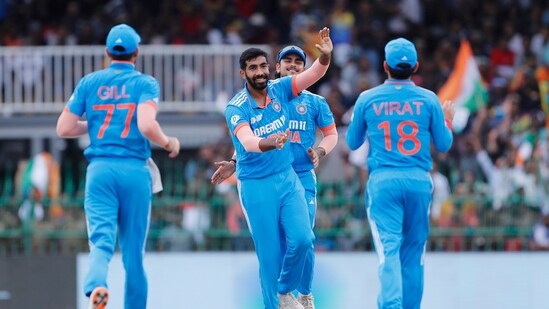
Among the deluge of positives drawn from India’s triumphant Asia Cup campaign — KL Rahul’s century against Pakistan on return, Jasprit Bumrah’s hassle-free ODI comeback, Kuldeep Yadav’s breakthroughs in the middle overs and Mohammed Siraj’s six-for in the final — there’s a facet where ideal warm-up for the World Cup wasn’t had.
Jasprit Bumrah and teammates celebrate the dismissal of Sri Lanka's Kusal Perera in the Asia Cup 2023 final match (ANI)
It may have gone largely unnoticed but in only two of the six games did India bowl in the death overs — against associate member Nepal and Bangladesh in a dead rubber. Even more undesirable for India was allowing Bangladesh to wallop 77 runs in the final ten overs when they were six wickets down, resulting in a six-run defeat.
While rain abandoned India’s opening group-stage clash against Pakistan, it was to the credit of the bowlers, of course, that they skittled Pakistan in 32 overs in the Super 4 stage, followed by Sri Lanka in 41.3 overs and the latter again in 15.2 overs in the final. But when exploring strengths and weaknesses ahead of the World Cup was the primary purpose of these matches, skipper Rohit Sharma would have certainly wanted more of a workout for his bowlers in the death overs. It would have also tested Sharma’s captaincy smarts more, and given him a fairer idea of how to juggle his bowlers around for that final phase.
Death bowling is demanding even for the best in the business, the slightest error in execution carrying dire consequences. Since the 2019 World Cup, India haven’t quite got it right. Among the teams that will be playing the upcoming edition, their economy of 7.72 is the third worst in the slog overs. Only Australia and New Zealand have fared worse in this period.
Extenuating circumstances, it can be argued, contribute to these numbers. After all, Bumrah — he was out of action for more than a year owing to a stress fracture that required back surgery — has featured in only 12 of the 39 innings where India have bowled in the slog overs. His economy rate in these games is a thrifty 6.48. He was rested even for the loss to Bangladesh in the Asia Cup.
He’s undeniably India’s ace weapon in this period of pressure, often dictating terms with his repertoire of deadly yorkers and cunning slower balls when most bowlers are resigned to punishment. Much like Lasith Malinga, his mentor at Mumbai Indians in his early years, Bumrah seems unfazed by the pressure, responding with a wide grin even on the rare occasions that he's carted. It’s worth adding that his overall economy in the death overs is 5.87.
The only caveat is that Bumrah’s sharpness in the closing stages since his return is yet to be gauged. He doesn’t seem to have lost any efficacy with the new ball, hooping it both ways at will in his opening spells right through the Asia Cup. But can he nail his yorkers at the back end with the same precision and intensity? He may not always get wickets with these deliveries — as eight scalps in 12 innings in the death overs in the last four years indicate — but they are crucial to instilling caution among the batters.
Among the other pacers in the World Cup squad, Siraj has decent numbers at the death but hasn’t bowled in this phase regularly enough to command the complete confidence of the captain yet, particularly considering he has been meted out rough treatment in the IPL. Mohammed Shami and Shardul Thakur are more accustomed to getting the ball at the end, but their economy rates of 8.26 and 9.12 respectively suggest they are hit-and-miss.
Four years ago, the situation was different. In Bumrah and Bhuvneshwar Kumar, India had two certified operators at the death. Bhuvneshwar, though not blessed with as much pace as his younger teammate, was just as canny while mixing up his yorkers with his off-cutters and knuckle balls. It allowed Virat Kohli to bank on them without hesitation at the end.
Right now, India’s spin-bowling options at the death are also fairly limited. Jadeja has bowled a mere 30 deliveries in the slog overs since the last World Cup while Kuldeep’s biggest plus is his ability to strike in the middle phase. As a left-arm wrist spinner, he has the variety to throw batters off in the final ten, but it’s a big risk at the same time to pit him against those looking to launch big hits. Fitness permitting, Axar may be more suited to that role, but he’s likely to feature only when conditions merit three spinners.
Much of India’s fate in the death overs will depend on how they fare in the powerplay and middle overs. The ideal scenario, which they managed in the Asia Cup, is to deprive opponents of firepower at the end by making consistent inroads. But in evenly-contested matches between the top teams, it will often come down to that nerve-racking climax. Though Sharma has been rested for the first two games of the series against Australia starting Friday, he won’t mind his bowlers then being put to the test in the death overs to cap off a perfect prelude to the World Cup.
Vivek Krishnan is a sports journalist who enjoys covering cricket and football among other disciplines. He wanted to be a cricketer himself but has gladly settled for watching and writing on different sports.Read More


 Live Score
 Cricket Teams
 Cricket Players