
 E-Paper



Foxing the prowling leopards in Uttarakhand with a little help from Australian technology
Harendra Rawat can’t recall a night in 10 years when he slept peacefully. For the 65-year-old resident of Ekeshwar block in Pauri, nights invariably meant the time when he had to remain alert and on guard.


Harendra Rawat can’t recall a night in 10 years when he slept peacefully. For the 65-year-old resident of Ekeshwar block in Pauri, nights invariably meant the time when he had to remain alert and on guard. Nights were the time when leopards from the nearby forests ventured out looking for an easy prey.
Rawat didn’t want to lose his livestock or life.
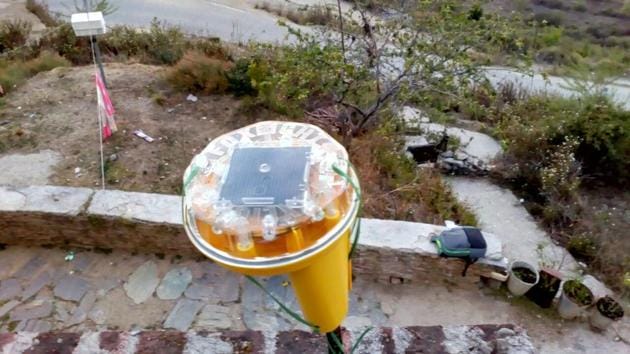
Things have, however, changed. For the last two months, Rawat has been sleeping peacefully — courtesy a fox light that Dehradun-based Wildlife Institute of India (WII) has installed at his house.
Used in Australia to keep prevent prowling fox from killing cattle — that’s how it got its name — the equipment has been replicated by the WII under a sub project of National Mission on Himalayan Studies (NMHS) on human-wildlife conflict.
Ten equipment each were installed in Pauri, Uttarakhand and in Kugti Wildlife Sanctuary, Chamba, Himachal Pradesh. The WII wanted to check its efficacy against leopards in Uttarakhand and against brown bear in Himachal Pradesh.
“The machine emits light in various patterns. The shadow falling within 1 km area projects shapes of people walking with torches. The haphazard pattern keeps the animals confused and they do not enter the area where the light is placed,” S Sathyakumar, who is heading the project at the WII, said.
Imported at USD 50 ( ₹3,366) each, the equipment is powered by a solar panel.
“The leopards have gotten used to the routine methods of bursting crackers and beating drums. The machine emits light, which is unpredictable. In the last two months, I haven’t sighted a leopard or heard of the big cat in the near vicinity,” Rawat said.
As per the forest officials, Pauri has recorded the most man-leopard conflict cases in Uttarakhand. Nearly 30% of all leopard attacks reported took place in the district. Over 200 people have died in leopard attack since 2000 in Uttarakhand in last 17 years.
In Himachal Pradesh, brown bears killed 314 cattle between 2015 and 2017.
Experts say the equipment can be easily developed in the country, thereby bringing down its price. It could be used in and around villages, especially in man-animal conflict areas.
“Our camera records show movement of leopards between 5pm till 7 am in the morning. That’s when these lights work the best,” Sathyakumar added.
Man-animal conflict is one of the key problems ailing both towns and villages of Uttarakhand. Leopard menace is severe in states like Uttarakhand and Maharashtra.
The project will study the influence of Fox Light for at least one year and will submit the report to Ministry of Environment, Forest and Climate Change (MoEFCC).


