E-Paper



Planning weekend car trip to Nainital? Don’t
Instead of “Welcome to Nainital”, the approach roads to this tourist town are now sporting a new banner — “Nainital Houseful”


Instead of “Welcome to Nainital”, the approach roads to this tourist town are now sporting a new banner — “Nainital Houseful”.
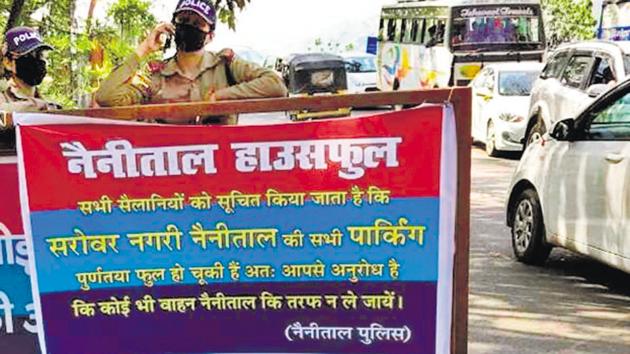
Put up by local police, the banners in Hindi request the tourists not to enter the hill station with their vehicles as all the parking lots are full.
Nainital has 12 parking lots with combined capacity to accommodate nearly 2000 four-wheelers. The town has been witnessing an influx of 3,000 to 4,000 tourist vehicles every day. The numbers go up exponentially when “weekend tourists” from Delhi and neighbouring Uttar Pradesh reach here.
Having a tough time managing the traffic, the local authorities finally came up with the idea to urge tourists to leave their vehicles beyond town limits.
Mahesh Chandra, inspector in-charge, traffic police, said they have put the houseful banners on the approach roads to Nainital such as Nariman Crossing, Kathgodham Police Chowki Crossing, Bhimtal Crossing and others.
“One can gauge the traffic stress in Nainital from the fact that on Sunday nearly 6000 vehicles came out of the town. Nainital has limited parking lots. When they get full, we are left with no other option but to take such a measure,” the official said.
The unprecedented step, officials said, follows the directives issued by the Uttarakhand High Court in April this year.
Pulling up the state government for failing to address the traffic problem in the hill town, the high court had directed the authorities to ensure that “those coming to Nainital with their own vehicles should first make advance arrangements for parking their vehicles”.
The court had directed the authorities to advertise the same in at least four national newspapers and channels and also publicise that those who “cannot arrange advance parking should not bring their own vehicles to the town.”
With weekend tourists returning, the situation started to improve from Monday morning, Chandra said, adding “hopefully it would be normal within a few days.”
Spread over 11 sq kms, most of the habitations and constructions in Nainital are on the hill slopes around Naini Lake, the water body from which it derives its name. With existing parking lots unable to cater to the tourist rush, the district administration is now identifying areas within and on the outskirts where parking spaces could be created.
Earlier, the high court in 2017 had asked the local administration to create a smartphone app to enable tourists to book parking slots before they reached Naninital.
The court had, prior to that, directed the district administration to seal all such hotels, gueshouses and homestays that do not offer parking space to their guests.