
 E-Paper



Delhi’s transport network back today
The Delhi government Monday said it is opening up all modes of transport, except the Metro, to allow free movement of people in the city.


Over 50 days after all public modes of transport were taken off the national capital’s roads, as part of the nationwide lockdown from March 25 to prevent the spread of the coronavirus disease (Covid-19), the Delhi government Monday said it is opening up all modes of transport, except the Metro, to allow free movement of people in the city.
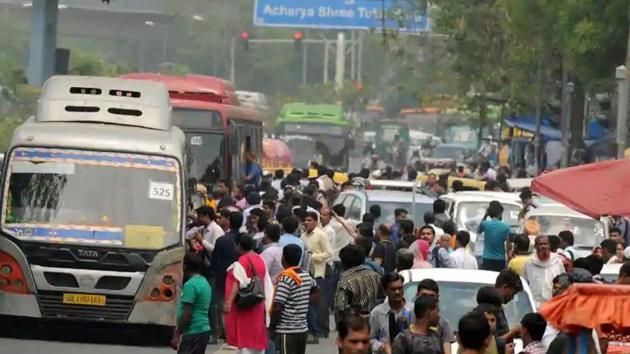
This means that Delhi Transport Corporation (DTC) buses and cluster buses, all forms of cabs, autos, electric and cycle rickshaws, gramin sewas and RTVs (small sized buses) will be allowed to operate from Tuesday, in addition to private cars and two-wheelers.
While making the announcement during a digital media briefing Monday, chief minister Arvind Kejriwal said all transport modes will be allowed to operate with restricted passenger intake and adherence to strict social distancing norms. No such movement, except for essential services, will be allowed in the 73 containment zones of Delhi.
“Auto-rickshaws, e-rickshaws and cycle rickshaws will run, but will be allowed to have only one passenger each. Likewise, taxi and cabs will be allowed to carry a maximum of two passengers. Gramin sewa, eco-friendly sewa and phat-phat sewa will also have a cap of two passengers per vehicle. Maxi cabs will be allowed up to five passengers, an RTVs up to 11 passengers,” Kejriwal said.
He added that the drivers will have to sanitise the vehicles after every run. On buses, the chief minister said, only 20 passengers will be allowed at a time and the transport department will ensure social distancing at bus stops.
In the case of private four-wheelers, two people in addition to the driver will be allowed, whereas for two-wheelers pillion riders will not be allowed. A senior government official said passes will no longer be required for movement inside the city.
Shreya Gadepali, transport expert and south programme lead at the Institute for Transportation and Development (ITDP) ,said besides providing citizens access to services, transport undertakings must also prioritise the health and safety of its staff, who are completely exposed to the disease, on the road and at its facilities.
“These efforts will go a long way in building public trust and ensuring that people continue to use public transport. Covid-19 provides Indian cities with an opportunity to transform their public transport services by improving user experience through technology and reforming informal transit services,” she said.
4,000 MARSHALS AT 740 BUS STOPS
Transport minister Kailash Gahlot said his department has identified 740 bus queue shelters that see a heavy rush throughout the day. The department will deploy 4,000 marshals at these stops in two shifts to ensure social distancing and to conduct thermal screening of those waiting to board. Senior officials said the department will to procure contactless thermal screening devices within the next three days.
Delhi has a total of 6,487 buses, which include 3,746 buses of the DTC and 2,741 cluster buses.
“We will be deploying as many as six marshals at busy bus queue shelters such as those at AIIMS, Badarpur and Uttam Nagar terminals. Once a bus has 20 passengers, it will stop only to allow passengers to alight, and only then will new passengers be allowed to board. There will be one passenger per two seats and all will be seated in zigzag pattern. Entry will be through the rear door and exit through the front door,” Gahlot explained.
When asked about contactless ticketing, the minister said the One Card will continue to be accepted. But, since many may not have these cards, usual paper tickets will issued as of now. “As a long-term solution, we are already working on a system wherein passes can be issued to passengers. Women will continue to get free rides,” he said.
Wearing masks will be mandatory, but downloading the Aarogya Setu app will not be compulsory. The buses will be sanitised after every trip and conductors and drivers will have to undergo mandatory thermal checks before starting each trip.
NO CLARITY ON INTERSTATE MOVEMENT
The Delhi government order on Monday did not mention specifically about interstate movement of people. The order only stated that interstate and intrastate movement of medical professionals, nurses and paramedical staff, sanitation personnel and ambulances will be allowed, “without any restriction”. It also added that interstate movement of all types of goods and cargo carriers will be allowed.
Since the government has allowed government and private offices to open, and industries and construction activities to resume, lack of clarity on interstate movement may pose a difficulty to staff residing in neighbouring cities.
The order also did not talk about contract carriage buses, private buses which are extensively used as chartered buses by office-goers.
Senior government officials acknowledged that the point was missed in the guidelines issued Monday.
“Since there is no mention about contract carriage buses, it is unlikely that private bus operators will resume their services for now. Unless our buses are requisitioned by the government, normal services for office purposes and so on are unlikely to start,” Harish Sabharwal, general secretary of Delhi contract bus association, said.
Gahlot said he will soon convene a meeting to resolve the issue.
NO SHARED RIDES IN CABS
Mobile app-based cab aggregators Uber and Ola said they will restart services in the capital starting Tuesday. The Delhi order stated that no pool or shared rides will be allowed in the city till May 31.
In a statement, the Uber India team said a passenger should not sit in the front, next to the driver.
“If you are booking a car or an auto ride, to maintain social distancing, we recommend not more than two riders should travel at a time, besides the driver,” it said.
Ola said driver-partners operating three and four-wheelers on its platform will be available but “with the highest levels of safety precautions”.
“This also brings relief to millions of drivers-partners whose livelihoods depend on serving citizens on a daily basis. In all of the 160+ cities where Ola is now operational, enhanced safety protocols are applicable across every single trip. This includes compulsory mask usage for driver-partners and passengers, complete sanitization of cars post-trips, adhering to social distancing norms by limiting passengers to two,” it said.


Stay updated with all top Cities including, Bengaluru, Delhi, Mumbai and more across India. Stay informed on the latest happenings in World News along with Delhi Election 2025 and Delhi Election Result 2025 Live, New Delhi Election Result Live, Kalkaji Election Result Live at Hindustan Times.


