
 E-Paper



Death and dearth, the reality of patients outside AIIMS
A 100 metres away, under the AIIMS flyover, 29-year-old Madhuri, weeping, sings a sad folk song while her two children sleep on a plastic sheet next to her.


All that Rizwan Hasan wants is help to board a bus towards his hometown in Muzaffarpur of Bihar. Being visually challenged, Hasan was accompanied by his wife to Delhi for a second eye surgery at the All India Institute of Medical Sciences (AIIMS) on March 21, but has been left without shelter and certainty of two meals a day, since a lockdown was imposed on March 25 to control the spread of coronavirus (Covid-19) .
“The day we arrived, my wife had to return home to attend to the last rites of her uncle. Now, I am alone, at the mercy of anyone who is kind enough to bring an extra plate of food for me,” says Hasan, 30, before the police chases him away from outside the AIIMS Metro station, his latest residence.
A 100 metres away, under the AIIMS flyover, 29-year-old Madhuri, weeping, sings a sad folk song while her two children sleep on a plastic sheet next to her. Her eight-year-old son has a heart illness (a hole), but his treatment is not on the immediate priority list.
“The police offers us lunch, but does not allow others to us food. They let us sleep outside an AIIMS gate at night, but keep chasing us away in the daytime,” said Madhuri, of Ballia in Uttar Pradesh, adding they sometimes make do without dinner. Her son’s surgery, scheduled for March 25, has been postponed and she hasn’t been given a revised date.
In the initial days of the lockdown, there was no one to offer them meals, forcing them to spend all their money on food. “If you lift the lockdown today, we’ll have to either travel without a train ticket or walk all the way home,” says Madhuri, who goes only by her first name.
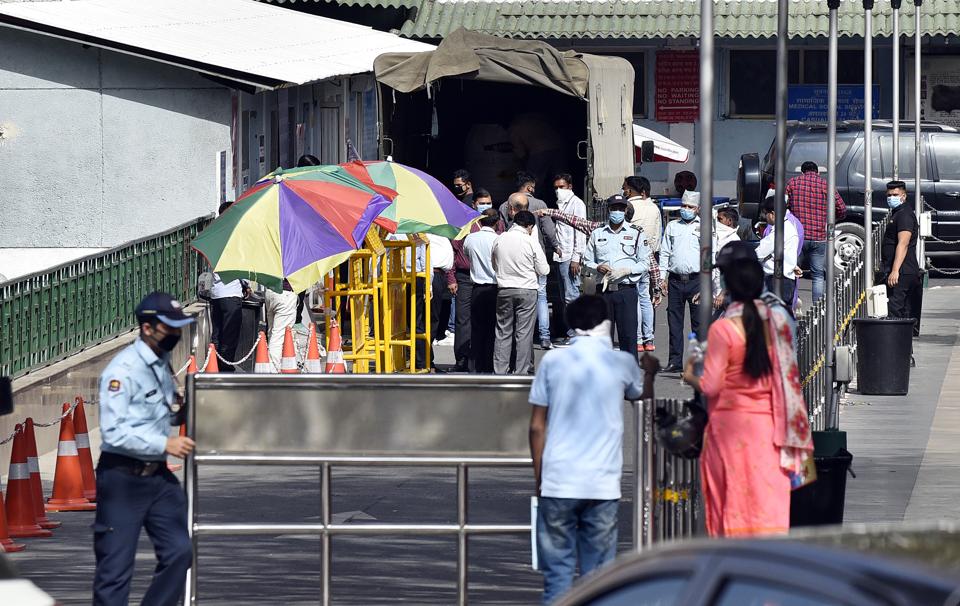
Hasan and Madhuri are not alone in this situation. Scores of patients and their relatives, who had arrived at AIIMS for treatment before the lockdown, are spending their days under the flyover, in subways, on footpaths and outside the AIIMS Metro station, as the hospital has shifted its focus to treating Covid-19 patients.
While the Delhi government has made shelter arrangements for the homeless and stranded migrants, many AIIMS’ patients and their kin have been left in the lurch.
The rain baseras, dharamshalas and tents near AIIMS are operating at full capacity and government officials say that finding space for shelters in this area has been a problem.
“We have 25 tents around AIIMS, which can accommodate up to 1,000 occupants at one point. Currently, all shelters are saturated in terms of occupancy because of the lockdown. Space has been a big issue in the area,” said Bipin Rai, member and spokesperson of the Delhi Urban Shelter Improvement Board.
He said that authorities concerned have been requested to allocate space for more shelters in the vicinity of the hospital.
Atul Kumar Thakur, the deputy commissioner of police (south), said that food is being provided to stranded patients and their relatives. “Our officers go out to serve them meals and also respond with food when we get specific calls about anyone not receiving meals,” said Thakur.
TREATMENTS UNCERTAIN
While many of these patients are stranded due to the lockdown, there are some who continue to stay on in the hope of getting surgeries and treatments done.
Urmila Devi of Dumka in Jharkhand is one such person who had a chance to leave the city before the lockdown, but stayed back on in the hope that her nine-month-old granddaughter could undergo heart surgery on March 25. “When the hospital does reopen for the regular patients, I don’t know when we’ll get the next date,” said Devi.
AIIMS authorities said that no new dates are being given. “We are only doing emergency surgeries at the moment. All those who got the dates before the lockdown or before the out-patient departments (OPDs) closed were sent a message informing about the cancellations. We have the mobile phone numbers of all our registered patients,” said Dr DK Sharma, medical superintendent, AIIMS.
When are these postponed surgeries likely to resume? “We do not know. It depends on the situation. We will likely extend our working hours to accommodate more patients when the routine services resume,” said Sharma.
DEATH
Amid those undergoing hardships here was a 35-year-old cancer patient, Sanjeev, who died last Friday in a subway right outside the hospital, where he was staying. “He had been admitted to AIIMS for the last eight months, but had to leave the hospital due to the coronavirus. Now, my husband and I bide our time sitting on the same blanket on which our son died,” said Meena Devi, Sanjeev’s mother, of Banka in Bihar.
Devi and her husband share the subway with 30-40 other patients and their relatives, all sleeping on blankets or plastic sheets. They say this is the only spot outside AIIMS where the police don’t chase them.
HEALTH GOES FOR A TOSS
Among the patients is Pankaj Kumar, a 26-year-old resident of Samastipur in Bihar. A liver problem has left him with an abnormally bulge in the stomach and doctors had prescribed him a diet of eggs, milk, pulses and green vegetables, which are currently out of the question. “The people offering us food mostly bring pooris. I shouldn’t eat that, but I would starve to death if I don’t eat what is served,” said Kumar.
Even those who have found a place at shelter homes before the lockdown say they are left without the basic nutritious foods prescribed by doctors. Sunil Sharma, a cancer patient, of Begusarai in Bihar, was prescribed coconut water, fruit juice and milk, but neither are they available nearby nor does he have the money to purchase them. “We had come prepared to bear expenses for a month. This has gone much beyond that,” he said.
NO MONEY
Outside the AIIMS Metro station, Karan Das, who is his late 30s, is left without any money to buy medicines for his 12-year-old son, who was slated to undergo heart surgery. “He has difficulty waking up and remaining active without medicines. But medicines cost us ₹6,000 a month and we have exhausted all our money,” said Das.
While some of these patients continued staying in Delhi in the hope of receiving treatment once the lockdown ended, others said they have been stranded.
One such patient is Hari Lal, who came to AIIMS on March 23 with breathing problems, but couldn’t leave due to the lockdown. He has no mobile phone, doesn’t remember the phone number of his family members and hasn’t spoken to them since coming to Delhi. “I just want to go home. I’ll walk when the lockdown ends on April 15,” said Lal, unaware that the lockdown has been extended.
LACK OF SHELTER
Many of the patients said they tried to gain entry into the rain baseras, but weren’t let in.
Sudeep Kumar, who manages a group of tents, run by an NGO, near AIIMS, said that the need for social distancing has forced them to accommodate just half their usual capacity. “We also can’t allow in new people for the fear of infection,” said Kumar, adding that about 300 people are being accommodated in 13 tents set up here.
At a rain basera run by the same NGO, social distancing seems impossible, despite closing their doors to new entrants. “You give me space and I’ll ensure social distancing,” says Uttam Thakur, the in-charge of the shelter.
At the same shelter, cancer patient Mohd Salam, of Bhagalpur in Bihar, said his chemotherapy session has been postponed by two months. “I don’t want to die here. I’ll try to walk back home.”

Stay updated with all top Cities including, Bengaluru, Delhi, Mumbai and more across India. Stay informed on the latest happenings in World News along with Delhi Election 2025 and Delhi Election Result 2025 Live, New Delhi Election Result Live, Kalkaji Election Result Live at Hindustan Times.


