
 E-Paper



Delhi air enters ominous ‘severe’ zone; local factors, stubble play crucial role
Local pollutants, weather factors, and a season-high contribution of stubble fire to the city’s air together pushed pollution in the national capital to the ‘severe’ throughout Thursday, with some areas perilously close to the 500-mark — the highest level on the air quality index (AQI) scale.

 Prefer HTon Google


Local pollutants, weather factors, and a season-high contribution of stubble fire to the city’s air together pushed pollution in the national capital to the ‘severe’ throughout Thursday, with some areas perilously close to the 500-mark — the highest level on the air quality index (AQI) scale.
In some areas, the levels of major pollutants exceeded the accepted safe-limit by eight or nine times.
Data from the Central Pollution Control Board (CPCB) showed that as Delhi collectively gasped for breath on Thursday, pollution levels in areas such as Anand Vihar, Mundka, Bawana, Narela, Vivek Vihar, Jahangirpuri and Dwarka spiralled out of control.
The India Meteorological Department (IMD) said that while weather did play a spoiler for Delhi, local pollution sources also acted up. In a meeting with the CPCB taskforce the IMD said that the primary pollutant in Delhi’s air on Thursday was PM10 (coarse particulate matter), which is primarily dust.
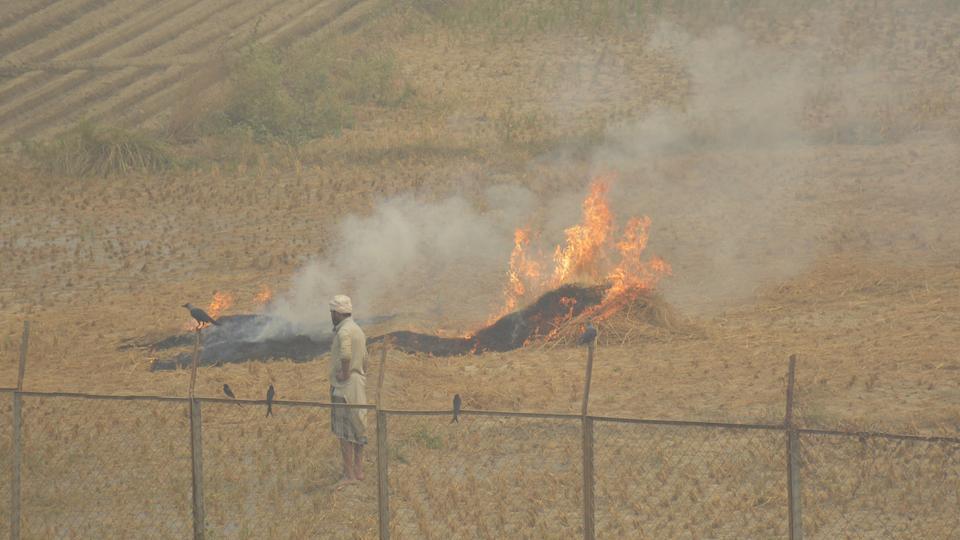
Stubble fires also contributed to 42% — the highest so far this season — of Delhi’s PM 2.5 load on Thursday, according to the System of Air Quality and Weather Forecasting and Research (Safar) under Indian Institute of Tropical Meteorology.
At 7am on Thursday, when the city’s hourly average AQI was moving upwards from 450, pollution levels in Anand Vihar and Narela were above 480. Bawana, Vivek Vihar and Dwarka were also quick to join the list with their hourly average AQI reading settling at 492, 488 and 482 respectively.
In Anand Vihar, which is surrounded by two major inter-state bus terminals, the levels of PM 2.5 (ultrafine particulate matter with diameter less than 2.5 micrometres) started climbing during the intervening night of Wednesday and Thursday. At midnight on Wednesday, the PM2.5 level in Anand Vihar was 507ug/m3, and though it consistently reduced through the night, it remained above the 300-mark. At 7am on Thursday, the levels were 385ug/m3.
In west Delhi’s Mundka, the situation was no better. As winds calmed on Wednesday, the PM 2.5 levels around the area spiked to touch 567ug/m3 at 11pm on Wednesday. Data maintained by Delhi Pollution Control Committee (Dpcc) shows that at 7am on Thursday, the PM 2.5 levels in Mundka were recorded 416ug/m3, as against the acceptable standards of 60ug/m3.
Shops owners around Mundka Metro station said the area was covered in a blanket of haze throughout Thursday. Despite the visible deterioration in air quality, industrial activities, private constructions and garbage-burning continued unabated, residents said.
“It was like a scene from a Hollywood movie set in a post-apocalyptic world. The government claims that they are conducting high-level meetings to control pollution in Delhi, while all they need to do is fix the basics. The road here is broken, which means that any vehicle crossing from here pushes a cloud of dust all over. There is no check on industrial activities and open burning. Garbage is not picked up roadsides for days together and once or twice a fortnight, someone sets it on fire,” said RP Yadav, a businessman in Mundka.
In residential areas such as Dwarka, dust became a primary contributor in Thursday’s pollution.
The Delhi Pollution Control Committee’s monitoring station in Dwarka’s Sector 8 recorded a peak PM10 level of 902ug/m3 at 6pm, which dropped marginally, but remained above 800ug/m3 as of 9pm.
In India, the acceptable standards for PM10 are 100ug/m3.
In south Delhi’s RK Puram, the PM10 level saw a sudden spike after 4pm. Data shows that from 257ug/m3 at 4pm, the levels consistently rose to reach 659ug/m3 at 9pm. While locals in all of these areas complained of insufficient pollution measures by government agencies in these areas, enforcement teams continued to repeat their claims that action was being taken across the city to reduce pollution levels.
The latest action taken-report submitted by the North Delhi Municipal Corporation shows that the agency has deployed 134 water sprinklers in their jurisdiction to keep dust levels in check.
Jai Prakash, north Delhi mayor said, “Sprinkling was done twice on Thursday, keeping in mind the high pollution levels. Apart from this, 48 vigilance teams were also put into action to check for violations. From October 29 to November 3, we have issued 113 challans amounting to around R17 lakhs.”
Experts said since weather conditions become unfavourable during winters, it becomes imperative that enforcement be made effective.
“In Delhi, even though we have bent the annual pollution curve, we still have to reduce levels of bad air by 60% to meet the clean air standards for PM2.5. So, if you are still so high above the acceptable mark and you also have the unfavourable winter conditions, action needs to be stepped up,” said Anumita Roychowdhury, executive director (research and advocacy), Centre for Science and Environment (CSE).


