
 E-Paper



Delhi to get its own pollution warning system this month
This system, which will be in place by the end of the month, with draw data from 36 monitoring stations and will factor in real-time aerosol information from Nasa satellites and will give a prediction taking meteorological factors into account.


Delhi is expected to be better equipped to tackle sudden pollution spikes this winter, with an ‘early warning system’ that can predict air quality levels at least two days in advance, according to senior government officials familiar with the development.
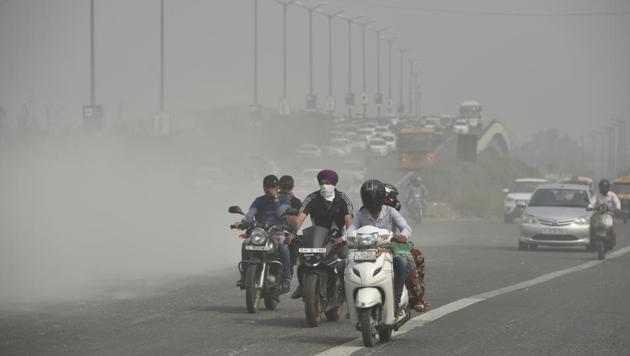
This system, which will be in place by the end of the month, will draw data from 36 monitoring stations run by the Central Pollution Control Board (CPCB), Delhi Pollution Control Committee (DPCC) and Safar, and will factor in real-time aerosol information from Nasa satellites, giving a prediction taking meteorological factors into account, the officials added.
This will not only help residents brace for high-pollution days, it will also enable the Graded Response Action Plan (Grap) that kicked in last year to be implemented in advance.
“Delhi’s early warning system for predicting air pollution levels is almost ready. We have been working on it for the past eight to nine months. The system would be installed by the end of October or the first week of November,” M Rajeevan, secretary of the Union ministry of earth sciences, told HT.
As of now, Safar, which is operated by the government, collates data from 11 stations it runs in Delhi, and the prediction mechanism it employs is not enough to give an accurate forecast of what is coming because it focuses more on local emission sources.
Explaining how the new system will work, Sachin C Ghude, a scientist with the Indian Institute of Tropical Meteorology-Pune who is associated with the project, said it will give Delhi the most accurate pollution information it has got so far.
“Satellites will pick up real-time sources of pollution, such as stubble burning in northwest India or dust storms in west Asia,” said Ghude.
“These would be fed into the model along with daily meteorological data and data from air quality monitoring stations in the national capital. With these, the model would be able to tell us how pollution levels in Delhi would shoot up in the next 48 hours and what would be the contribution of each source,” he added.
Experts said the system becomes all the more important as meteorological factors, such as wind speed and wind direction, play an important role in determining Delhi’s pollution levels. Also, at least 64% of the ultra fine particles (PM2.5) in Delhi’s air come from outside the city during winters, according to a study by The Energy Resources Institute. These pollutants also come from NCR towns, and sometimes even from as far as Pakistan, Afghanistan and Oman.
“Such a system would help Delhi be better prepared when it comes to implementing measures under the Graded Response Action Plan (Grap). As of now, Grap measures come into play when pollution level has already spiked. But if we get to know in advance that pollution levels could spike after two days, we can implement some measures in advance to prevent the spike,” said Anumita Roy Chowdhury, executive director (research and advocacy) of Centre for Science and Environment.
Supreme Court-appointed body Environment Pollution (Prevention and Control) Authority, which enforces Grap during the winter, has been pushing for such a system over the past one year. Last November, when dust from Sahara pushed up pollution levels resulting in a week-long smog and the city’s air quality index shot up to a peak of 486 on November 9, the authorities were caught unawares and had to scramble to bring in emergency measures. But by the time the authorities planned to introduce the odd-even road rationing scheme and other such restrictions listed under Grap, the smog had already dispersed. Things got so bad that the city declared a public health emergency.
“If we get to know the sources that could lead to a spike in pollution levels after a gap of two days, it would give us a buffer time to take actions on the ground. If the sources are beyond the boundaries, authorities can at least prevent the local sources from further aggravating the problem,” said D Saha, former head of the CPCB’s air quality laboratory.
The ‘early warning system’ will be fine tuned to further cater to Delhi’s needs over a two-year period, Ghude said. This year, only PM 2.5 data will be fed into the computer, but in the coming years parameters such as PM10, SO2 and NO2 will also be taken into account to make the forecast even more accurate.


Stay updated with all top Cities including, Bengaluru, Delhi, Mumbai and more across India. Stay informed on the latest happenings in World News along with Delhi Election 2025 and Delhi Election Result 2025 Live, New Delhi Election Result Live, Kalkaji Election Result Live at Hindustan Times.


