E-Paper



Experts go deeper into Delhi for micro-action to fight pollution
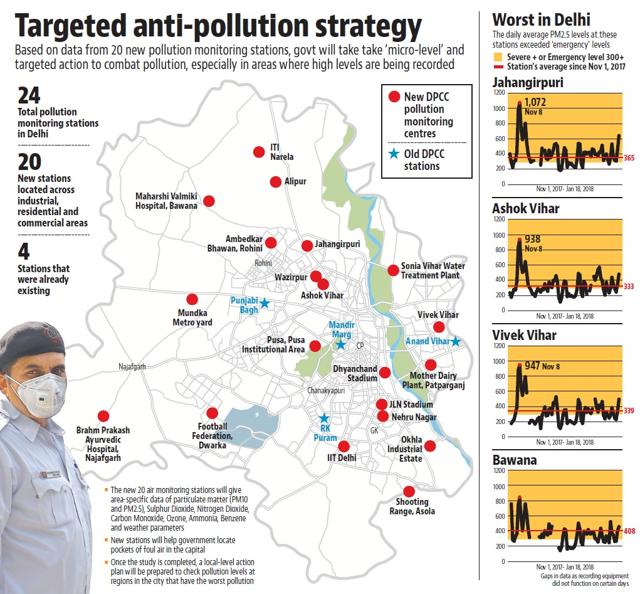
Based on an analysis of pollution recorded at 20 new monitoring stations across the city, govt will take take ‘micro-level’ and targeted action to combat pollution.

 Prefer HTon Google


A team of scientists from the Delhi Pollution Control Committee (DPCC) has started a detailed analysis of pollution levels recorded in the 24 monitoring stations across the city.
According to a senior environment department official, this study will provide a road map for next year so that government is able to take micro-level action to combat pollution, especially in areas where high levels are being recorded.
“We can find three types of areas in terms of pollution. Next year in October, we can identify these stations and take steps to curb local emissions. That can help pollution levels of the whole city,” DPCC senior scientist MP George said.
Preliminary analysis revealed that at stations in Najafgarh, Alipur and Mandir Marg, pollution is low. Stations with average pollution levels include Sonia Vihar, National Hockey Stadium, Dr Karni Singh Shooting Range, Okhla, Jawaharlal Nehru Stadium, Punjabi Bagh and RK Puram. The ones which have the worst air quality are Wazirpur, Jahangirpuri, Narela, Patparganj, Ashok Vihar, Nehru Nagar, Vivek Vihar, Mundka, Rohini, Bawana, Anand Vihar, Shahdara and Dwarka.
“Wazirpur and Jahangirpuri are the worst in terms of concentration of PM2.5, which is about 30 times finer than a human hair and is considered more harmful to humans as the pollutants can penetrate deep into the lungs and cause severe diseases. Dwarka tops the list in terms of PM10, the coarser particulate matter primarily found in dust,” George said.
The 20 new stations are covering other micro-environment zones to provide a realistic picture of city’s air quality. These are evenly distributed between industrial, commercial and residential areas.
“Pollution is definitely bad in the city but now we know which areas are worse compared to others and which are better. Najafgarh and Alipur have emerged as the background stations, which gives us an idea of normal air quality in the city. Pollution levels in these areas have been 20-30% less than average levels throughout winter. It gives us an idea of what can be achieved in Delhi,” the DPCC official said.
Once the study is completed, a local-level action plan can be prepared to check pollution levels at the foul air pockets of the city, he said.
In recent years, the city of about 20 million people has been struggling to clean its air that contains a toxic cocktail of dust, smoke and gases from vehicle and factory exhausts. Among mega cities — cities with population of at least 14 million — Delhi has the worst air quality, according to the latest World Health Organization (WHO) report.
Like Beijing and Paris, Delhi-NCR, too, last year got a graded response system for pollution. The Supreme Court-mandated Graded Response Action Plan came into force from October 17, 2017.
The plan includes top emergency measures such as odd-even car rationing scheme and ban on construction activities, which will be automatically enforced in the city if levels of PM 2.5 breaches 300 micrograms per cubic metre and PM 10 levels stay above 500 micrograms per cubic metre for two consecutive days.