
 E-Paper



Folk fests that make tourists of residents
Government officials, who have been organising several events wherein locals are the centre of focus, say the objective is to “democratise cultural events”

 Prefer HTon Google


On a pleasant autumn evening in October, a Municipal Corporation of Delhi (MCD) park at Shahpur Jat, the South Delhi urban village, is all decked up. There are colourful banners, strings of lights, and giant puppets. A makeshift stage has been set up with rows of chairs in the front, which are quickly filling up. A loudspeaker is blaring in the background. “We request everyone who is inside their homes to come out and be a part of this festival celebrating our culture.”
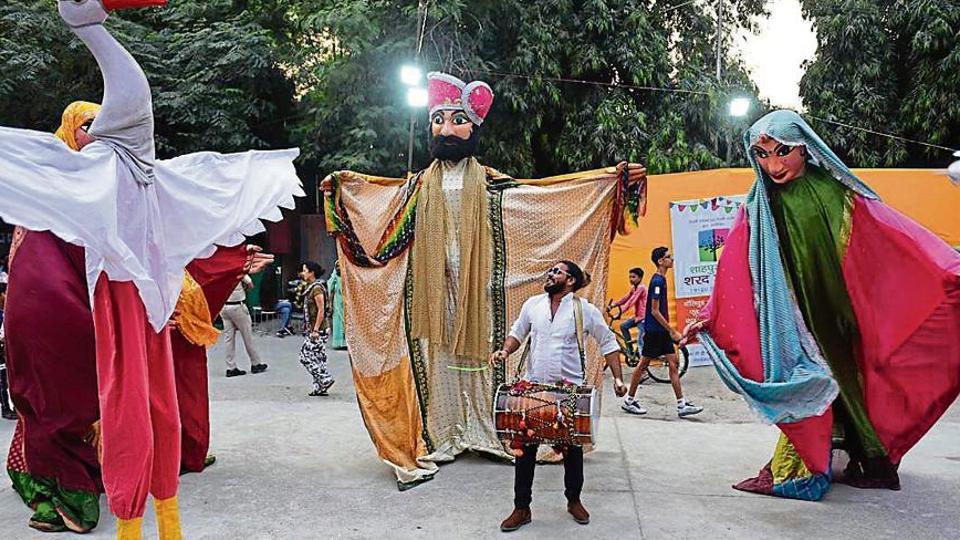
Forty-eight-year-old Santosh Devi, a homemaker and a resident of Shahpur Jat, usually comes to the park at this time of the day for a walk after completing her household chores. On this particular evening though, she has come all dressed up, along with her neighbours and family members, to be part of the autumn festival being held in the neighbourhood park. Seated along with a cheerful group of friends, Devi says, “I am excited to see the Haryanvi cultural programmes. Very rarely do we get to see our culture being celebrated this way.”
The autumn festival held at Shahpur Jat earlier this week was organised by the Delhi government to celebrate the historic Jat rural culture of the locality, along with giving attendees a taste of the urbanised hub of fashion and cafes it has become over the years. The two-day-long festival hosted events like Haryanvi folk dances and raginis, heritage and fashion walks, and a fashion show wherein village elders walked the ramp along with the village ‘bahus’ (daughters-in-law) and ‘betis’ (daughters).
Celebrating a neighbourhood’s culture, and encouraging residents to come out of their homes to become tourists in their own locality have become a regular feature in Delhi in recent times. Officials in the Delhi government, who have been organising several such events wherein locals are the centre of focus, say that the objective is to “democratise cultural events.” According to them, about 100 such festivals have taken place in Delhi in past two years.
“Earlier, cultural programmes arranged by the government took place mostly in central Delhi, where the target audience was elite. Local programmes were mostly private, and neither did they have balanced participation of the audience, nor did they have quality. We started these neighbourhood programmes to decentralise cultural events,” Manish Sisodia, deputy chief minister and minister in charge of art, culture and language department, says.
These events take place in the parks and streets of the neighbourhood and are free for all.
Neighbourhood festivities and cultural events have been a regular feature in several big cities in the West for decades. For instance, the Brooklyn Caribbean carnival in New York, which first started in the early 20th century, and the Notting Hill carnival in London, which has been an annual affair since 1958, are examples of local community celebrations which have gained large-scale popularity over the years.
“The practice of neighbourhood festivities has a much older history in India than in modern European countries. Even in Delhi—in areas like Mehrauli, Malviya Nagar and Old Delhi—a sense of camaraderie in the neighbourhood is still there. The architecture of a neighbourhood has a major impact on the way communities interact with each other,” Astha Chauhan, a community art practitioner who organises festivals in Khirki village, says.
The Delhi government’s initiative of taking cultural events to the neighbourhoods began in December 2017, when it hosted Dastak (knock on the door). The festival comprising qawwalis, mushairas, ghazals and other cultural programmes would take place every second Sunday of the month, in community parks in different locations across Delhi.
The first such event was ‘Ghazal ki dastak’, which took place at a community park in Mayur Vihar. “We had laid out chairs for 500 people, but more than 800 turned up,” Abhinandita Mathur, cultural advisor to the Delhi government, says. “During one of the performances, a girl walked up to the performer and requested him to sing a particular song. She also recited some sher (couplets). This is not something she could have done in the formal setting of a big auditorium,” Mathur adds.
In December 2018, the ‘Mayur Utsav’ was organised at different locations in Mayur Vihar phases 1,2, and 3. The three-day cultural event, organised by Sahitya Kala Parishad, the cultural wing of the government, saw performances by Indian Ocean, the fusion band, a hasya kavi sammelan, folk performances, and a performance by singer Kailash Kher.
Speaking about his experience at the Mayur Utsav, 28- year-old Soutik Ghosh, a resident of Mayur Vihar 1, says, “In a city like Delhi, where going to such a show would cost a huge amount, we watched one for free at a walking distance from my house.”
The project of neighbourhood festivities took a new turn with the MLA local area development scheme, announced in December 2018, which set aside ₹25 lakh for each of the 70 constituencies annually to hold cultural events in local parks and streets. According to officials, in the past one year, about 70 such programmes took place in the city, including a performance by pop singer Daler Mehendi at Shahdra, a qawwali performance by the Qutbi Brothers at Krishna Nagar, and a performance by singer Ashok Masti at Kalkaji.
Neighbourhood festivals organised by MLAs are varied in their experiences, and unique to the dominant community in the locality and their sociocultural needs. While some highlight the local heritage of the neighbourhood, others provide a taste of the community’s cultural practices, and then there are others in which popular artistes are invited to perform.
“If I am organising an event at Lajpat Nagar, which has a majority Punjabi population, we try to ensure that we hold programmes highlighting their culture. But we also try to organise some events through which we can highlight cultural practices of other communities to them,” Madan Lal, MLA of Kasturba Nagar, says. In the past one year, Lal has organised about seven such neighbourhood programmes, the latest being a showcase of folk dances of India at Jangpura on October 24.
Saurabh Bharadwaj, MLA of Greater Kailash, says he has been focussing on promoting the culture of urbanised villages in Delhi. In the past one year, he has organised events at Shahpur Jat, Chirag Dilli, and Zamrudpur. “These villages were urbanised after independence. The residents’ land was acquired by the government and they lost their agricultural income. Through these festivals, we want to attract business in these villages in the form of restaurants, cafes, boutiques, etc.,” he says.
The Shahpur Jat festival, which took place for the second time this year, also emphasised the over-900 years of Haryanvi history in Shahpur Jat. “This is a way of inculcating pride among the villagers about their Jat legacy and culture. We are also trying to revive historic monuments in these areas so that the locals feel proud of their history and outsiders also recognise them as small cultural centres in the city,” Bharadwaj says, adding that in the winters, another village of Delhi will be celebrated.
“When it comes to monuments in Delhi, people only know of the major ones such as the Red Fort, Qutub Minar and Humayun’s Tomb. The idea is to bring focus to the lesser-known monuments,” Manisha Saxena, secretary (tourism), Delhi government, says.
Speaking of the Mehrauli monsoon festival which was held in September this year, she says, “The community showed great enthusiasm. Now the Residents’ Welfare Association (RWA) has a process to rejuvenate the Shamsi Talab. There is another lesser-known monument called Jharna, which is now being used for art workshops.”
“Places like Mehrauli, Nizamuddin and Shahpur Jat, have centuries of living as well as built heritage. Festivals in these places allow the local community to put their best foot forward and showcase their heritage to the world,” Ratish Nanda, CEO of the Aga Khan Trust, which has been organising the ‘Apni Basti Mela’ at Nizamuddin for the past 10 years, says.
The annual festival celebrates the 700 years of heritage in Nizamuddin through food, fairs and heritage walks. “The festival draws about 6,000-7,000 people over two-three days, who would otherwise never visit Nizamuddin. So it is about celebrating heritage, instilling a sense of pride in the local community, sharing a common heritage and creating economic opportunities through culture,” Nanda adds.
Speaking about another festival—Antarashtriya Khirkee (international Khirkee)—organised in Khirki by the NGO KHOJ in 2014, Chauhan says, “Throughout the day, different African communities in Khirki put up their respective countries’ food stalls, and we had also had hip-hop and b-boying dance performances, for which Khirkee is well known.”
“The African community was extremely agonised at that time, and this became one more way of dealing with a sociopolitical situation. These contemporary neighbourhood festivals are the only spaces wherein people from all castes, class and community can come together,” she adds.
Elaborating on the impact the government hopes to achieve through these events, Sisodia says, “There is a lot of tension in communities, such as fights over parking or other such neighbourhood issues. The only occasions for people to come together are religious festivals. So why not come together for something that breaks barriers and brings people from all segments of society together as well?”


