
 E-Paper



Local volunteers being trained to look after community
The medical training of local volunteers to triage and manage mild cases of coronavirus disease (Covid-19) admitted to isolation facilities in neighbourhood community centres and marriage halls began in Delhi on Tuesday.

 Prefer HTon Google


The medical training of local volunteers to triage and manage mild cases of coronavirus disease (Covid-19) admitted to isolation facilities in neighbourhood community centres and marriage halls began in Delhi on Tuesday.
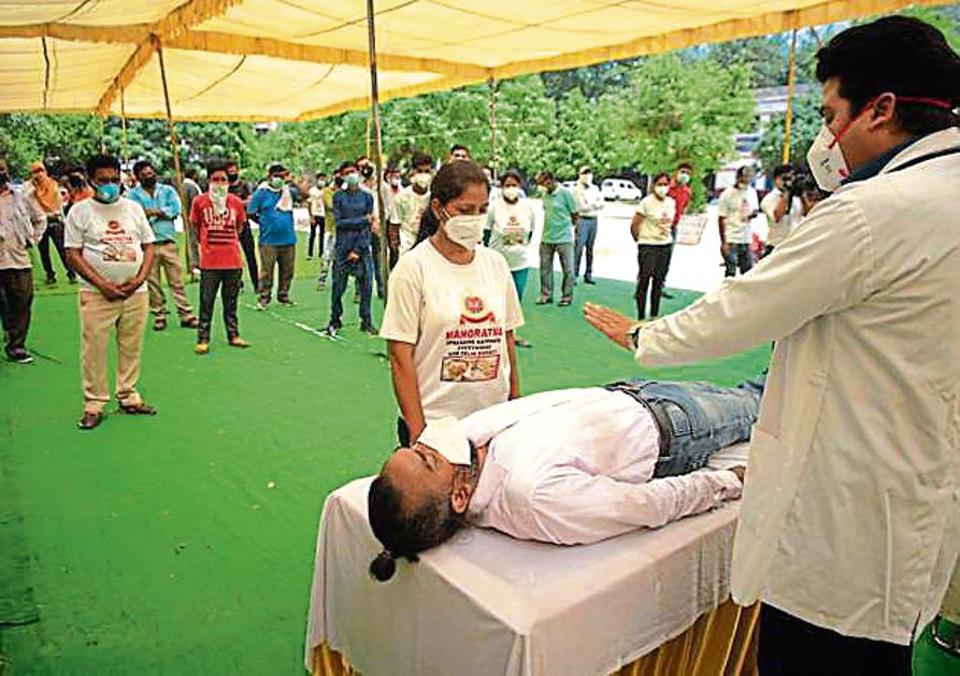
As a pilot project, the government has started training the first batch of volunteers in New Delhi district’s Budh Nagar Colony. Over the next five days, these volunteers will be taught about human anatomy and to measure vital indicators such as pulse rate, blood pressure, respiratory rate, temperature, hygiene and infection control practices, record keeping, and basic life support.
These centres are for patients with mild to moderate symptoms who do not have adequate space in their homes to isolate themselves. The centres will have the provision to provide oxygen to the patients, according to officials.
Under Delhi government guidelines, asymptomatic patients and those with mild symptoms can stay isolated at home if they have a separate room and bathroom. If not, they will be moved to either Covid Care Centres or Covid Health Centres. There are more than 6,000 beds at the existing centres, of which around 30% are occupied, according to data provided by the Delhi government.
“The number of Covid-19 cases is increasing every day, so the government has decided to set up these small centres within the community, managed by the people from the community, for the people from the area. This is a pilot project, and if it is successful, then it will be implemented across Delhi. We train around 1,000 such volunteers in the district,” Dr Nitin Shakya, the nodal officer for Covid-19, New Delhi district, said.
“The centres will be linked to nearby hospitals and there will be doctors available for tele-consultation,” he said.
The volunteers have to between the ages of 18 and 55 and free of comorbid conditions such as diabetes, hypertension, heart or kidney disease. Anyone can sign up to volunteer through the Delhi government website.
“We also carried out a door-to-door drive asking people to volunteer. Around 35 people showed up for the training session today. The number might increase later on; people are scared that they will get the disease. Even when we started doing the antigen testing, it was difficult to motivate people to get tested,” Jay Prakash, the chief coordinator from the office of the Sub Divisional Magistrate, Delhi Cantonment, said.
Harish Arya, a driver who lost his job during the lockdown, was among those who attended the training session on Tuesday. “Initially, I had started donating food during the first lockdown and slowly got in touch with the district office, and have been volunteering with them ever since. I even helped motivate people who live in my area to get tested. I got myself and everyone in my family tested for Covid-19 as well. Today, the doctor taught us about all the parameters we had to monitor – most of it was easy like reading the temperature on the thermometer or blood pressure or oxygen machine,” he said.
Homemaker Shakuntala Pande has also been helping the district authorities with various activities related to Covid-19 in the area. “I was informed that they will be starting centres for those who get sick in our community in some hall nearby. The officers asked me whether I wanted to help and I agreed. So, they asked me to come to the training today. A doctor taught us about the human body,” she said.
The government is also working to add over 15,000 beds in makeshift hospitals for those with a severe infection in hotels and banquet halls. To staff these, the government is relying on doctors’ organisations.
“This is like a war situation where, as a last resort, you train civilians to shoot and send them to the frontlines. We are also providing basic training so that they can take care of Covid-19 patients when there is a shortage of doctors, nurses,” said Prakash.


