
 E-Paper



The curious case of Delhi’s under-utilised foot overbridges
Several studies have shown that pedestrians always prefer at-grade or road-level crossing facilities instead of going up-and-down to cross the road.


Manoj Rajput, 36, first tosses his bag on the other side of a railing dividing the busy Mathura Road near Ashram. He then starts to squeeze his frail frame through a small opening in the grille in order to cross the road.
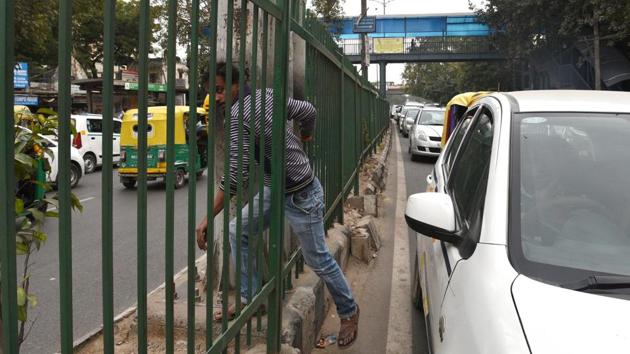
Barely 30 metres ahead, there is a foot overbridge (FoB) which largely lies unused. But pedestrians like Rajput still prefer crossing at-grade or road-level crossing, even if that means risking their life.
“I work at a shop on the other side and crossing the road like this is more convenient than climbing the bridge and walking back,” Rajput said.
Hindustan Times on Tuesday took stock of several of such FoBs across the city, to assess the problems that plague these facilities.
State of foot overbridges
The FoB at Bhairon Marg-Mathura Road crossing lies vacant. Just 20m from the exits of the FoB, pedestrians were seen using zebra crossings to get to the other side of the road.
In the Ashram-Mathura Road intersection too, the same problem persists. Improper placement of the FOB on this stretch also became the reason for traffic snarls, as pedestrians were seen crossing at-grade at the foot of the Nizamuddin Flyover (towards New Friends Colony).
Cleanliness and safety have also become a major concern.
“There is trash thrown all over the bridge and on the staircase, which makes it difficult to use it. There is also a urinal just where the FoB lands because of which the section is always filled with stink,” said Akash, a student, at Shakarpur.
At Anand Vihar — which sees heavy footfall due to its proximity to two intra- and inter-state bus terminals, a Metro station and a railway station — though several people were seen going up and down the FOB, there were no lifts or ramps to make the trip.
The escalators are also mostly not functional, users said. If a person is wheelchair-bound, then they cannot cross the road. The reason — the median is covered by high railings and on the FoB, there are no lifts.
“At least one of the two escalators is always dysfunctional because of which people have to take the stairs even with heavy luggage. Climbing up and down is an arduous task for someone my age,” said 66-year-old Ashok Kumar, a Brij Vihar resident. A provision of lifts and ramps would make this FoB more user-friendly, he said.
For women users, poorly lit pedestrian bridges become a nightmare after sundown.
“The bridge and the road below it need to be more lit so that working women and students can feel safe while using it,” said Ayesha Khan, a user.
Reasons for lack of use
Traffic and road design experts said the placement of a pedestrian facility is instrumental to ensure its optimal use. Several studies have shown that pedestrians always prefer at-grade or road-level crossing facilities instead of going up-and-down to cross the road.
Gaurav Jangid, a road design consultant, said that out of 80 FoBs in the city, around 40% are underutilised. “There are studies, which prove that the innate tendency of pedestrians is to move at-grade. If given an option they would not take an extra effort to cross the road,” he said.
Jangid explained that generally, such facilities are used at expressways and high-speed corridors where the crossing time at-grade would be higher than the time taken to cross through FoBs. If a road can be crossed in less than a minute’s time at-grade, then people will tend to use avoid FoBs, he said.
“For instance, at Mathura Road, which is punctuated with intermittent traffic signals, there are several unused FOBs. Why would a person cross a 30m-wide road by using bridges, which would require extra effort?” he said.
Mukti Advani, senior scientist at Central Road Research Institute (CRRI), agreed that the intention behind the construction of FOBs is to remove pedestrians from roads. “Using pedestrian bridges increases efforts by at least six-to-seven times, which pedestrians tend to avoid. If you need to install these, then effort needs to be reduced by installing ramps, lifts and escalators, and ensuring its functionality,” Advani said.
The way forward
In cities such as Vienna and Prague, in the last five years, over-head pedestrian facilities have been dismantled to create more user-friendly on-road facilities.
Traffic experts said such models can be developed in Delhi as well, at comparatively lower costs. The cost to construct a FOB usually is between ₹2 and Rs3 crore, but developing pedestrian facilities at-grade is way cheaper.
“Crossing at-grade can be improved by installing speed calming measures. For example, speed bumps at the ITO crossing. The improvement of pedestrian signals will also help,” Jangid said.
He added that dedicated pedestrian walkways will also go a long way making cities pedestrian friendly, and this will not cost the government agencies more than ₹20 lakh.

Stay updated with all top Cities including, Bengaluru, Delhi, Mumbai and more across India. Stay informed on the latest happenings in World News along with Delhi Election 2025 and Delhi Election Result 2025 Live, New Delhi Election Result Live, Kalkaji Election Result Live at Hindustan Times.


