
 E-Paper



Traffic snarls return to Delhi, Covid-19 lockdown curbs take back seat
Controlling movement, especially when the Capital is under the “Red Zone” where strict adherence is required to control the spread of Covid-19, was difficult because there was no way to ascertain if a person on the road was out for a genuine reason, an official said.


For 40 days, the Capital’s roads were empty. Cars remained parked, motorcycles sped away only when the police were not looking.
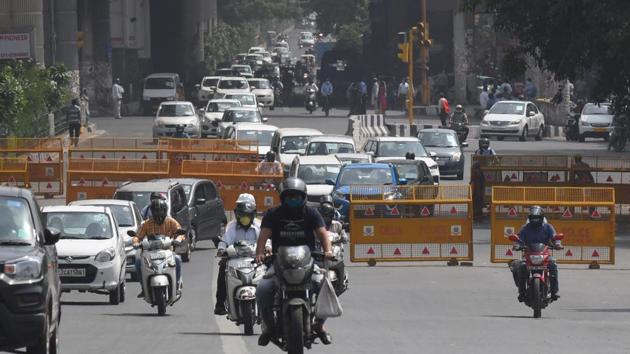
But from Monday, rush hour was back in many areas as the lockdown norms, in place since March 25 to contain Covid-19, were considerably relaxed. Along with “Covid-19 hot spots” (all 11 districts) were now over a dozen “traffic hot spots” that the Delhi traffic police counted. Many commuters brazenly violated lockdown norms by overloading vehicles beyond the prescribed limit of passengers, and flouted traffic rules too.
Traffic police assessment showed that in areas around Chirag Delhi, Akshardham, Rajouri Garden, Zakira, Karol Bagh, Patel Nagar, Uttam Nagar, Janakpuri, Kirti Nagar, Kondli, Ghazipur, Okhla and Seelampur, reported long traffic snarls during the peak morning and evening hours over the last three days. On Wednesday, traffic was slow moving in areas around Palam, Naraina, Vikaspuri, Mundka and Munirka (on the Outer Ring Road).
The traffic department say the traffic at these areas were considerably more than what they had estimated after factoring in the relaxations -- government and private offices could resume work with 33% workforce, standalone shops, industrial units and in-situ construction were also allowed.
“We knew traffic would increase since during the lockdown it had been nearly zero. However, it was more than what we had expected. Especially during office hours, we now need some officials at these areas to manage traffic flow,” said a senior traffic police official.
The official said controlling movement, especially when the Capital is under the “Red Zone” where strict adherence is required to control the spread of Covid-19, was difficult because there was no way to ascertain if a person on the road was out for a genuine reason.
ON THE GROUND
The Delhi government order on May 3 relaxing the restrictions added there would be no public transport and private vehicles are required to adhere to passenger limits -- only driver and two passengers. To ensure social distancing, no pillion riders will be allowed on two-wheelers. However, when HT visited some of the police pickets in the city, people were found openly flouting this restriction.
“If there is no picket to slow the vehicles they just zoom past us. Some plead that they be allowed to go this one time because there is no public transport,” said Dheeman Singh Yadav, a traffic constable stationed at east Delhi’s New Ashok Nagar.
Policemen on the road also said they generally don’t stop vehicles with just the driver and a passenger to verify why they were out.
Delhi police officials said that though there is no provision to book people under the Motor Vehicles (Amendment) Act, because of the special nature of such times, violators were booked under section 188 of the Indian Penal Code (IPC) (disobedience of an order promulgated by a public servant), which carries a fine of ₹200 and a jail term of up to a month. Police are also slapping sections 269 and 270 of the IPC, which books them for the spread of the infection of any disease dangerous to life.
“Action will be taken looking at the gravity of each violation. If anyone flouts the rules of the lockdown, they are not only risking their own lives, they are also putting the lives of others in danger. They are being prosecuted and action includes fines and even jail term,” said MS Randhawa, Delhi police spokesperson.
Data provided by Delhi traffic police shows that during the lockdown period, between March 25 to May 3, 454,438 speeding challans were issued and 18 people lost their lives in 17 accidents. Since Monday, 12,098 fines have been issued for speeding and 4,987 fines have been issued for jumping the red-light.
Traffic experts said that the relaxations should have been implemented in a phased manner with a proper plan for enforcement agencies to follow.
“There should have been a mechanism in place to ensure that the vehicles that are out on the road are actually out to reach their offices and are not out without reason. The state government can ask private companies to give letters of authenticity to those employees who have started coming to work, which can be handed over to the policemen on duty,” said Dr Tribhuvan Jain, epidemiology and disease control expert, who is a consultant with the union government.


Stay updated with all top Cities including, Bengaluru, Delhi, Mumbai and more across India. Stay informed on the latest happenings in World News along with Delhi Election 2025 and Delhi Election Result 2025 Live, New Delhi Election Result Live, Kalkaji Election Result Live at Hindustan Times.


