
 E-Paper



Cost of education in Delhi tripled in 7 years
Children’s education is burning three times as big a hole in the pocket for Delhi parents as it did seven years ago. A government survey shows amid rising fees charged by private schools and colleges, education spends nearly trebled over the period in the Capital and doubled nationally.


Children’s education is burning three times as big a hole in the pocket for Delhi parents as it did seven years ago. A government survey shows amid rising fees charged by private schools and colleges, education spends nearly trebled over the period in the Capital and doubled nationally.

The National Sample Survey Office survey across states released this week shows the annual cost for educating a child in 2014 was Rs 6,788 for general education, Rs 62,841 for technical or professional programmes and Rs 27,676 for vocational training — a massive jump from the 2007-08 figures of Rs 2,461, Rs 32,112 and Rs 14,881, respectively.
Among states, Delhi witnessed the highest rise, as the average annual expenditure for both government and private schools shot up from Rs 6,149 to Rs 19,941.
Admitting that school fees had increased exponentially, a Delhi government official said implementation of the latest pay commission recommendations increased the burden on schools, which was passed on to parents. “I believe school fees in Delhi are comparable with those in cities such as Mumbai and Bangalore,” the official said.
The survey does not provide a city-wise comparison of education spends, except in case of Chandigarh, a Union territory, where the annual expenditure per child saw a jump of about Rs 6,000 to hit Rs 18,426.
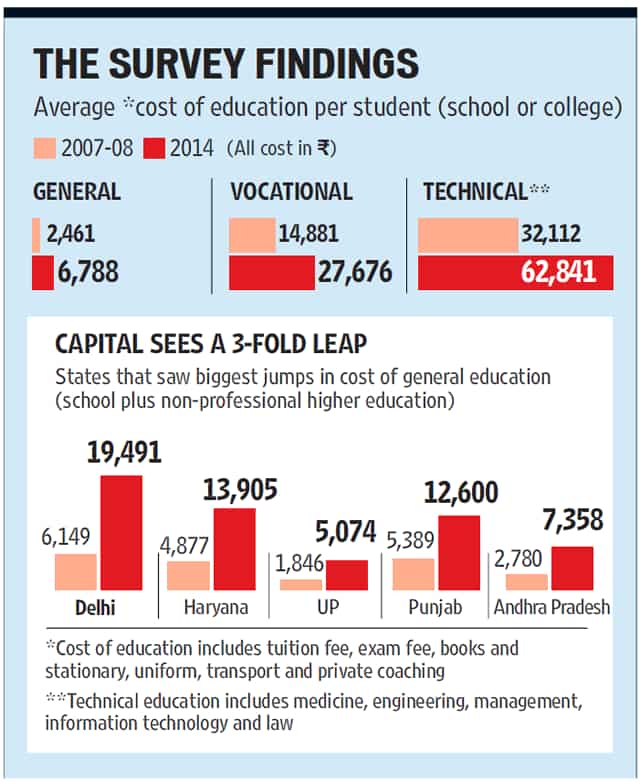
Apart from Delhi, school fees in Goa, Haryana, Gujarat, Maharashtra, Jharkhand, Karnataka and Uttar Pradesh also trebled over the seven-year period.
The survey also showed the gap on spending between rural and urban India is shrinking, especially in higher education.
The overall cost appears low nationally because it includes the highly subsidised education provided by the government through 1.4 million schools and 10,000 higher education institutions.
But a breakdown of data shows the cost of providing education in private institutions in 2014 was about 11 times that in government schools, where parents may have to pay for transport, uniform and extra coaching classes but not tuition fees. The cost of higher education from a private institution is about three times that in one run by the government.
Only a fifth of all girls who enrol at the primary level complete higher education compared with half of the boys. The cost disadvantage for providing higher education to a girl child weighs heavily on the minds of parents as they prefer to provide education to sons instead of daughters, a University Grants Commission official said.
On the brighter side, the survey shows that the quest for education has increased in India over the past decade, so private education providers promising quality have witnessed a boom. This is also quantified by HRD ministry data for 2014 showing a substantial increase in enrolment in private schools, with admissions in government schools stagnant.
An inference that education policy makers could draw is that parents are willing to pay more for education, provided quality is ensured.
Surveys by advocacy group Pratham have shown that learning levels in government schools are falling across states, a reason for parents to opt for private schools. But, an HRD ministry official cites the 25% quota for students from economically weaker sections in private schools under the Right To Education Act as the reason for the shift.
Education activists blame the lack of fee regulation for the huge rise in private school fees. The schools counter that by saying parents pay for the service they get as education is highly competitive in the country.

Stay updated with all top Cities including, Bengaluru, Delhi, Mumbai and more across India. Stay informed on the latest happenings in World News along with Delhi Election 2025 and Delhi Election Result 2025 Live, New Delhi Election Result Live, Kalkaji Election Result Live at Hindustan Times.


