E-Paper



Delhi needs watertight plan to save resources
Lajpat Nagar resident Rajinder Singh was a happy man when the Aam Aadmi Party (AAP) government announced 20,000 litres of free water for each household every month.

 Prefer HTon Google


Lajpat Nagar resident Rajinder Singh was a happy man when the Aam Aadmi Party (AAP) government announced 20,000 litres of free water for each household every month.

But for Prakash Kumar, who lives in a crammed one-bedroom house in South Delhi’s Sangam Vihar — Delhi’s biggest urban slum sprawl — it sounded like a discount offer on rocket fuel.
Lajpat Nagar is one of the privileged localities that fall under the Delhi Jal Board (DJB) water network but piped water is yet to reach the homes of thousands of people like Kumar who live in colonies such as Sangam Vihar, Mahipalpur and Bawana in outer Delhi.
Though the state government has taken up projects to bring such areas in the DJB network, people who ration even mugs of water are apprehensive. “Free water sounds good but what about people with no water?,” Kumar, a carpenter, said.
Free water was delivered even under the Congress regime as the DJB did not charge for consumption up to 6,000 litres per family per month. But many just didn’t get any or enough water.
Nothing has changed today.
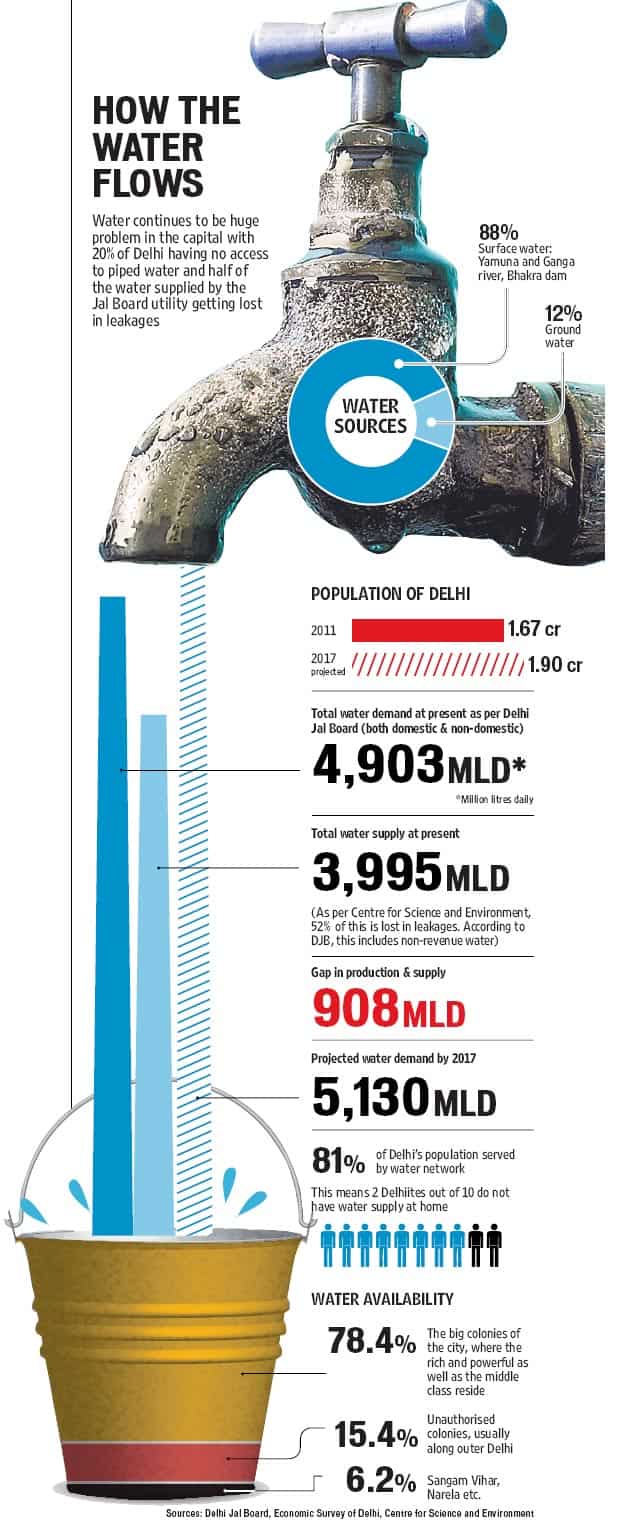
Nearly 81% of the population is served by the water supply system.
Delhi’s water demand, according to the DJB, is 4,903 million litres daily (MLD) but the total supply is 3,995 MLD. Of this, according to the Centre for Science and Environment, 52% is lost to leakage.
This projected total demand in 2017 is expected to rise to 5,130 MLD.
Delhi needs additional 80 million gallons water per day (MGD) from Haryana. The Renuka dam in Himachal promises to bring in another 275 MGD in the next decade. Recent reports say Haryana has been not releasing enough water into the Yamuna to maintain production in Delhi, causing officials to panic.
So why such scarcity of water in a city that has flourished for hundreds of years? For centuries, Delhi’s primary source of water used to be its water bodies — wells and ponds. As the population increased, the demand rose, putting pressure on the earlier “ample” water supply. The city had to look for other sources — the Yamuna basin and groundwater.
Now the main source remains surface water from the Yamuna basin from where it gets 735 MGD. With only a slim chance of getting additional river water, groundwater is the only hope. But that too is under threat. Surface water accounts for 88% of the city’s water supply.
The groundwater level has been going down. This means one would have to dig deeper to find water. An analysis of the last 10 years shows the overall groundwater level is going down by .02 to 1.44 metres per year because of increased extraction and reduced natural recharge.