
 E-Paper



Energy efficiency gain for all
A global treaty to fight climate change may still be a far cry but India has come up with an ambitious plan to adopt greener technologies, to help people save more for each unit of power they consume.


A global treaty to fight climate change may still be a far cry but India has come up with an ambitious plan to adopt greener technologies, to help people save more for each unit of power they consume.

A green road map for the 12th plan is almost ready, with a Planning Commission expert group on low carbon economy for inclusive growth focusing on energy efficiency for consumers, better public transport system and incentives the government should give to adopt cleaner technologies. The report says the high investment for low carbon economy can be recouped in five years, as the country will save in energy cost.
India can be hub of future clean technologies, as there is a huge market in two energy intensive sectors — electricity and transport. About 45% Indians don't have a regular power connection and annual growth of automobile sector is about 15 %, second to China.
According to NGO Climate Group's estimate, India's energy efficiency market will treble to R3,51,500 crore in the next 10 years driven by demand in industry, buildings, energy storage and transport. This will need an investment of R45,650 crore in energy-efficiency improvements. By then India’s energy demand is likely to double from 90,000 MW as in 2010.
"We have looked at technology options available, which are easy for industry and people to adopt and the government to promote," said Kirit Parekh, head of plan panel group.
The group, in its interim report, has suggested highly energy efficient LED lights, gasification technologies for coal sector and electric public transport systems. Finance minister Pranab Mukerjee, in his budget speech, announced excise duty cut on LED lights.
"The government's approach on clean technologies has been piecemeal," said Chandra Bhushan, associate director with Centre for Science and Environment. "There is no overarching policy of the government on green economy. Each ministry is doing its own bit."
CEO of Climate Group Mark Kenber does not fully agree and said the government should ensure long term policy stability for investor confidence.
Despite policy constraints, the consumers can look for next generation energy efficient TV sets or refrigerators soon.
"We will soon come with super star labelling for appliances, which would be 20 to 30% more efficient than five star rated electrical appliances...," said a senior official with bureau of energy efficiency (BEE), mandated under law to promote energy efficient appliances.
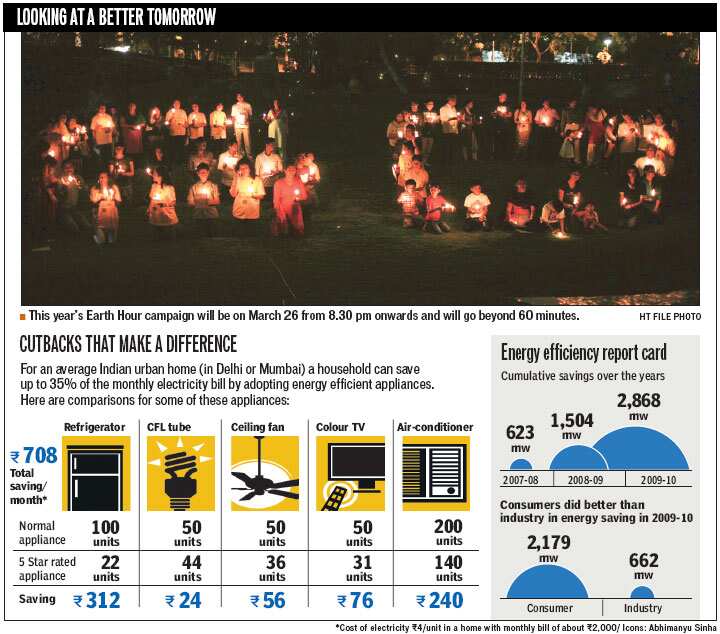
At the same time least efficient appliances will be phased out to ensure that only labelled appliances are sold in the market. Till now, India has saved 2,900 MW of power through energy efficiency, enough to light cities such as Delhi or Mumbai for about a day.
For promoting efficiency in the industry, the BEE has already initiated Perform Achieve and Trade scheme for electricity consumption and the Central Pollution Control Board for emissions. The companies, which achieve the annual efficiency target would trade the energy efficiency or emission reduction certificate with not-so efficient industries.
Experts believe much more than what has been planned can be achieved. "Our underdevelopment is an opportunity to make India a green capital of the world," said Vijay Chaturvedi, CEO of Moser Bear, the company in the area of solar energy.
It is early days for India, an advantage over the West, said Kenber, adding that the government needed to look at a mix of public and private investments for the next 10-15 years.

Stay updated with all top Cities including, Bengaluru, Delhi, Mumbai and more across India. Stay informed on the latest happenings in World News along with Delhi Election 2025 and Delhi Election Result 2025 Live, New Delhi Election Result Live, Kalkaji Election Result Live at Hindustan Times.


