
 E-Paper



Constitution @70: It has made India what it is. Live up to its ideals
It unified India. Irrespective of region, class, caste, religion anyone who subscribed to the Constitution and lived within its framework was (and is) an Indian citizen.


On November 26, 1949, the Constituent Assembly ratified the Constitution of India after three years of high-quality deliberations. They reflected the idealism as well as the pragmatism of the times. The proceedings were a lesson in how to conduct debates with utmost civility. The process itself should make Indian citizens proud of their legacy. And so, 70 years ago to the day, India finally had a modern vision for its future.
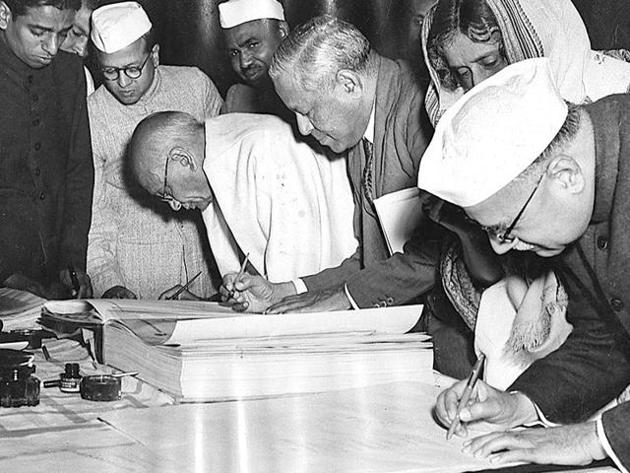
This achievement can only be understood if placed within the context in which it was drafted. India was emerging from colonial rule. Its society was mired in hierarchy, particularly caste. Partition had just taken place. India was barely unified administratively. A war with Pakistan over Kashmir had already taken place. And poverty and illiteracy were widespread.
Yet, the Constitution’s ambition was staggering. It unified India. Irrespective of region, class, caste, religion, anyone who subscribed to the Constitution was (and is) an Indian citizen. It gave India a democracy and granted universal adult franchise. Every citizen was entitled to freely exercise the right to vote for representatives and a government. It gave Indians fundamental rights — of speech, association, movement, life, liberty, and religious practice. It made India federal. Even though the term is not used in the text, the Constitution recognised regional diversity and its conception of India as a Union of States cemented the nation. It made India a plural polity. While the term secularism was introduced in the Preamble only in 1976, the philosophical underpinning of the Constitution was that the State would not discriminate on the basis of religion. It also provided justice, ensuring affirmative action to India’s marginalised segments, particularly the Scheduled Castes and Tribes, and assigning responsibility to the State to lift the poor and deprived out of poverty. The Constitution shaped both the Indian State and Indian society, and made India what it is today. Both the political leadership and citizens must live up to each ideal prescribed in the Constitution, in both letter and spirit.


