
 E-Paper



16th Finance Commission's awards to states deciphered | Number Theory
.
Updated on: Feb 5, 2026, 08:45:47 IST

 Prefer HTon Google
Share via


Copy link

The first part of this series looked at the rationale and importance of equality in India’s fiscal federalism. It also explained how this path has been vitiated by the concurrent issues of demographic and economic divergence among states. This part will explain how FC awards have changed overtime, especially in the more recent past, the role the 16th FC has played in this trajectory and what an ideal fiscal federalism framework could look like going forward.

16th Finance Commission's awards to states deciphered
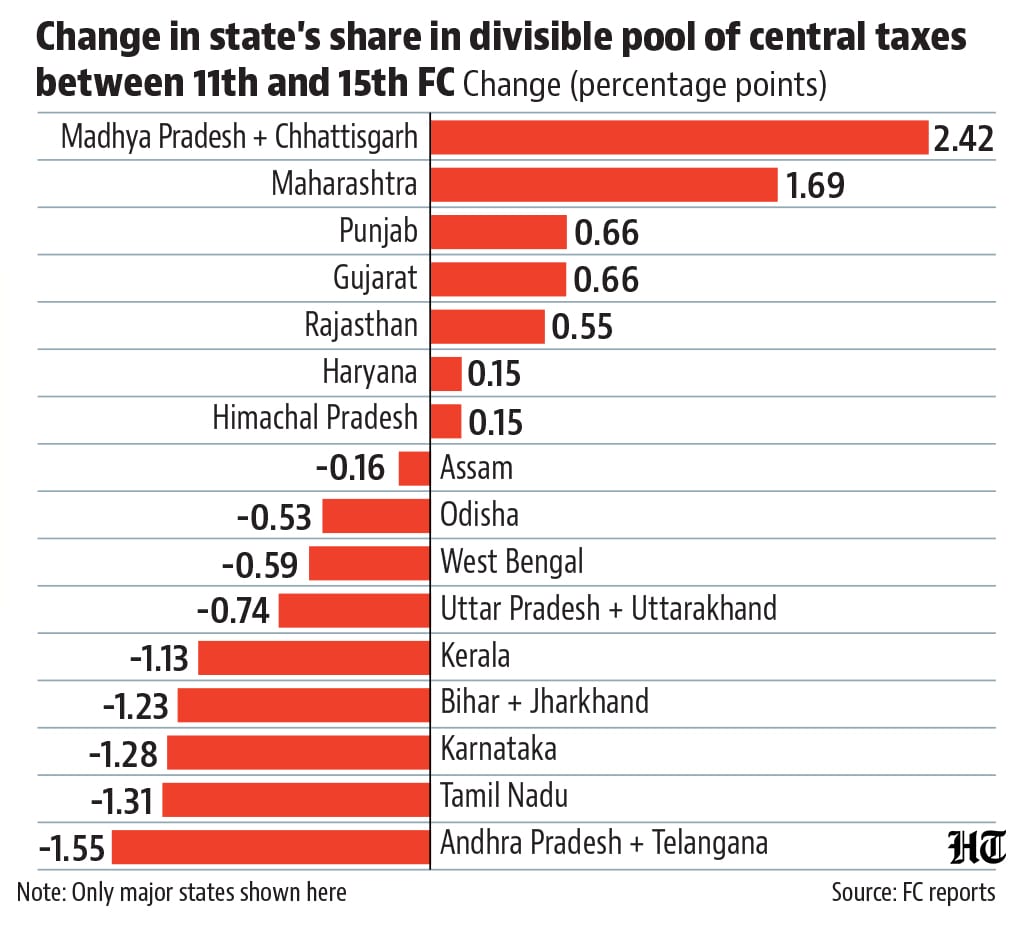
 Southern states saw a large fall in the tax share which bottomed out in the 15th FC awardsAn analysis of long-term horizontal share of states from the 11th FC (2000-05) onwards shows a large fall in the share of southern states overtime. Undivided Andhra Pradesh, Karnataka, Kerala and Tamil Nadu had a combined share of 21.1% under the 11th FC awards. This number fell by more than 25% to reach just 15.8% under the 15th FC awards. Southern states rank very high even if one were comparing fall in shares of individual states between the 11th and 15th FC awards even though the 15th FC award did see a marginal gain in Tamil Nadu’s share. The states which were the biggest gainers in terms of tax shares are undivided Madhya Pradesh and Maharashtra.
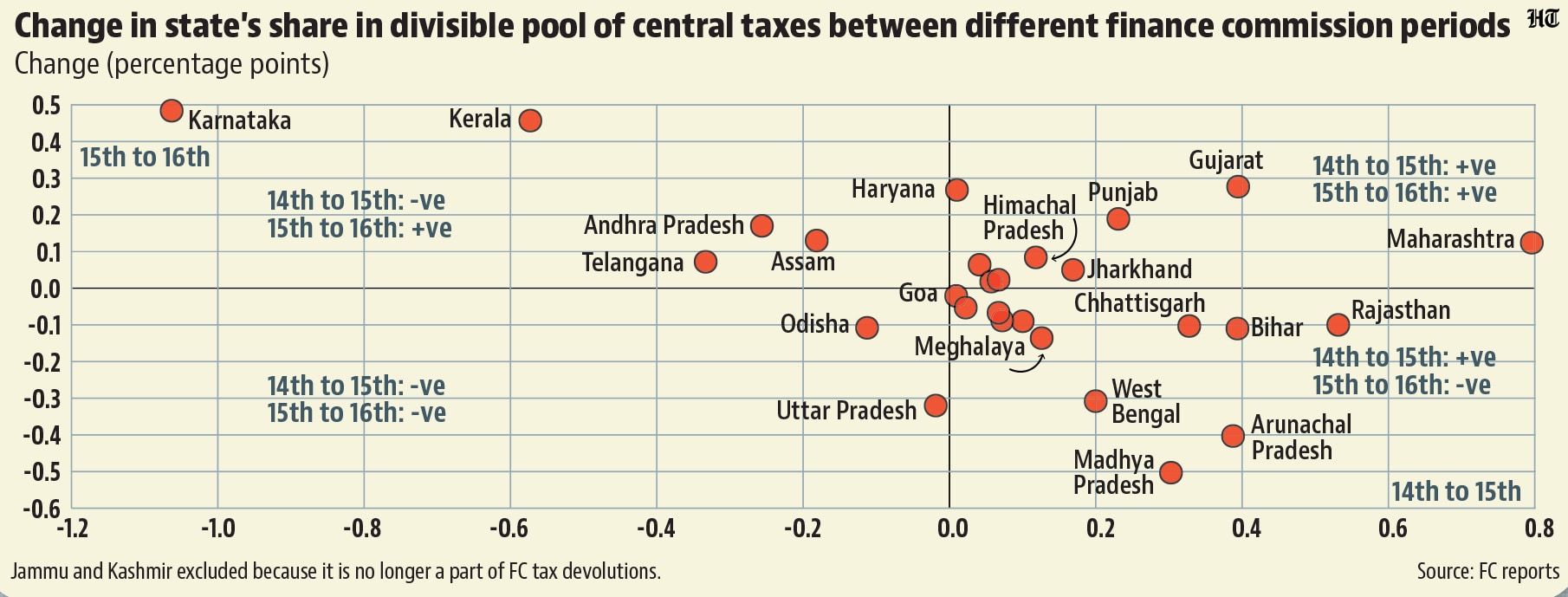
- 16th FC has maintained the pecking order of states in terms of horizontal share but it has reversed the direction of change between 11th and 15th FCThis is the most important takeaway of the 16th FC awards. If states were ranked by their horizontal share in central taxes, the rankings are almost unchanged from the 15th FC awards. However, what is different is the fact that the direction has now reversed from falling share of southern states to a rise in their share. While the magnitude of change ushered in by the 16th FC awards is not very large and it stops somewhere in between the 14th and 15th FC awards for most states, the optics of arresting the reversal of southern states or preventing the rising share of low-income high-population growth states is extremely important.
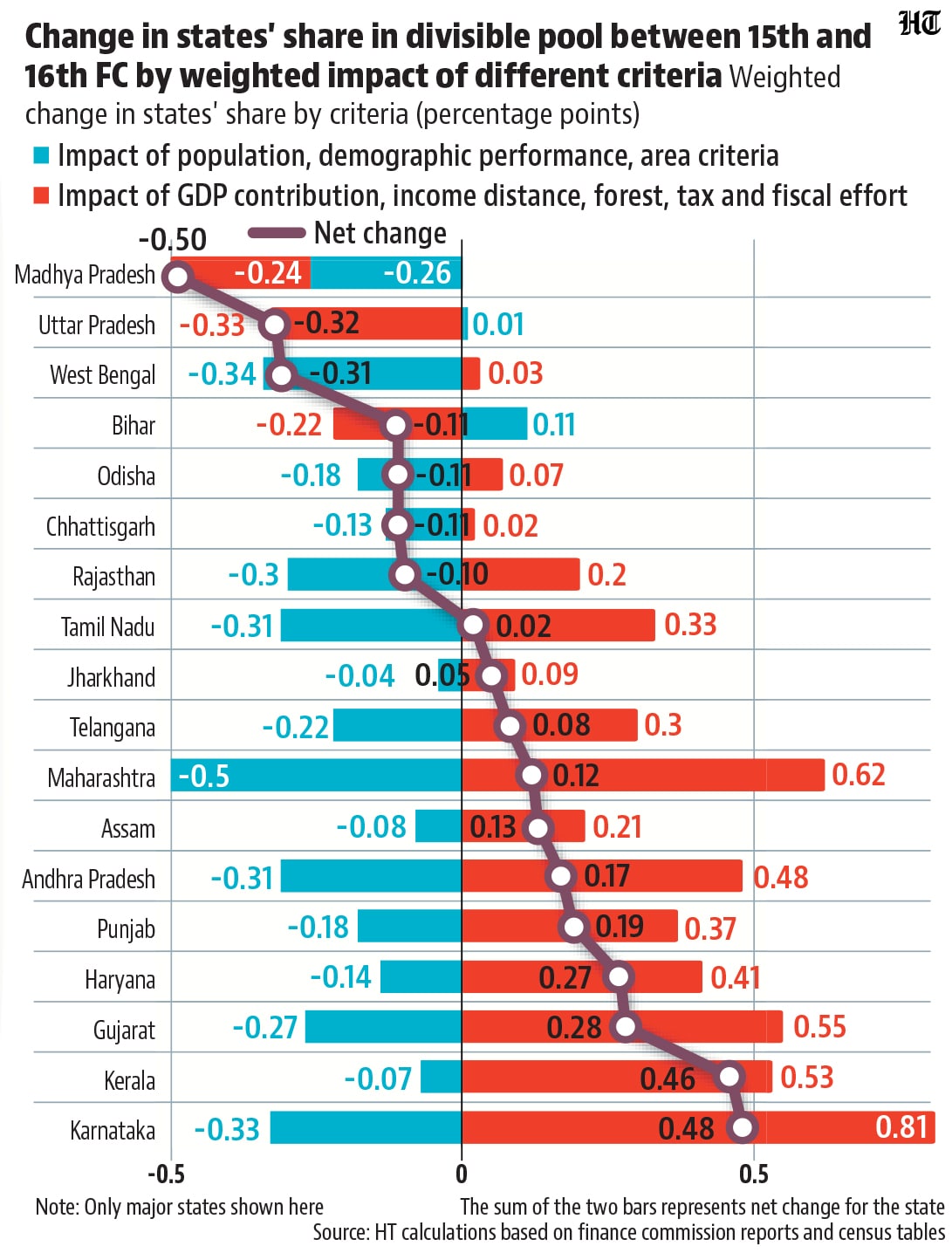
- At the root of the change in 16th FC awards are the contrasting factors of population and economyHow has the 16th FC managed to reverse the prevailing direction of state-wise horizontal share until the 15th FC awards? The answer largely lies in the contrasting effects of population and area criteria (which accounts for around one third weight in the 16th FC) and that of economy and ecology (which accounts for two thirds of the weights in the 16th FC). For example, Karnataka has gained 81 basis points – one basis point is one hundredth of a percentage point – because of population, demographic performance, and area criteria and lost 33 basis points because of income distance, GDP contribution, and forest criteria, netting a gain of 48 basis points, the highest among all states. While it would have been ideal to calculate the impact of the new GDP share criteria employed by the 16th FC for the first time, it is not possible because the per capita GSDP rankings used by the 16th FC do not match the ones available in the public realm. This could be because of revision in the figures since the FC’s analysis or details not apparent in the formula given in the FC’s report.
- What is an ideal fiscal federalism environment for India?It is best captured by a sentence in Volume I of the 16th FC report. “India is currently at risk of becoming old before it becomes rich, a prospect it must strive to avoid”, it says. While population growth has stalled significantly more in the southern and richer states than the poorer ones, even they have a good share of the working age population and can continue to actively pursue economic growth. Of course, the demographic dividend among the currently poorer and high-population growth states will continue for longer. This means that the poorer states ought to spend more on their future growth than their richer and southern counterparts. There is no constitutionally mandated provision or law to dictate how states prioritize their spending. One can very well say political choice and their democratic drivers will ultimately determine the future of fiscal federalism in India.



Unlock a world of Benefits with HT! From insightful newsletters to real-time news alerts and a personalized news feed – it's all here, just a click away! -Login Now!


