
 E-Paper



Developing country to export superpower: China's journey | Number Theory
The charts below trace China’s rise into a global exporting powerhouse since joining the WTO and examine how its trade dominance contrasts with income levels
Updated on: Sep 26, 2025, 09:40:53 IST

 Prefer HTon Google
Share via


Copy link

China has announced that it will no longer seek for itself the special and differential treatment provisions reserved for developing countries at the World Trade Organization (WTO). The move reflects not only an acknowledgement of its growing economic weight, but is also an effort to present itself as a constructive force in multilateral reform. The charts below trace China’s rise into a global exporting powerhouse since joining the WTO and examine how its trade dominance contrasts with its still modest income levels.
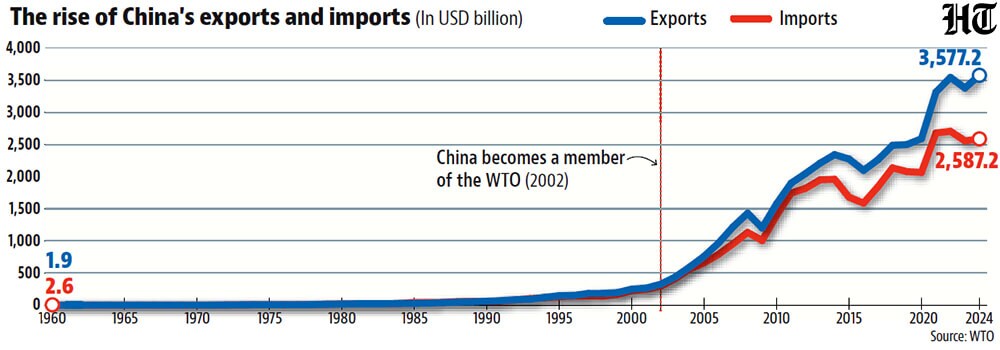
 The meteoric rise of Chinese exportsBefore joining the WTO, China’s exports had already been growing from a low base at a steady pace, rising from about $62 billion in 1990 to $249 billion in 2000. After WTO accession in 2001, this trajectory steepened sharply—exports, which stood at $266 billion that year, more than quintupled to $1.43 trillion by 2008. This boom was driven by deeper access to global markets, foreign investment in export-oriented manufacturing, and China’s rise as the assembly hub of global supply chains. Although the 2008 financial crisis caused a brief setback, shipments quickly recovered and continued to climb, surpassing $2.5 trillion by 2019. The pandemic years underlined China’s central role in global supply chains, with exports surging to over $3.5 trillion by 2022 and reaching a fresh high of $3.58 trillion in 2024. Imports have been central to this story too as no country can become the “world’s factory” by shutting itself to imports. China imported almost as much as it exported till the early 2000s, before a persistent surplus opened up in the 2010s. Since the pandemic, that gap has widened sharply, with its trade surplus being almost $1 trillion in 2024. Since joining the WTO, China has transformed into the world’s pre-eminent manufacturing powerhouse, with “Made in China” becoming a ubiquitous phrase in global commerce.
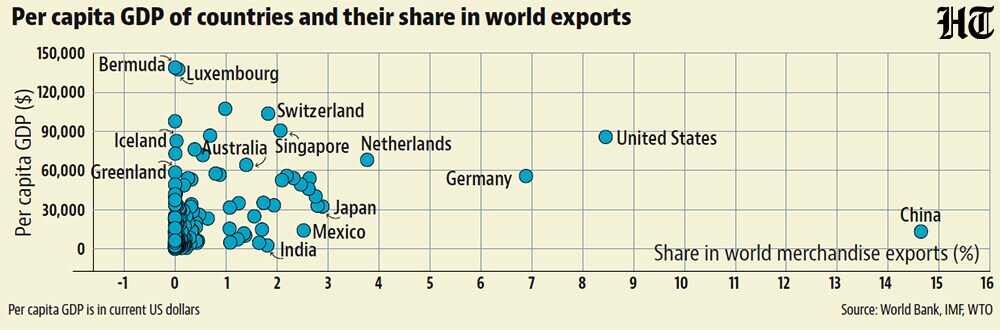
- China’s export power outpaces its income levelChina’s position in global trade is strikingly disproportionate to its level of income. In 2024 its per capita GDP was about $13,300, placing it among middle-income economies, yet it accounted for 14.6% of world merchandise exports, the largest share of any country. This is far higher than the United States, which contributed 8.5% despite a GDP per capita of more than $85,000, or Germany at nearly 7% with more than $55,000 GDP per capita. Among economies closer to China’s income level, the contrast is even sharper: Mexico, Malaysia and Turkey each accounted for only 1–2% of global exports. This mismatch between China’s export share in the global stage and its per capita GDP also feeds into the unresolved question of how China should be classified in the global system. By living standards (per capita GDP) it still counts as developing, but by trade power it has already eclipsed the so-called developed nations. This tension has long been a source of friction at the WTO, with the United States, especially under Donald Trump, pressing Beijing to give up developing-country privileges. China’s decision to finally do so is thus as much a response to external pressure as it is a recognition that its export dominance makes such treatment increasingly hard to justify.
- And its global export footprint has widened overtimeWhen China joined the WTO in 2001, its exports were concentrated in advanced economies—the United States absorbed more than 20%, while Hong Kong and Japan together took another third. By 2023 the US share had dropped to under 15% and Hong Kong’s to just over 8%, though the latter remains China’s second-largest market because of its role as a re-export hub funnelling goods to the rest of the world. In contrast, developing economies have gained prominence. Vietnam now takes over 4% of Chinese exports, a sixfold rise since 2001, while India, Brazil, Mexico and markets across Africa and the Middle East have also become more significant destinations. This shift underscores China’s success in reducing dependence on Western markets by steadily diversifying its exports towards emerging economies that now form a core part of its global trade network.
- China’s decision to forego the benefits of having the “developing country” status at the WTO comes as trade tensions with the US remain unresolved, with tariff disputes and supply-chain realignments continuing to strain relations. At the same time, Beijing is presenting itself as a champion of the Global South and a supporter of multilateral institutions such as the WTO, in contrast to the US under Donald Trump, which has increasingly sought to weaken them. Beijing’s real strategy is to get the best of both worlds: its economic relationship with the US as well the Global South.



Unlock a world of Benefits with HT! From insightful newsletters to real-time news alerts and a personalized news feed – it's all here, just a click away! -Login Now!


