
 E-Paper



Evolution of India’s tax burden: Progressive with a caveat | Number Theory
.
Published on: Feb 3, 2026, 08:37:27 IST

 Prefer HTon Google
Share via


Copy link

India will become the world’s third largest economy in a couple of years. It will still lag by a distance when it comes to average incomes. India’s per capita GDP in current dollar terms – the same yardstick which will make it third largest by size of GDP – is ranked 144 in 2025. To be sure, even China, which is already the world’s second largest in terms of GDP ranks 78 on per capita GDP. The mismatch between size of the economy and per capita incomes makes the question of tax burden an extremely important one in India. More so because it is also a democracy. The evolution of India’s tax burden – as seen in central taxes – makes for an extremely interesting study. Here are four charts which summarise this.
Evolution of India’s tax burden: Progressive with a caveat
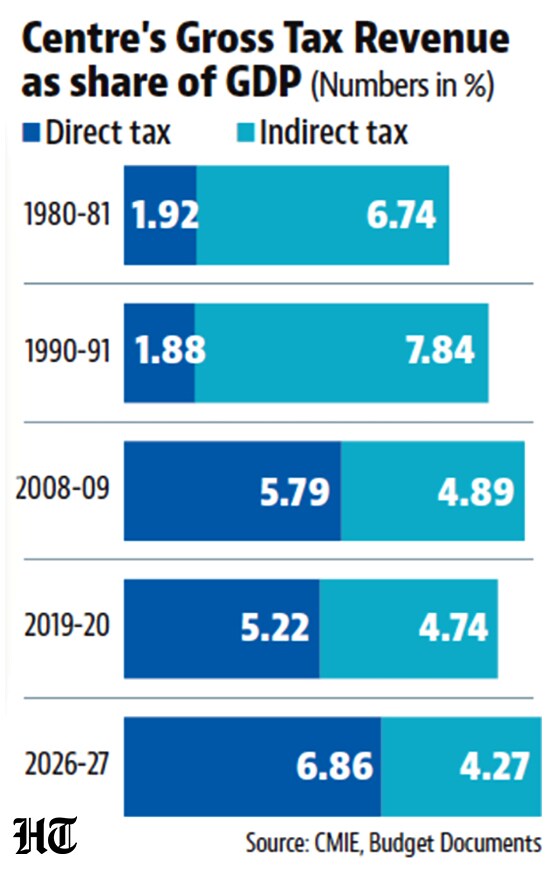
 Direct taxes have seen a large increase in total tax revenue in the post-pandemic periodIn 1980-81, direct taxes were less than 30% of the Centre’s indirect tax revenues. This number fell to less than 25% by 1990-91, the year India’s embraced large-scale policy reforms. The story changed radically after reforms and direct taxes reached 118% of indirect taxes by 2008-09, the year of the Global Financial Crisis (GFC). Reforms, simply speaking, made India’s tax-burden drastically progressive compared to the pre-reform era. Direct taxes are progressive in nature because the rich pay higher taxes and most of the poor do not pay any of them at all. Indirect taxes, in contrast, do not differentiate between rich and poor. The decade between the GFC and the pandemic saw a stall, in fact, marginal worsening in the share of direct taxes in the Centre’s tax revenues. Things changed once again in the post-pandemic period and the share of direct taxes started rising. Direct taxes are now 160% of indirect taxes in the Centre’s gross tax revenue.
- Income tax collections are now more than domestic indirect taxes put togetherThere are two major direct tax heads in India: income tax and corporate taxes. The former is a tax on individuals and the latter on company profits. Income taxes surpassed corporate taxes a few years ago in India. One of the immediate reasons was a reduction in corporate tax rates in 2019. A more structural reason was the rising fortunes of salaried income elite which was flagged in these pages earlier (https://www.hindustantimes.com/india-news/the-rise-and-rise-of-white-collar-salaried-aristocracy-in-india-101692642090205.html). 2026-27 will see a new milestone on the growing importance of income tax collections in the Indian economy despite a large reduction in tax slabs last year. Income tax collections are now higher than combined collections from union excise duty and Goods and Service Tax (GST). This means that individuals pay more in direct taxes than all indirect taxes levied within the country (customs is an indirect tax on imports). Simply speaking, it suggests a huge growth in individual incomes in the country overtime. Why, one may ask then, are people complaining about lack of employment opportunities in India?
- Rising income tax collections are based on a very skewed base of individual incomes91.8 million income tax returns (ITRs) were filed in India in fiscal year 2024-25. This number could well have crossed or will cross 100 million soon. Not all income tax returns have respectable incomes though. A comparison of share in number of ITRs filed and total income reported shows a huge inequality. ITRs with reported income of more than ₹One Crore had a share of less than 0.5% in number of ITRs in 2023-24 but accounted for 44% of total reported income. Almost 50% of the ITRs under the less than ₹Five Lakh category had a share of less than 13% in total reported income. How has this changed overtime? The earliest data we have is from 2012-13 and it seems that the most, although not all, of the change could be on account of inflation moving people in higher income brackets.
- Our thoughts...The growing importance of direct, even income tax collections are a testimony to India’s tax burden turning progressive. But there is a deeper inequality story inside this progressive turn. It might not be hurting the fisc at the moment, but is definitely fuelling an aspiration-reality gap in the country.


Unlock a world of Benefits with HT! From insightful newsletters to real-time news alerts and a personalized news feed – it's all here, just a click away! -Login Now!


