
 E-Paper



Making sense of MPC's policy rate status quo | Number Theory
.
Updated on: Aug 7, 2025, 09:21:05 IST

 Prefer HTon Google
Share via


Copy link

The Monetary Policy Committee (MPC) of the Reserve Bank of India has decided to keep the policy rate and monetary policy stance unchanged at 5.5% and neutral in its August meeting. This comes even as MPC has retained its growth forecast of 6.5% for 2025-26 and brought down its inflation forecast for the fiscal year from 3.7% to 3.1%. What explains MPC’s decision in the wake of the ongoing trade deal turbulence with the US which, at the moment, includes the threat of additional tariffs over the 25% US president Donald Trump has already announced? Here are three charts which explain what might have explained RBI’s decision.
Making sense of MPC's policy rate status quo
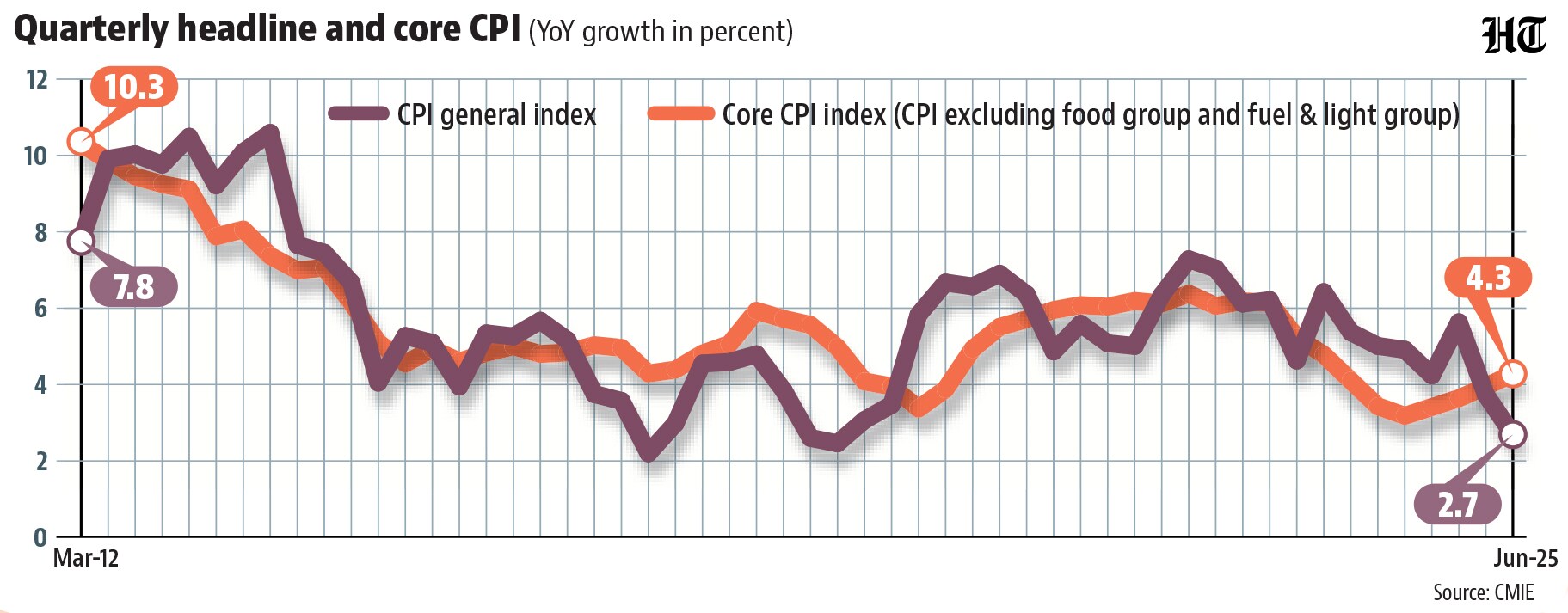
 Core, rather than headline inflation, might be driving RBI’s caution against too much monetary easingWhile RBI has categorically pointed out that it has already frontloaded rate cuts and the transmission is already in progress, its revised inflation forecast of 3.1% for 2025-26, if it were to materialize, will be the lowest annual inflation in the current Consumer Price Index (CPI) series, which starts from 2012-13. Why is RBI not cutting rates more aggressively then? One reason could be the different trajectories of headline and core – non-food non-fuel inflation which is considered to be more immune from seasonal fluctuations – with the latter ending up at 4.3% in the June quarter while the former was just 2.7%. The core versus headline differential was also highlighted in the MPC resolution. To be sure, even the headline inflation environment will turn relatively adverse from the beginning of the next fiscal year. RBI’s inflation forecast for the quarter ending June 2026 is 4.9%, which is above the RBI target of 4%. While the higher inflation number could just be a reflection of an adverse base effect (June 2025 quarter inflation is just 2.7%), RBI will have to be careful about the optics of its inflation management. “Monetary policy has appropriately used the policy space created by the benign inflation outlook to support growth without compromising on the primary objective of price stability”, Governor Sanjay Malhotra said in his post-MPC statement underlining that RBI is still committed to its mandate to control inflation.
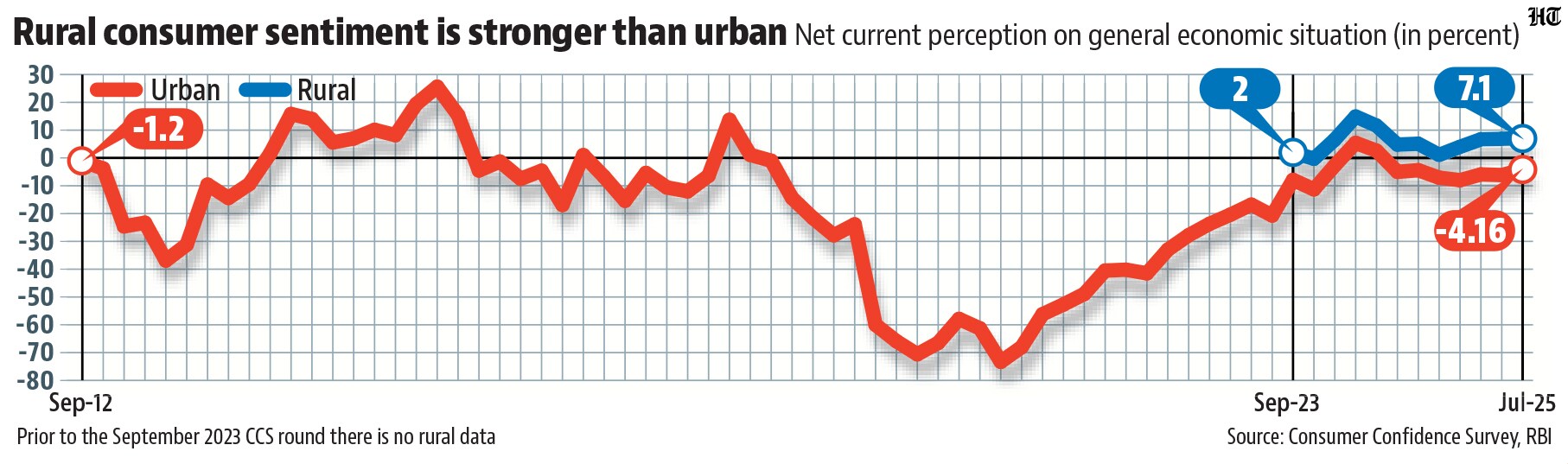
- Consumer sentiment indicators show nascent green shoots in domestic demand, especially in rural areasThat the Indian economy’s headwinds are external and the tailwinds internal has been the prognosis for quite some time now. A good monsoon has further buttressed this idea as agricultural production, and rural incomes, are supposed to do well. That the rural might have a relative advantage vis-à-vis the urban part of the economy is also something which can be seen in RBI’s rural and urban Consumer Confidence Surveys (CCS). The net current sentiment as seen in urban and rural CCS in the latest round was -4.2% and 7.1%. Net current perception is the share of respondents who report an improvement in conditions compared to a year ago. To be sure, even the urban net sentiment has been improving over the last three rounds. At a time when the economy is going to need more support from its domestic growth drivers given the uncertainty surrounding exports, the CCS trends paint an encouraging picture for growth prospects.
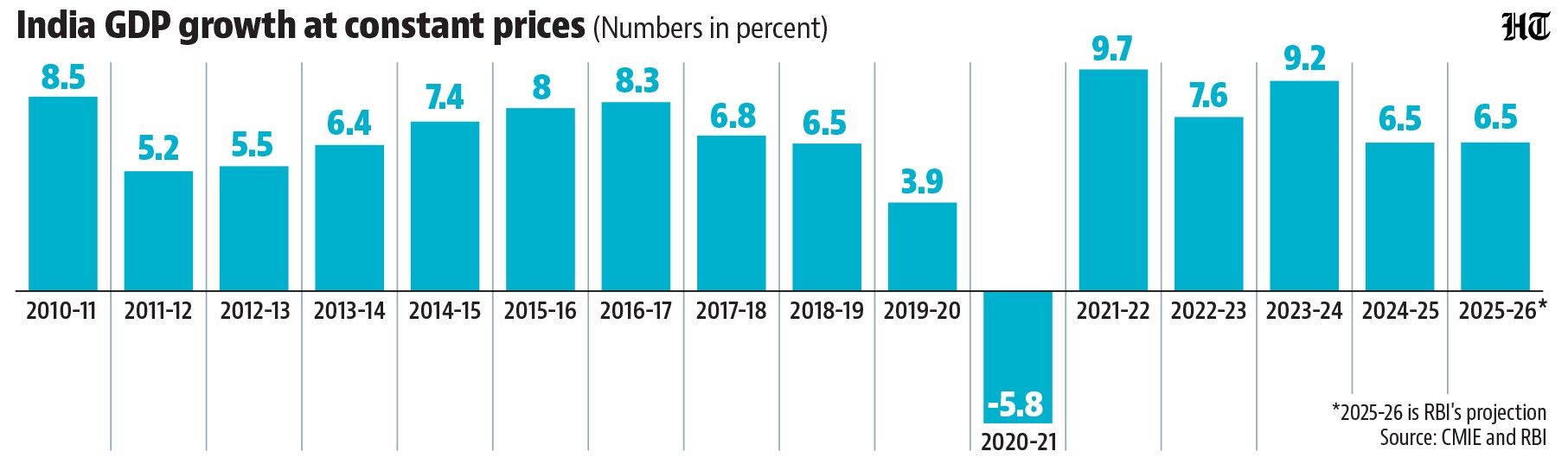
- To be sure, MPC itself has advocated against complacency about growthWhile the MPC resolution and the Governor’s statement rightly touts India’s growth prospects, both in absolute and relative terms, it has also sounded a note of caution in becoming complacent about the existing economic momentum. “Growth is robust and as per earlier projections though below our aspirations”, the MPC resolution said. If India’s GDP growth in 2025-26 were to come in at 6.5% in keeping with the MPC’s latest projection, it would be the same as in 2024-25 but the joint lowest since the pandemic’s contraction in 2020-21. This underlines the challenge of reviving economic momentum after the dissipation of the pandemic’s pent-up demand even as capital spending by the government has likely peaked.
- Monetary easing is not the only or sure-shot way to drive growthGovernor Sanjay Malhotra’s post-MPC statement actually said this in as many words. “As the Indian economy strives to attain its rightful place in the global economy, stronger policy frameworks across domains, and not just limited to monetary policy, will be pivotal in its journey”, his statement said suggesting that the solution to India’s recent or medium-term growth challenges might also lie outside the realm of interest rate cuts or greater liquidity. Experts have read this as a suggestion for either fiscal policy support or targeted reforms.


Unlock a world of Benefits with HT! From insightful newsletters to real-time news alerts and a personalized news feed – it's all here, just a click away! -Login Now!


