
 E-Paper



Number Theory: How did Muslims vote in Delhi this time?
This is not an insignificant share. How did they vote in these elections?
Updated on: Feb 11, 2025, 18:36:13 IST

 Prefer HTon Google
Share via


Copy link

According to the 2011 Census, 12.9% of Delhi’s population was Muslim. Assuming a roughly similar share in the electorate, more than one in ten of the Union territory’s voters are likely to be Muslims. This is not an insignificant share. How did they vote in these elections? Here are four charts that try to answer this question.
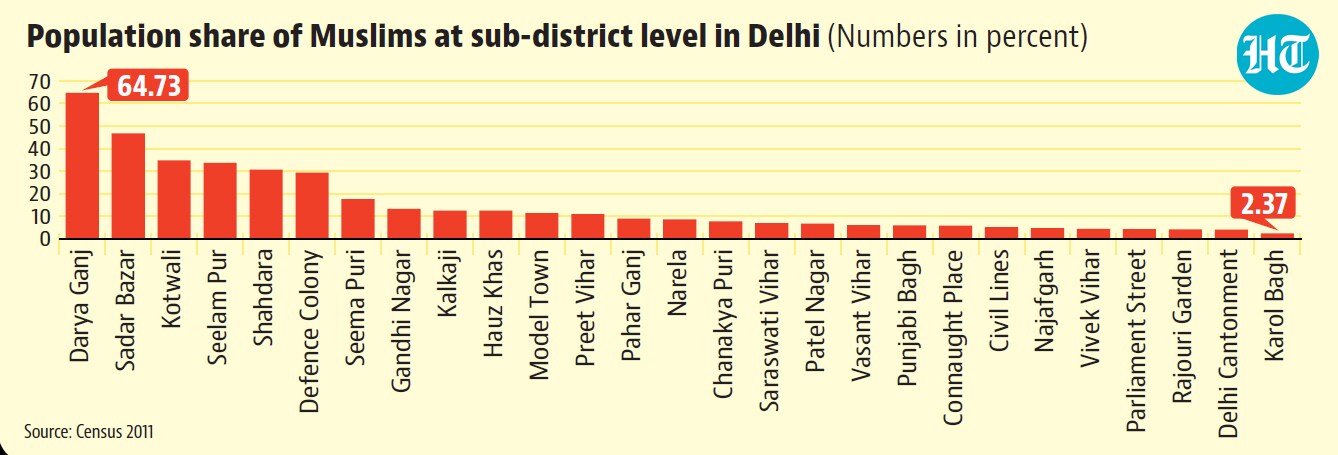
 Muslims are regionally concentrated demography in DelhiDelhi had nine administrative districts in the 2011 Census. The district-wise share of the Muslim population in Delhi shows a large variation. The Central Delhi district (it has large parts of Old Delhi) had a one-third share of Muslims in the total population while South West Delhi had just a 4.9% Muslim population. An analysis at the subdistrict level suggests an even bigger skew. Just eight out of 27 subdistricts, which together accounted for 22% of Delhi’s population, were home to 53.6% of the Muslims living in the city. Since assembly constituency (AC) boundaries do not overlap with district boundaries, this is bound to reflect in the AC-wise presence of Muslim voters too. Unfortunately, there is no way to get religious break-up of population at the AC-level. However, a proxy confirms the geographical skew of Muslim voters. Since 2008 – AC boundaries pre-2008 are not comparable because of delimitation – only five ACs have elected a Muslim MLA at least once. They are Okhla, Mustafabad, Ballimaran, Matia Mahal and Seelampur. Okhla was in the East district in 2011 Census, Mustafabad and Seelampur were in North-East district, and Ballimaran and Matia Mahal were in the Central district. It is reasonable to assume that major political parties field Muslim candidates in these ACs in keeping with the higher presence of Muslims in the electorate. For our analysis, we will call them Muslim-dominated ACs and the remaining 65 ACs in Delhi non-Muslim-dominated. See chart 1: Subdistrict-wise share of Muslim population in Delhi
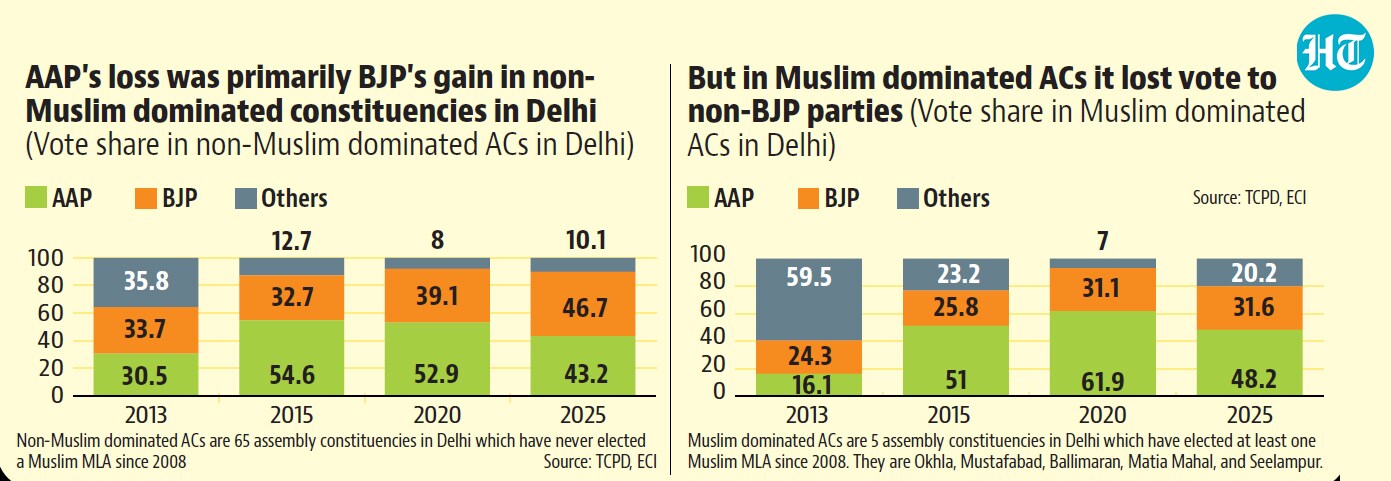
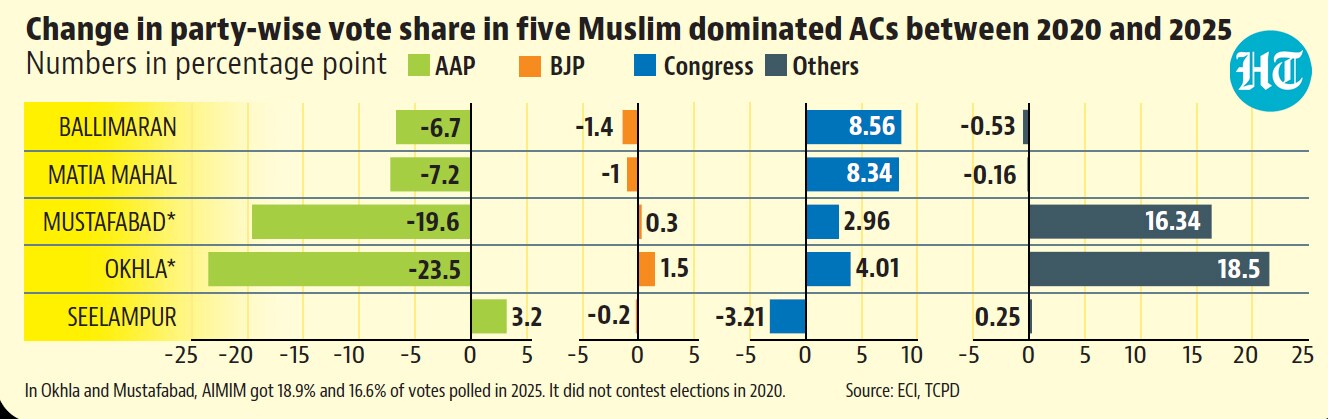
- AAP’s vote share has fallen more in Muslim-dominated ACs but it is still higher than what it is in non-Muslim-dominated ACsThe AAP’s total vote share has fallen by 10 percentage points (53.6% to 43.6%) between 2020 and 2025 assembly elections. The fall in its vote share in Muslim-dominated ACs (13 percentage points) is higher than the remaining 65 ACs (10 percentage points). However, its average vote share in Muslim-dominated ACs is still a formidable 49%, which is why it has won four of these five ACs. The AAP has lost votes to non-BJP parties in the Muslim-dominated ACs, unlike other ACs where the BJP is the prime beneficiary of AAP losing support. Even within Muslim-dominated ACs, there is a story to be told A large reason for the fall in the AAP’s vote share in the five Muslim-dominated ACs is its performance in the ACs outside the Walled City in Old Delhi. In the two Muslim-dominated ACs in the Walled City – Ballimaran and Matia Mahal -- the AAP’s vote share has fallen by just 6.9 percentage points between 2020 and 2025. In the remaining three ACs – Okhla, Seelampur and Mustafabad-- its combined vote share has fallen by almost double that number at 15.8 percentage points. The fall is the highest in the Okhla AC where it has come down from 66% in 2020 to 42.5% in 2025. Even in these three ACs, the BJP’s vote share largely remained unchanged compared to the 2020 elections, suggesting that the AAP’s vote-share fall is driven by fewer votes from Muslims.
- What explains this divergence in AAP’s performance in Muslim-dominated ACs in the Walled City and outside?Two out of the five Muslim-dominated ACs where the AAP has suffered the biggest fall in its vote share -- Okhla and Mustafabad -- were the respective sites of large anti-CAA protests and the 2020 communal riots in Delhi. The AAP was seen as having reneged on the concerns of Muslims during both the anti-CAA agitation and in the aftermath of riots. It was this alienation that was exploited by the AIMIM. To be sure, the AAP should not be surprised at the large erosion in its vote share in these two ACs -- it did not win even one Muslim-dominated ward (where the winning candidate was a Muslim) in these two ACs in the 2022 MCD elections



Unlock a world of Benefits with HT! From insightful newsletters to real-time news alerts and a personalized news feed – it's all here, just a click away! -Login Now!


