E-Paper



Number Theory: The caste calculus of NDA and INDIA in Uttar Pradesh
Have the NDA and the INDIA bloc fielded candidates from the same or different caste category/castes in parliamentary constituencies?

 Prefer HTon Google


Uttar Pradesh is India’s most populous state and sends 80 members to the Lok Sabha. With the Bahujan Samaj Party being reduced to just one MLA in the 2022 assembly elections, the main contest in the state is likely to be between the Bharatiya Janata Party (BJP)-led National Democratic Alliance (NDA) and the Samajwadi Party (SP)-led Indian National Developmental Inclusive Alliance (INDIA). Caste has always been an important factor in Uttar Pradesh’s politics. The BJP is contesting 75 parliamentary constituencies (PCs) while the remaining five PCs are being contested by its allies. The SP is contesting 62 PCs, while its allies Congress and Trinamool Congress are contesting 17 and 1 respectively.
What is the caste strategy of the two major blocks in these elections? HT has matched the caste of all 80 candidates from these two alliances to try and answer this question. Here is what the data shows.
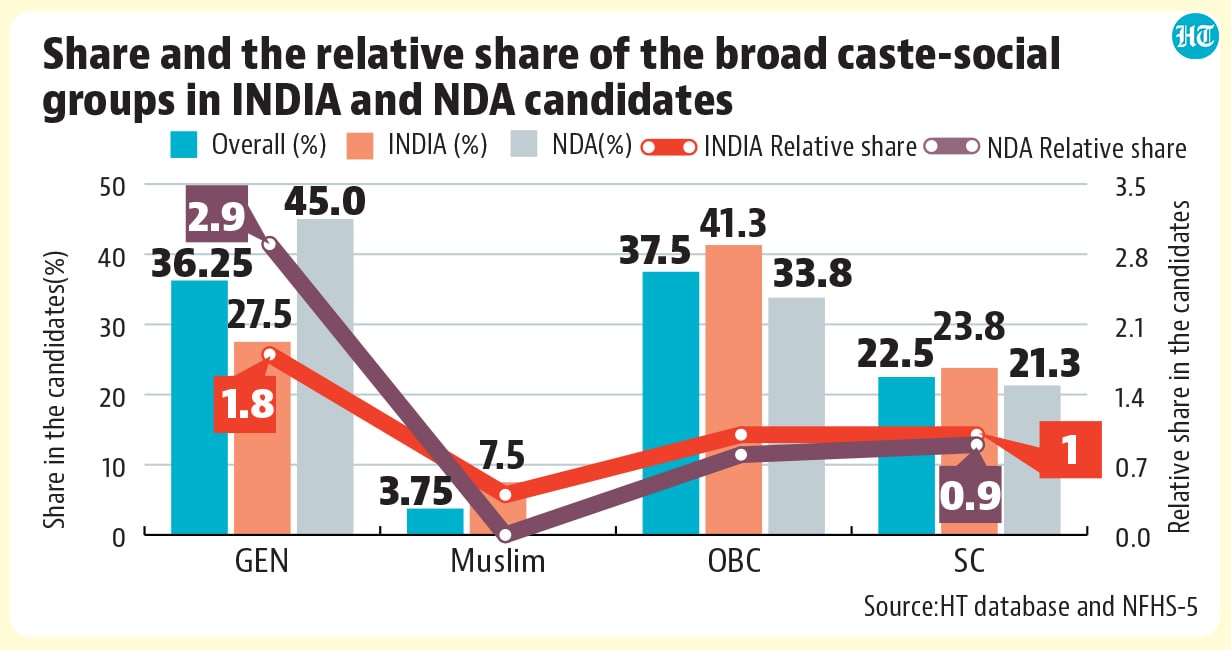
 ‘Upper caste’ Hindus have a disproportionately large share among candidates thanks to the BJPWhat is the broad social classification of the 160 candidates from the BJP and SP-led alliances? Sixty belong to other backward classes (OBCs), 58 are from “upper caste” groups, 36 from the Scheduled Castes (SC), and six are Muslims. If one compares these numbers with the broad social composition of Uttar Pradesh from the 2019-21 National Family Health Survey (NFHS), the relative share – share in number of candidates divided by share in population – is the highest for the upper castes (general category) among the four broad groups described here. The disproportionate advantage to the upper castes is largely a result of the BJP’s candidate selection: 45% of its candidates are upper castes compared to just 27.5% for the SP-led alliance.
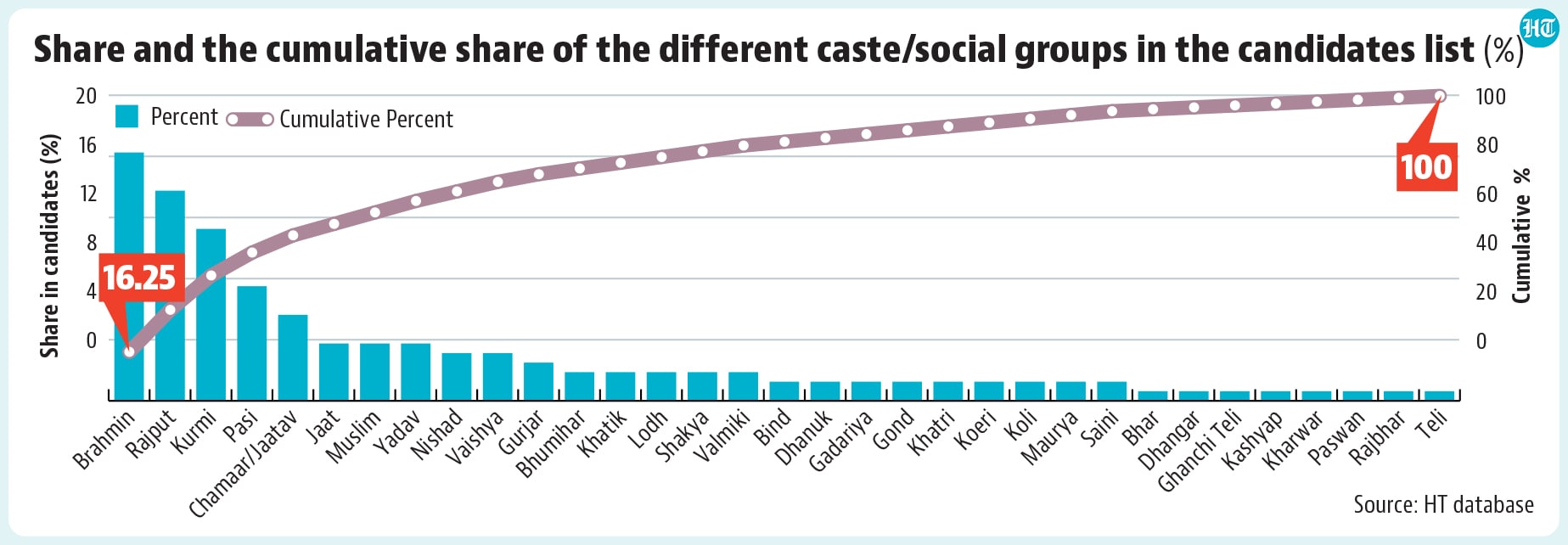
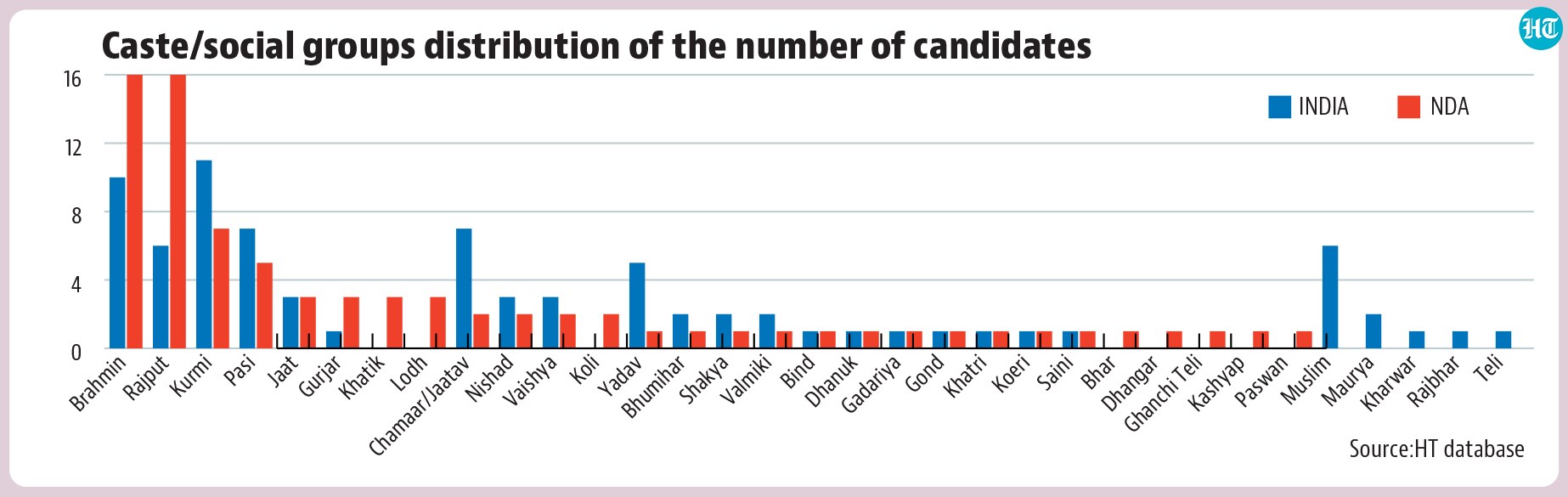
- Just four castes account for almost half of the BJP and SP alliance candidates in Uttar PradeshBrahmins (26), Rajputs (22), Kurmis (18) and Pasis (12) top the caste-wise list in the state. No other caste group has candidates running into double digits. This also holds true for Muslims whose share in the state’s population is close to 20%. Just eight caste and religious groups account for two-thirds of the 160 candidates fielded by the two major alliances in the state. What is remarkable about the caste-wise break-up of candidates in Uttar Pradesh is that Yadavs have a lower than expected representation in the candidate list of both major alliances. Out of the six Yadavs contesting from the SP and the BJP alliances, five are from the SP and they are all part of the Mulayam Singh Yadav family. The only Yadav contesting from the BJP is Dinesh Lal Yadav alias Nirahua, who is contesting from Azamgarh The share of Yadavs in the SP’s candidate list is much lower than what it is for the RJD in the neighbouring state of Bihar. The RJD has fielded Yadavs in 9 of the 23 PCs it is contesting in that state.
- Distribution of castes in the BJP and the SP candidate listsThe BJP has fielded 16 candidates each from the Brahmin and Rajput castes. Additionally, there are six Kurmi caste candidates and five candidates from the Pasi caste, which falls under the SC category. In total, the BJP list includes representatives from 27 different castes across 75 candidates. On the other hand, the SP has the highest number of candidates from the Kurmi caste with 10, followed by 7 Pasi candidates and 6 Jatav candidates from the list of 62 candidates, representing a total of 23 different castes. The SP has fielded five Brahmin and four Muslim candidates.
- There is a regional difference in the distribution of the caste categoriesTrivedi Centre for Political Data classifies Uttar Pradesh into seven subregions-- Avadh, Bundelkhand, Doab, East UP, North-East, Ruhelkhand, and West UP. In the Avadh region, “upper castes” have a share of 43% out of a total of 28 candidates from the region. They also have the highest share in Bundelkhand at 50%. OBCs have the maximum share in the Ruhelkhand region at 50% followed by Doab where they account for 46.4% of the candidates. Of the 6 Muslim candidates, one is contesting in the East UP while rest 5 are in the fray in the western part of the state.
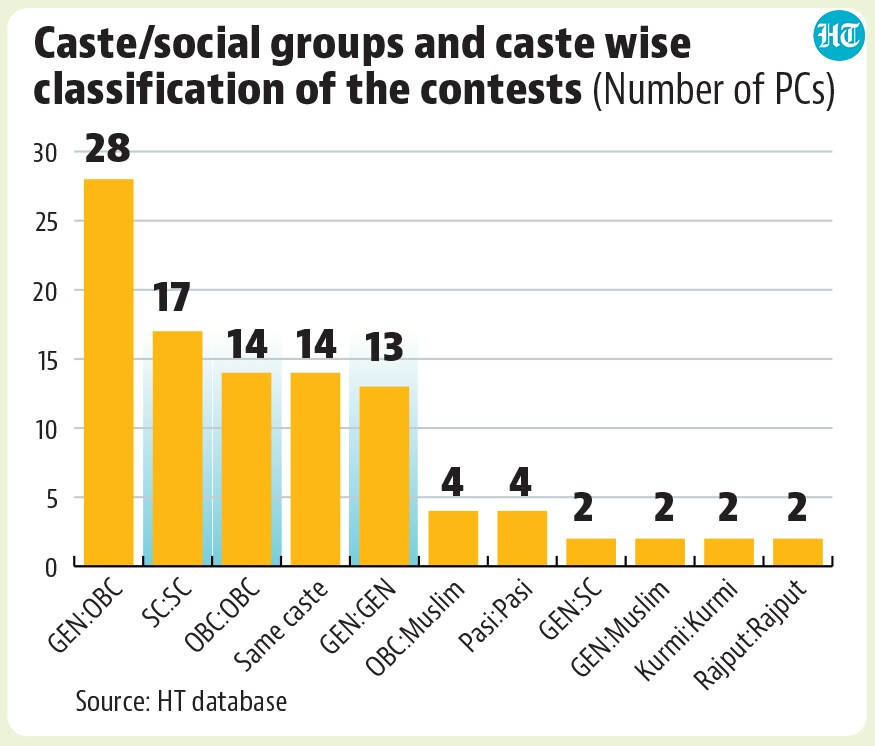
- What is the caste equation at the constituency level?Have the NDA and the INDIA bloc fielded candidates from the same or different caste category/castes at the level of the parliamentary constituencies (PCs)? The former would indicate the numerical preponderance of a particular caste group at the PC level while the latter indicates an effort to exploit caste fault lines. Only 14 out of 80 PCs are seeing a contest between the same caste candidates. If one looks at the contests between the caste groups -- upper castes, OBC, SC, and Muslims -- the number of constituencies having the contest between the same caste groups increases to 44. Upper caste candidates are pitted against each other in 13 PCs whereas OBC candidates are contesting against each other in 14 PCs.