
 E-Paper



Problematics | Playing cards, words and a classroom game
Have you ever created something, like a poem or a word game, only to find that someone else has created something similar? This week's puzzles are one of those.

 Prefer HTon Google


You may have gone through this before. You create something that you think is an original work of art — such as a poem, a word game or a puzzle — only to find that someone else had written a similar poem or created the same game or puzzle years earlier. This has happened to me a few times with puzzles I thought I had invented.
One such puzzle is among the best in my collection. I came across it for the first time in a form that uses words, which I adapted into a form that uses playing cards. At that time, I thought it my exclusive version; It was several years before I found the very same card version in a book of puzzles.
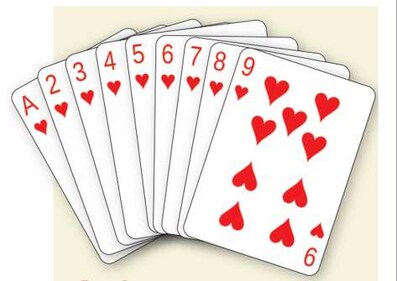
In this form, the puzzle requires the cards Ace to 9 (both inclusive). Although the illustration uses all hearts, the suits don’t matter.
In the word version too, you need nine of them. I don’t remember the exact nine words I saw the first time, so I have made my own list today:
BAIT CREW DIVE FORT LION MASH OPUS RANK SENT
It’s in the form of a game. So, let’s play.
I select a word, you select another, I select a third, and so on, until either of us has any three words with one common letter, thus winning the game. If neither player achieves that after all nine words are exhausted, the game is a draw.
Say, I select BAIT first, and you then select DIVE.
Next, say, I select RANK. You notice I have a common A in BAIT and RANK. To block my third A, you take away MASH.
My third move, FORT, leaves you in a fix. You may take away CREW to block a common R with my RANK and FORT. If you do that, I will select SENT, which will give me a common T with BAIT and FORT. On the other hand, if, after my FORT, you take away SENT to block my Ts, I will pick up CREW for an R-triplet.
Obviously, your first move was wrong. After I took BAIT at first, what word should you have taken to ensure I wouldn’t win? Do explain the reasons and strategies.
| #Puzzle 24.2: |
In the card version, you and I select cards from the given set, one by one. The aim is to get any three cards totalling exactly 15 (Ace = 1) or to block the other player from doing so. At school, all of us played a simple pen-and-paper game when teacher wasn’t looking. The principle behind that game also works with the words and the cards. Arrange the nine words and the nine cards in separate layouts, each of which recalls that game. |
| Mailbox: Last week’s solvers: |
#Puzzle 23.1, Hello, Let’s number the coins #1 #2 #3 Strategy A: Flip #1, Flip #2, Flip #1 again At most by the third flip, all coins will be either TTT or HHH. This is not a MINIMUM, rather a MAXIMUM number of moves*. Strategy B (coins must be HHH only): Begin with strategy A as above. If #3 is already H, then your friend will stop you in a maximum of 3 flips (see strategy A above). If, however, after 3 flips, HHH it is still not achieved, it means #3 is T. So then NOW flip #3 coin. Then repeat Strategy A for a maximum 3 flips. This will achieve the end result in a maximum of (3 + 1 + 3) = 7 flips That’s it! — Rohit Khanna, Noida |
| *It’s not maximum, Rohit. What I meant was the minimum number of moves necessary to guarantee success. You may get it in fewer moves, but there’s no guarantee. Your answer is correct, though.* |
#Puzzle 23.2: Hi Kabir, We have the three glasses placed in the sequence as 'Up Down Up', numbered 1,2,3. To get all glasses heads down with three moves flipping two glasses at a time, the sequence of moves is 12,13,12 — Amardeep Singh, Meerut |
| Solved both puzzles: Rohit Khanna (Noida), Amardeep Singh (Meerut), Nishant Iyengar (Faridabad), Sunita & Naresh Dhillon (Gurgaon), Gopal Menon (Mumbai), Jasvinder Singh (Nabha) |
| Apart from solving #Puzzle 23.2, most of the following (there are just about a couple of exceptions) who have also got the first part of #Puzzle 23.1 correct: |
| #Solved Puzzle 23.2: Dipak Sarin (Gurgaon), Angad Singh, Abhishek Anand (Delhi), Joy Pandya (Mumbai), Aditya Sood (Delhi), Vidhi Jain (Zakir Hussain Delhi College), Sumanyu Aggarwal (Delhi), Vasu Handa (Sonipat), Shivangi (Gurgaon), Yojit Manral (Faridabad), Madhuri Patwardhan (Thane), Dr G L Arora (Delhi), Sanjay Gupta (Delhi), Rina Kumari (Noida Extension), Shishir Gupta (Indore), Ravi Sondhi & Rudra Sondhi (Gurgaon), Lucky Singh Randhawa (Delhi), Jaikumar Inder Bhatia (Ulhasnagar, Thane) |
| Apologies to Dr Nakul Makkar for missing his name in the acknowledgements last week. |
Problematics will be back next week. Please send in your replies by Friday noon to problematics@hindustantimes.com


