
 E-Paper



Problematics | Surviving Russian roulette
A revolver is loaded with two bullets and the cylinder is spun at certain times. How likely is our shooter to survive?

 Prefer HTon Google


One of my most satisfying original puzzles involves Gabbar Singh’s revolver, and regular readers might remember it from 2023 when I ran it to mark the 50th episode of Problematics. We established that the bandit from Sholay is a fine probability theorist. He is, however, not the only one from cinema.
A much more harrowing scene with a partly loaded revolver features in the Oscar-winning 1978 film The Deer Hunter. Unlike Gabbar’s unfortunate victims, the characters in The Deer Hunter willingly take a chance with death. They play Russian roulette, with one out of the revolver’s six chambers loaded with a bullet, and players alternately place the weapon on their own temple and pull the trigger. Viewers will never forget the climactic showdown between Mike (Robert De Niro) and Nick (Christopher Walken).
The following puzzle lies somewhere in between the situations depicted in The Deer Hunter (one bullet among six chambers) and Sholay (three consecutive bullets). Here, two of the six chambers are loaded. I came across this puzzle in Mukul Sharma’s Mindsport, and I don’t know if he thought it up himself or borrowed the idea from another puzzler’s works.
#Puzzle 213.1
A drunk mathematician tests his knowledge of probability by playing a solo game of Russian roulette. He inserts two bullets into his revolver, spins the cylinder, and pulls the trigger twice on himself. There is no money to win, but the man is not only drunk but also a lover of adventure.
Take four different situations.
(a) The mathematician loads one bullet, spins the cylinder, loads a second bullet into the chamber that is now under the hammer, and spins the cylinder again. Placing the revolver on his temple, he pulls the trigger. If he survives, he spins the cylinder again and fires on himself a second time.
(b) He loads the first bullet, spins the cylinder, loads a second bullet into a new chamber, and spins the cylinder again. He then fires one shot on his temple. If it proves to be a blank shot, he fires a second shot without rotating the cylinder again.
(c) He loads the first bullet, and then, without spinning, loads the second in the next chamber. Only now does the man spin the cylinder. He then fires one shot on his temple. If he survives, he spins the cylinder again and fires on himself a second time.
(d) As in the previous case, the mathematician loads two bullets in consecutive chambers, then spins the cylinder. He then fires one shot at himself, and if he survives, fires a second shot without spinning the cylinder.
What is the probability of survival in each situation?
#Puzzle 213.2
This is a throwback to the time when we didn’t have the internet: a game we played at college that can easily become a puzzle. Take the 10-letter word CONDIMENTS. Now form 10 words, the first beginning with C, the second with O, the third with N and so on. You can only use letters present in the existing word. Because N appears twice, you may use N twice in any word (or just once if it’s more useful, or never). But the other letters cannot be used more than once in any word.
The idea is to form words that are as long as possible. With C, if you form COME, you score 4 points for the 4 letters, but CITES gives you 5 points and CONNED gives you 6. Each word must be at least 3 letters long. You can form 10-letter words if they are there to be formed, but you obviously cannot form CONDIMENTS from CONDIMENTS and claim 10 points. You will need to form two different words beginning with N, of course.
What is the best total score you can manage with your 10 words?
MAILBOX: LAST WEEK’S SOLVERS
#Puzzle 212.1
Hello Kabir,
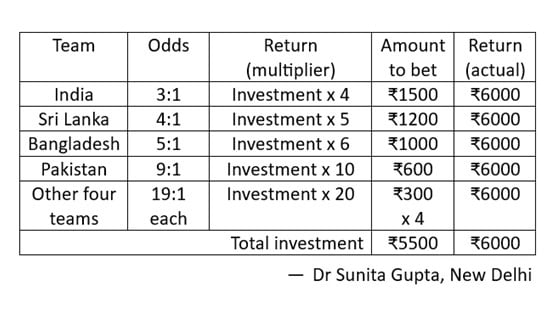
The total amount invested is ₹5500. No matter which team wins, the better will get an assured return of ₹6000, a profit of ₹500. The breakup is as shown in the table.
I found that there is a formula to calculate this, and it is called the Dutching system. First, take the returns on the eight teams — India (3:1 = investment x 4); Sri Lanka (4:1 = investment x 5); Bangladesh (5:1 = investment x 6); Pakistan (9:1 = investment x 10); Remaining four teams (each 19:1 = investment x 20).
The sum of the reciprocals of these return multipliers is = 1/4 + 1/5 + 1/6 + 1/10 + (1/20 x 4) = 55/60
The formula is
Total investment = (Desired profit x above sum)/(1 – sum)
= ( ₹500 x 55/60)/(5/60) = ₹5500
That means the better has to stake ₹5500 and win ₹6000. To collect ₹6000 irrespective of which team is the winner, the bets have to be ₹6000/4 = ₹1500 on India, ₹6000/5 = ₹1200 on Sri Lanka, ₹6000/6 = ₹1000 on Bangladesh, ₹6000/10 = ₹600 on Pakistan, and ₹6000/20 = ₹300 on each of Teams 5-8. The total amount invested is ₹1500 + ₹1200 + ₹1000 + ₹600 + (4 x ₹300) = ₹5500.
— Dr Sunita Gupta, New Delhi
Dr Gupta’s formula is indeed elegant. It is not difficult to understand where it comes from. If R is the total desired return (in rupees), and x is the return multiplier on any team (as determined by the odds), your bet on that team should be = R (1/x). This gives your total investment as:
R x [1/4 + 1/5 + 1/6 + 1/10 + (1/20 x 4)] = R (55/60)
Your targeted profit is therefore R – R (55/60) or R (1 – 55/60)
The rest of the formula follows from there.
This method of splitting your bets across multiple contenders, aimed at a fixed return, is called Dutching, as Dr Gupta notes. Dedicated betters know of this, but they can never pull off a heist because bookies know it too. In actual betting, you will never get odds as promising as those I imagined for this puzzle. Bookies design the odds in a way that betting on all teams (or horses) will never give anyone a profit.
#Puzzle 212.2
Hi Kabir,
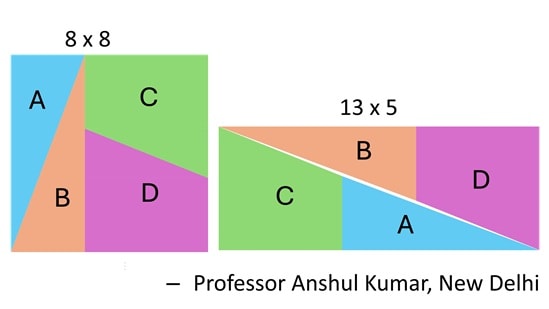
The slope of the boundary between the triangles A and B is not the same as that between the trapezoids C and D. Therefore, the shapes A, B, C and D cannot abut one another as shown in the figure on the right, implying that this figure is illusive. If the four shapes are drawn accurately as per the orientations given in the figure on the right, these will look as shown in the figure. As can be seen, a gap in the shape of a thin parallelogram shape lies in between. This gap has an area of 1 unit, accounting for the difference between 13 x 5 and 8 x 8.
— Professor Anshul Kumar, New Delhi
Solved both puzzles: Dr Sunita Gupta (Delhi), Professor Anshul Kumar (Delhi), Yadvendra Somra (Sonipat), Shishir Gupta (Indore), Kanwarjit Singh (Chief Commissioner of Income-tax, retired)
Solved #Puzzle 212.1: Amarpreet (Delhi)
Problematics will be back next week. Please send in your replies by Friday noon to problematics@hindustantimes.com


