E-Paper



Refocusing mid-day meals: What children really need | Number Theory
Introducing eggs in the meal is an effective way of improving nutritional quality and appeal of the scheme.

 Prefer HTon Google


Over the last week, government school students in Uttar Pradesh, Rajasthan and Bihar came out in protest, asking for better facilities. In addition to poor infrastructure and shortage of teachers, mid-day meals (MDM) are an important aspect of government school education in India. Following Supreme Court orders in 2001, hot cooked meals for children up to Class 8 across government and aided schools were expanded to the entire country. The MDM is a legal entitlement under the National Food Security Act (NFSA). Evidence shows that it protects against hunger, boosts enrolment and attendance, provides relief to mothers and improves nutritional outcomes. Over 110 million children across 1.2 million schools are covered under the scheme, providing employment to 2.5 million cooks and helpers, mostly women.
MDM however, does not get enough public attention, and concerns related to implementation and quality remain. It is in the news only when there is a controversy over serving eggs or when cases of food poisoning occur. MDM can be expanded creatively to address the continuing burden of malnutrition, poor dietary diversity and high anaemia among children. A proposal costing ₹4,000 crores to introduce breakfast in MDM by the education ministry, as recommended by parliamentary panels and the new National Education Policy (NEP) was rejected by the finance ministry a few years back. The state governments of Assam, Gujarat, Karnataka, Tamil Nadu and Telangana have started providing breakfast on their own.
With increasing enrolment in secondary and senior secondary classes, Andhra Pradesh, Karnataka, Tamil Nadu, Telangana, Lakshadweep and Puducherry have also extended beyond class 8. Expanding such initiatives nationally can have lasting benefits at a low cost. Here is a brief overview of what can be done to make MDM more effective.
Dipa Sinha and Bhargav BS are affiliated with the Centre for the Study of the Indian Economy, Azim Premji University. Views expressed are those of the authors and do not necessarily reflect the views of the University or its affiliates.
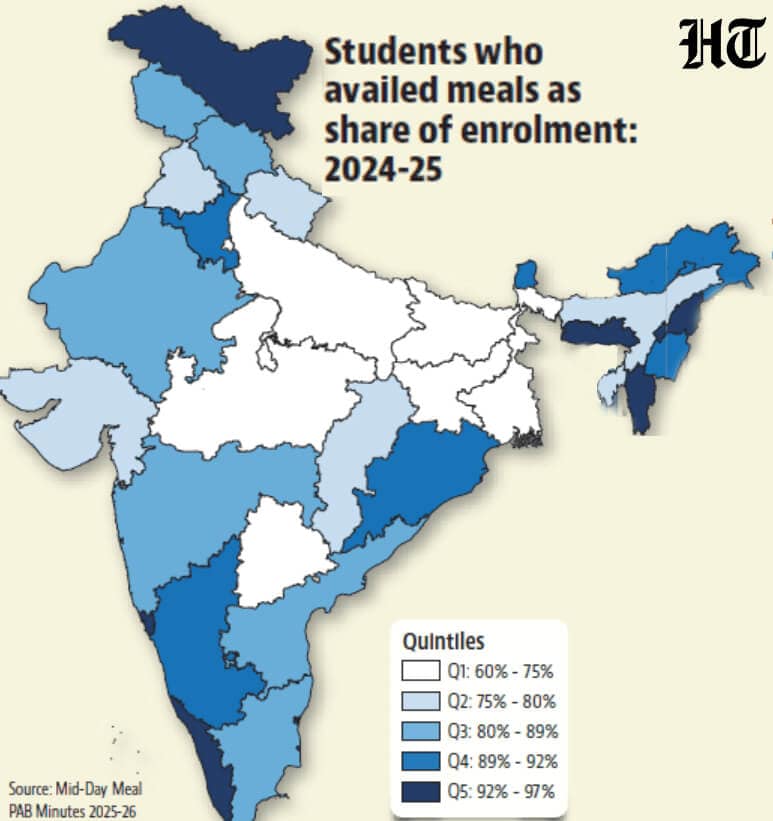
 Universal on paper, but MDM coverage varies across statesWhile MDM is a universal scheme covering all children in eligible schools, nationally only 76.2% of enrolled children are being served. The coverage is uneven across states, with Goa having the highest coverage of 97% and Bihar the lowest with 60%. What explains this large variation? A thorough evaluation is required, but anecdotal evidence suggests that this gap could be due to a combination of inflated enrolment figures and some better-off children opting out of the scheme because of quality concerns.
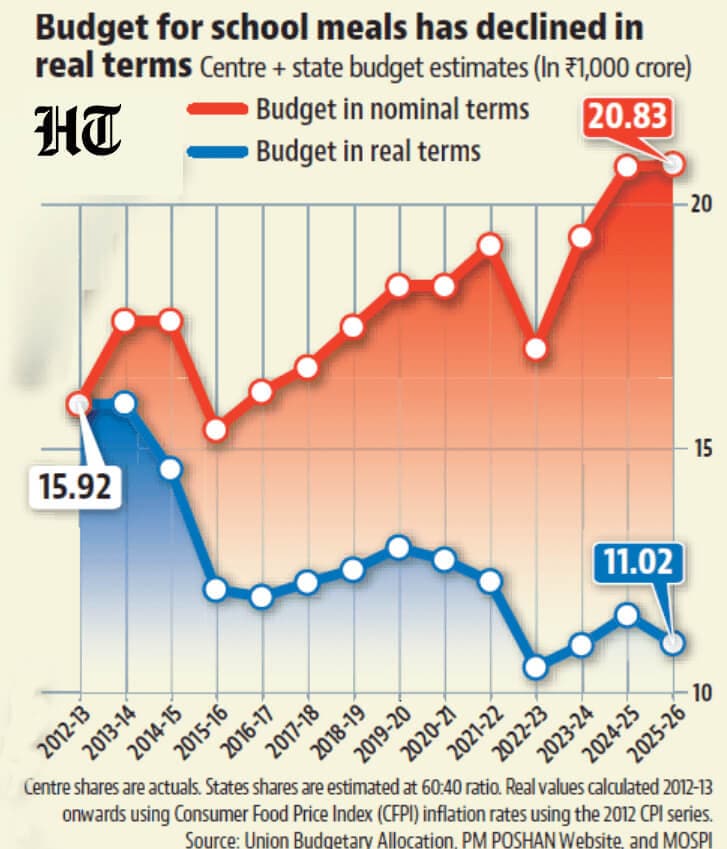
- MDM also has a funds problemOne of the reasons for quality concerns regarding MDM is that the scheme is under-funded. This is despite the fact that MDM is one of the rare schemes where the principle of inflation-indexing is built in. Reasons are manifold. The base costs have not been revised since 2009. The cost-sharing norms were revised in 2015, reducing the contribution of the union government from 75% to 60% of the cooking costs. Estimating allocations by states (at 40% of central allocations) and then doing an inflation adjustment using Consumer Food Price Index, one can see a decline 30% in real MDM allocations between 2012-13 and 2025-26. With increasing GDP and growing recognition of the nutritional challenge, we should be giving greater priority to the scheme; what we see is lower real allocations, which affect the quality and regularity of the scheme.
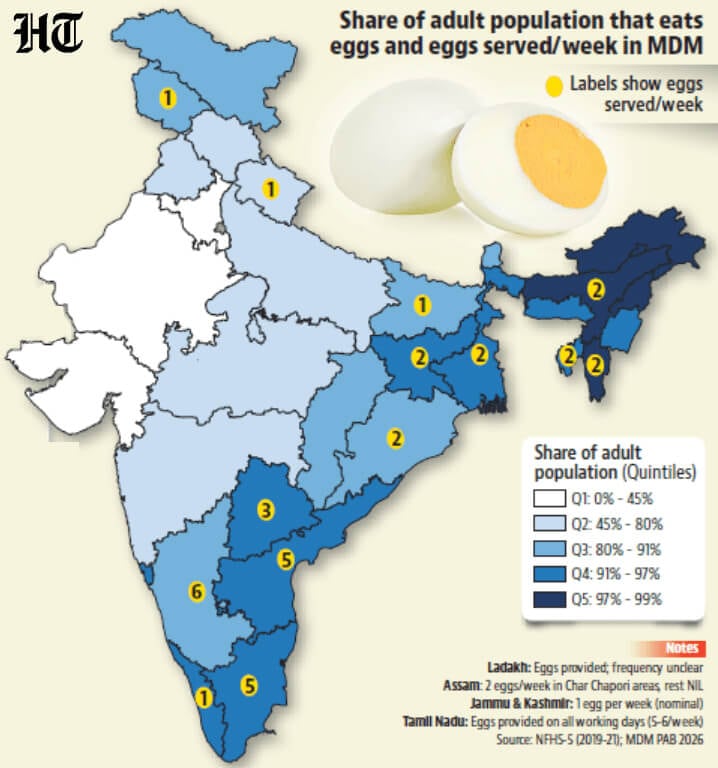
- The debate on eggs is more fiscal than culturalIntroducing eggs in the meal is an effective way of improving nutritional quality and appeal of the scheme. Eggs are a complete protein source, highly bioavailable, cost-effective, and logistically feasible. Barring religious opposition from a small minority, the bigger constraint is cost. While the richer southern states now provide 4-6 eggs a week in their school meals, the poorer states such as Bihar and Jharkhand give only 1 or 2 a week (Figure 3). Over 80% of the adult population in most states is non-vegetarian. Further, across the country, the vegetarian population is also typically upper caste and less likely to be in government schools. Rather than debate cultural objections, a red herring, the real constraint is the finances that can be addressed by raising cost norms. Currently, the cost is about ₹6 per egg. We can surely afford that for the children of this country who continue to be undernourished.