E-Paper



The caste inequality in India’s executive | Number Theory
.

 Prefer HTon Google


If there is one thing which has been vindicated once again by the Narendra Modi government’s decision to include a caste count with the next census, it is that democratic pressures have an important role in shaping policy on caste in India. From the provision of reservations for Scheduled Castes (SC) and Scheduled Tribes (ST) in legislatures and government jobs to post-independence democratic assertion for expanding the net of affirmative action to backward classes -- it eventually culminated in the creation of the Other Backward Class (OBC) category and reservations for them -- politics has always been the vanguard of affirmative action or what’s also called social justice in India. That the demand for a caste census is tied to the objective of making OBC quota proportionate with their population share should not be a surprise, given this history.

While caste is a major driver of inequality in income and employment in India, Indian democracy, given its universal franchise principle, is the least susceptible to caste-privilege in principle and should actually be tilted in favour of OBCs given their largest share in the population. HT has looked at two of its in-house databases; that of Union Council of Ministers and chief ministers, to assess caste inequality in Indian executive. Here is what the data shows.
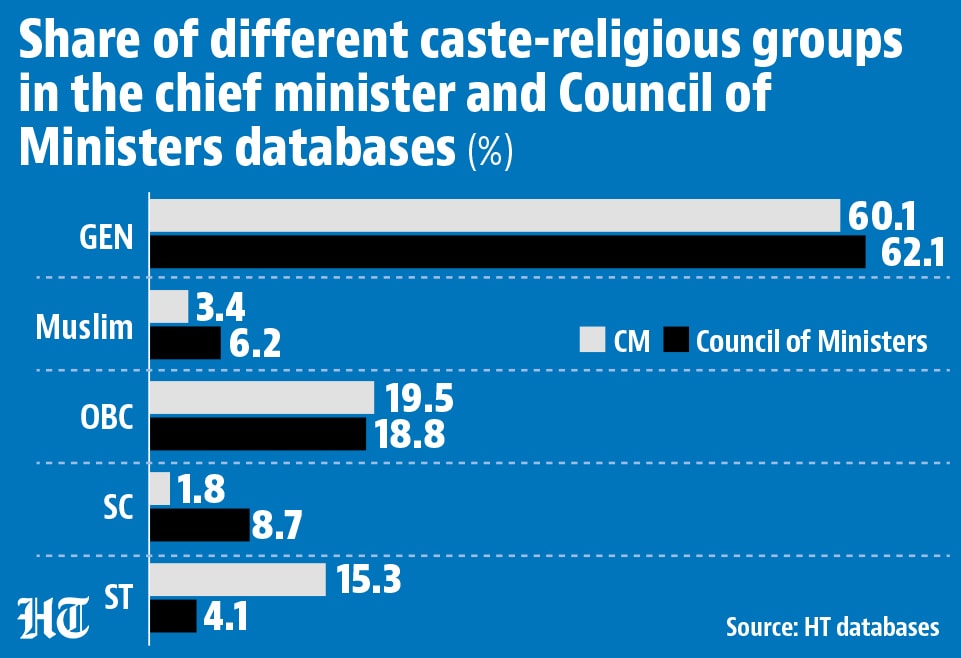
 Non-SC-ST-OBCs or so-called upper castes account for a majority of India’s chief ministers and council of ministersHT’s chief minister and council of ministers database has 708 and 3349 persons. 426 (60%) and 2079 (62%) persons in these two databases belong to groups which are not SC, ST or OBC. Given the fact that the population share of the non-SC-ST-OBC population is less than one-fourth at the national level, this does underline the existence of caste inequality even in the executive. OBCs are ranked second in terms of share in both these databases, while SCs have a slightly better representation in the council of ministers’ database than the chief ministers’ one. It needs to be underlined that while SCs and STs have always had a reservation in the legislative, no such provision exists for OBCs. To be sure, there is no reservation for either in the executive.
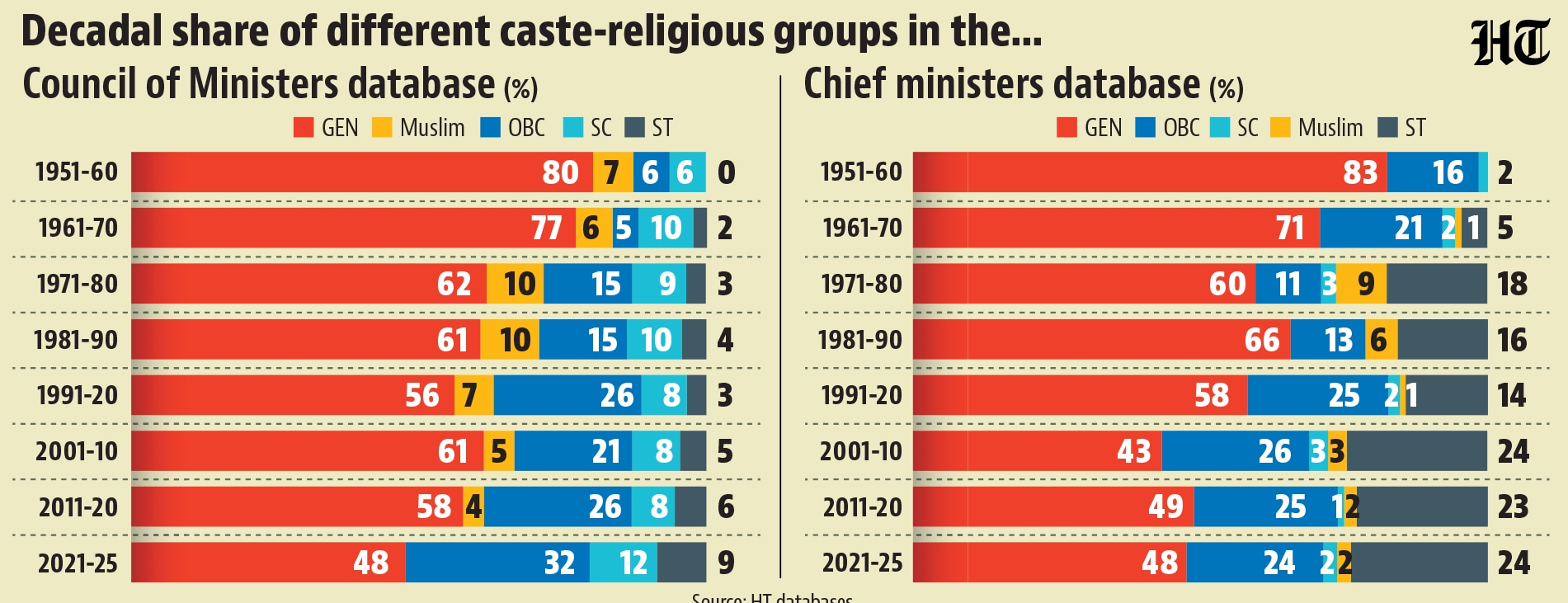
- The number of OBCs among chief ministers and council of ministers has increased overtimeA temporal classification of the data shows that social equality has been rising in India’s top executive and the trend has been primarily driven by a rising representation of OBCs. For example, the share of OBC chief ministers rarely crossed 20% in the pre-1990 period and it has hardly gone below that mark in the period after that. Almost a similar trend can be seen in the council of ministers database. Given the fact that SCs and STs do not show a similar rise in their share in both these databases, it can be said that political assertion has worked better for OBCs than other marginalized groups in India.
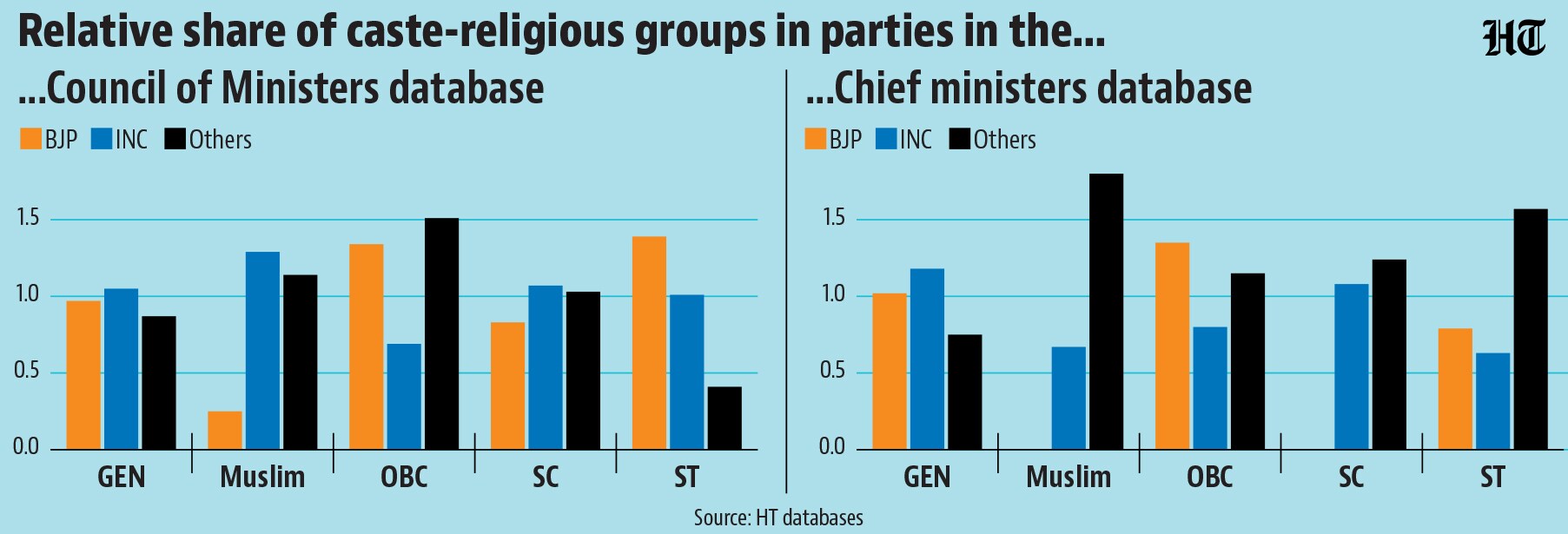
- BJP does better than the Congress in terms of OBC representation, Congress does better in SC representationWhat is the track record of political parties in caste-wise representation in the executive? HT has looked at relative share of three broad party groups; Congress, Bharatiya Janata Party (BJP) and others to answer this question. The relative share of a social group for a party has been calculated by a dividing the share of a particular social group in a given party by the share of that social group in the overall database. A relative share greater than one will mean that a particular social group has a higher representation in that party. Non-SC-ST-OBCs have an almost proportionate representation in the BJP and a higher than proportionate representation in the Congress. The Congress has had a lower than proportionate representation for OBCs and higher than proportionate representation for SCs, while the situation is the other way round for the BJP. To be sure, it needs to be kept in mind that the BJP did not exist as a political party when Indian politics was most upper caste dominated.