
 E-Paper



Why trade matters for India's economy | Number Theory
.
Updated on: Aug 18, 2025, 10:03:12 IST

 Prefer HTon Google
Share via


Copy link

India’s recent trade tensions with the US and the gradual but steadily rising protectionist tide in the advanced economies has raised questions about the viability of exports as a driver of India’s economic growth. While India is often not considered an export success story in the recent past, especially in comparison to countries such as China and even smaller economies in south-east Asia, exports or trade as a whole are far from insignificant in India’s macroeconomy. This two-part series will lay down some stylised facts around India’s exports and put them in the larger context. The first part will look at the importance of trade in India’s overall economy and the second will look at the country’s exports and imports in detail.
Why trade matters for India's economy
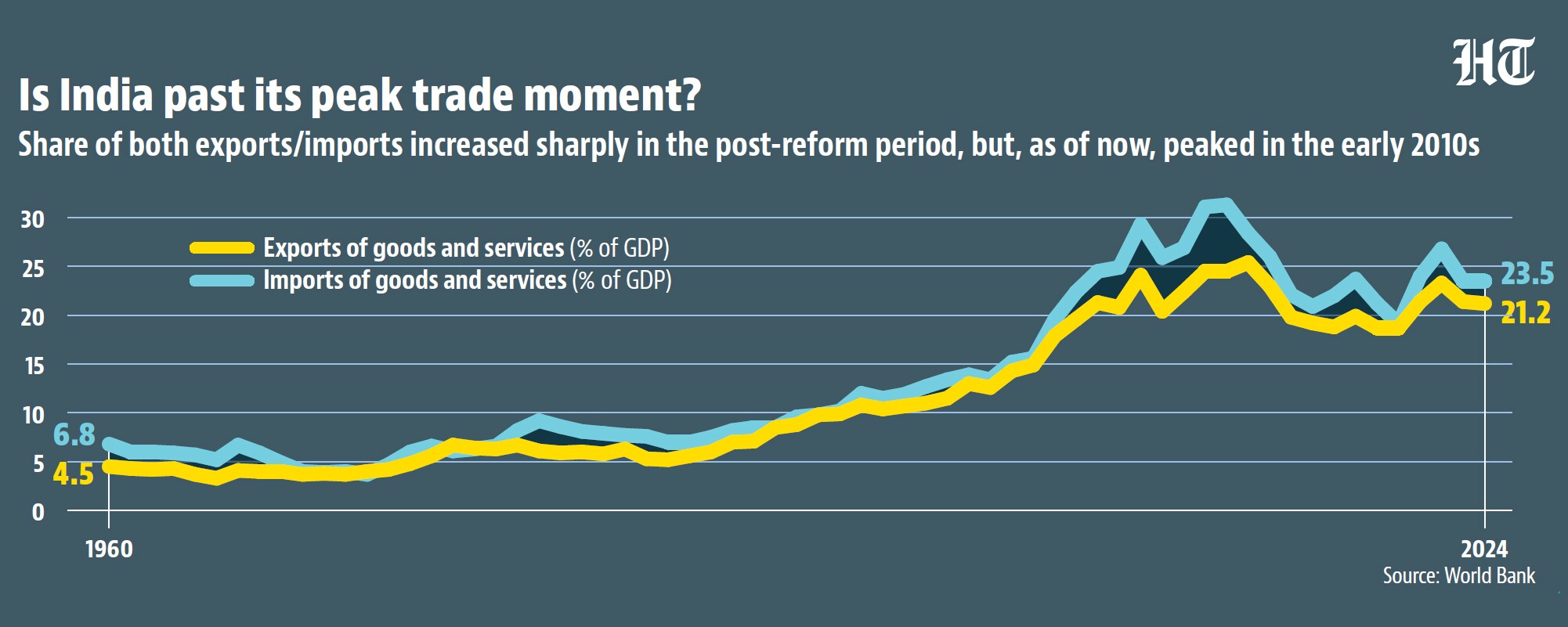
 Export/import-GDP ratios are significantly higher today than in the pre-reform periodThe World Bank has data from 1960 onwards on the share of export/import of goods and services in India’s GDP. Both these numbers were largely stable — hovering between 5%-10% — between 1960 and 1990. Economic reforms of 1991, which did away with a lot of restrictions on foreign trade in the Indian economy, opened the floodgates and this number started rising rapidly in the post-reform period. At the cusp of the financial crisis of 2008, the global economy would suffer a recession in its aftermath, both the export/import to GDP ratio was almost 25%, more than double from what it was even in the mid-1990s. However, both exports and imports, the latter more than the former, seem to have peaked in the early 2010s. While there are specific factors behind each of these trends, such as oil prices, commodity super cycles, etc, the trends do raise a provocative question: Is the Indian economy past its peak trade moment already? Answering this question for the future is difficult, but it will help to understand what contributed to the trade trends in the past.
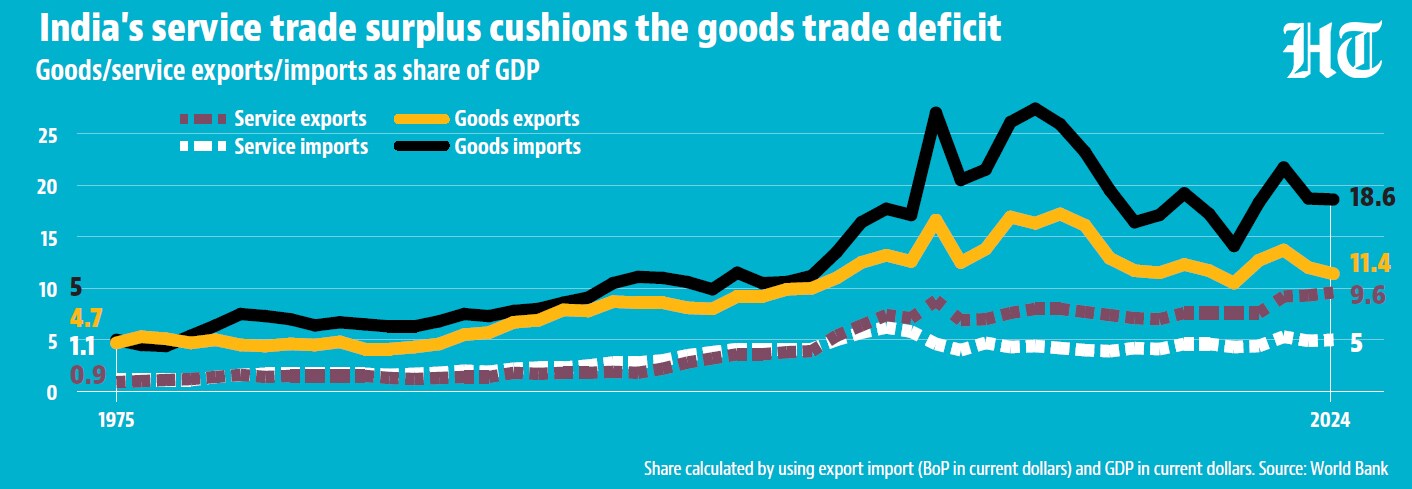
- Both goods and services trade have stalled in the post-2010 periodThe World Bank also has data on goods and services trade separately for India from 1975 onwards. Looking at them as a share of GDP — absolute numbers will not factor in the growing size of both the Indian and the world economy — it can be seen that goods and services trade increased significantly in the post-reform period. While India gradually developed a trade surplus in services, the deficit in goods trade increased through the post-reform period. India’s service trade surplus, as can be seen from the chart, cushioned some of the external account headwinds from goods trade. To be sure, it is important to remember that goods exports are, even today, larger than service exports. This should disabuse us of any illusions that disruption to goods trade will not have any impact on the economy. The data also shows that the post-2010 stalling can be seen in both goods and services trade, although services have not fallen as much as goods trade.
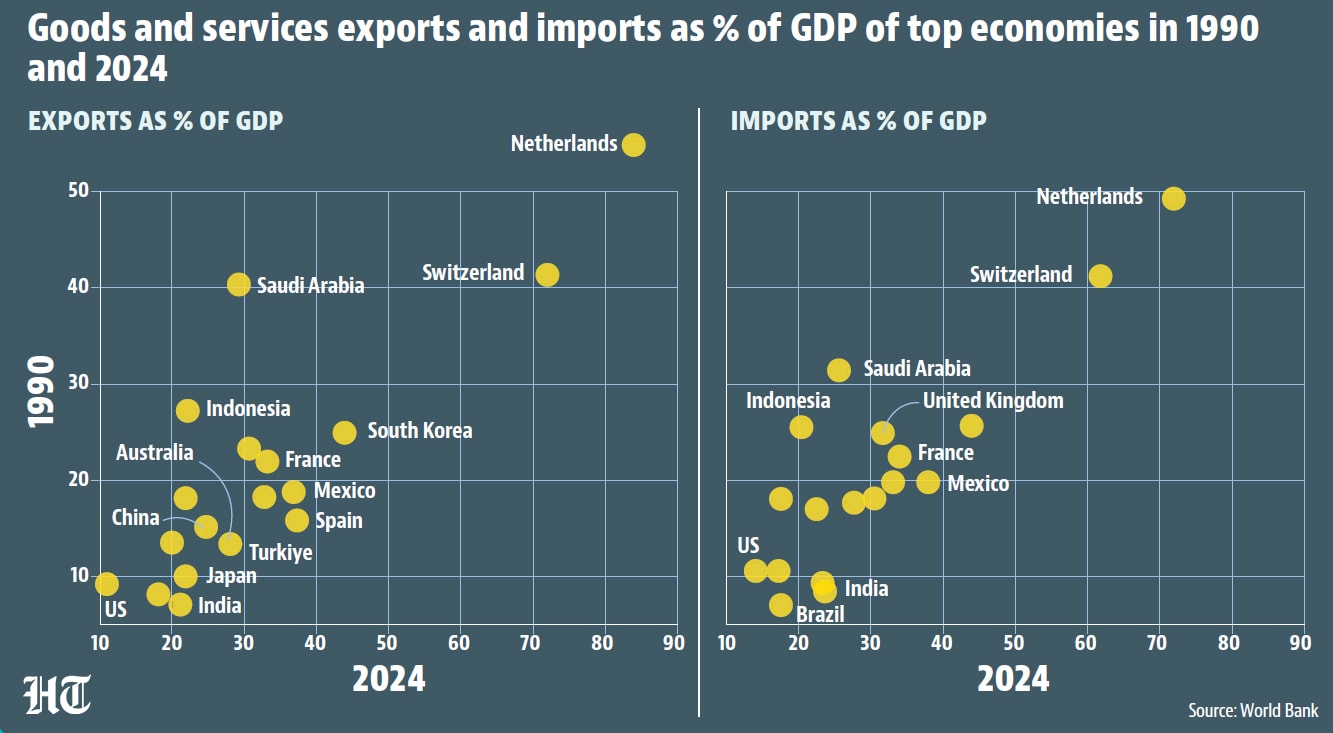
- India’s trade integration has risen, but lags behind the most open economiesIn the global context, India’s increase in trade to GDP ratios after 1990 is far from an outlier, although its trajectory has been more modest than some peers. Between 1990 and 2024, India’s exports as a share of GDP rose by just over 14 percentage points, a gain like Japan’s and not far from Italy, but well behind the sharp expansions seen in Switzerland, the Netherlands, Spain, South Korea and even Mexico. Meanwhile, China’s increase looks modest on a 1990-2024 comparison, but that masks a dramatic mid-period surge, with exports peaking at roughly 35% of GDP in 2006 before easing as the economy rebalanced towards domestic demand. On the import side, India’s rise has been even sharper, reflecting structural dependence on foreign goods, particularly energy. By contrast, the United States has seen very little change in both exports and imports as a share of GDP — which is consistent with having a vast, consumption-driven domestic market and a substantial resource base. Taken together, India’s post-reform integration has moved it into the mid tier of globally open economies, yet it still sits behind the most export-oriented nations, and the pace of convergence has slowed in recent years.



Unlock a world of Benefits with HT! From insightful newsletters to real-time news alerts and a personalized news feed – it's all here, just a click away! -Login Now!


