
 E-Paper



What another academic session amid rising Covid cases means for Delhi’s students
Even though stakeholders sounded a note of caution over continuing online education for the second year, schools said that the situation is relatively better than last year


With the new academic session beginning in Delhi schools this week amid rising Covid-19 cases, students are likely to continue their learning in either online or blended online and physical classes mode.
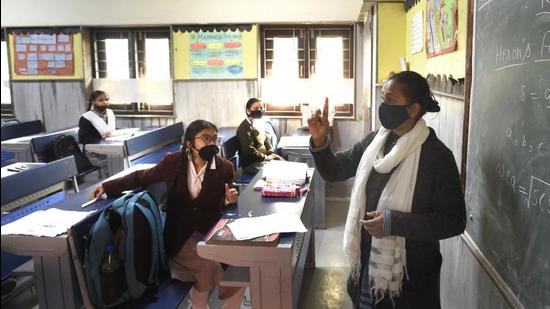
While schools were preparing to conduct lessons in blended mode for students of classes 9 to 12, the Delhi government on Wednesday said the classes would continue online. In January, the Delhi government had issued a directive allowing secondary and higher secondary students to return to school on a staggered basis to facilitate remedial classes and practicals while following all Covid-19 norms.
“The last reopening orders were issued to ensure that the schools manage to conduct practical and remedial classes for these students. It was also to prepare students for their upcoming CBSE class 10 and 12 board exams. It was for a specific purpose. The government has not yet allowed schools to reopen normally for senior students,” an education department official said.
Aditi Negi, 12, a class 8 student, who hasn’t been to return to her school RPVV in Shalimar Bagh, said the general excitement of a new session is missing this year.
Also Read | Sisodia meets DU’s acting vice chancellor to resolve pending issues
“All of us used to be excited about sitting in a new classroom and meeting our class teachers and getting acquainted with one another. We don’t even know who our class and subject teachers will be because that used to happen on the first day. It has been a year since we travelled to school with friends and came back home while discussing the day’s events. I miss it a lot,” said Negi, who is now waiting for a communication from her school on her online classes.
Even though stakeholders sounded a note of caution over continuing online education for the second year, schools said that the situation is relatively better than last year as teachers have received training, practice, and experience in conducting education in digital mode.
Sukhbir Singh Yadav, head of Government Co-Ed Sarvodaya Vidyalaya in Sector 21, Rohini, said that the schools would continue with the existing system of worksheets and continuing classes in semi-online mode. He added teachers would focus more on students of classes 9 to 12 due to their upcoming board exams.
“The pandemic has affected learning across all levels but everywhere, educators have had to do their best in the prevailing condition. While the academic session will officially begin this week, even in previous years, full-fledged studies usually began after summer break in July. So we are hoping that the situation is normalized by then and at least senior students are allowed to come back to school while maintaining safety norms,” he said.
While the education department had a year to develop the worksheets and facilitate an easier way to adopt the semi-online mode of learning for government school students, lack of social and emotional growth has become an area of concern.
RP Singh, principal of Rajkiya Pratibha Vikas Vidyalaya in Surajmal Vihar, said, “The quality of worksheets has also improved over the period. But we are really worried about the impact of prolonged closure of schools on the overall development of students since there will be the complete absence of socialisation.”
Also Read | Farmers’ protest: Several Delhi border routes remain closed
Since schools have had a year to identify gaps in the online learning system and address them accordingly, many are also devising new ways to help students. Meenu Goswami, principal of Bal Bharti School in Pitampura, said, “In the last one year both teachers and students have become familiar with different technologies, and mode of learnings and that’s why it will be a little easier for us to start a new academic year virtually. This year, we have decided to have mandatory slots for personalized, one-on-one interaction of students with their class teachers every day in order to rekindle their personal connection with their school and teachers. Also, we have decided to divide students of nursery and KG into smaller groups this year in order to ensure one-to-one connect.”
Some schools have also decided to introduce changes considering the work hours of parents. Tania Joshi, principal of the Indian School, said, “This year we have decided to shift classes of nursery and KG students to earlier slots considering the fact now their parents have started going to offices and they won’t be able to sit with them during the classes. Now the classes for these students will begin at around 8:30 am, at least two hours earlier than before.”
A major area of concern for stakeholders has been the lack of peer-to-peer interaction among younger children which is bound to leave an impact on the child’s overall development.
Anubha Rajesh, chair professor at Jamia Millia Islamia’s Centre for Early Childhood Development and Research, said, “The pandemic has affected children in all different domains of their development, especially young children whose early years are foundation years for lifelong learning. These children are in a home environment because they don’t have opportunities for games and physical exercise and interaction with peers. Since schools have had time to develop emergent measures, care must now be taken to address these psychosocial issues in innovative ways. Also, a one-size-fits-all approach will not be applicable so schools must devise means to address digital divide and facilitate learning for disadvantaged children.”
While the process for admissions to entry-level classes at the city’s private schools for unreserved students concluded Wednesday, parents whose children were admitted to these classes last year are worried about the impact of continuing online education on young children.
Gita Sagolsem, whose son will start kindergarten this year, was among those parents whose children started their first year of schooling when the pandemic struck last year. “While things are more in place now compared to last year as teachers are more trained and the online curricula more structured, parents like me are worried about the long-term impact of continuing online education for younger kids,” she said.
“Children learn more when they get to interact with their peers. In my child’s case, I think there was more social and emotional growth and learning during his pre-school than last year when we enrolled him in a private school. Several of my friends pulled their children out from schools last year and preferred to home school them because online education wasn’t connecting with the children much,” she said.
Anubhooti Bhatnagar, a resident of South Delhi and a software engineer who got her daughter enrolled in nursery this year, said that parents would assume a bigger role in the child’s education this year as well.
“I don’t think classes will reopen normally [physical mode] this year for younger children. But if I skipped getting her enrolled, she would cross the age limit for nursery this year and be eligible for kindergarten next year. Getting admission in KG would have been more challenging.”
“This is why we opted to get enrolled despite knowing the fact that there is going to be little learning. Nursery classes are where children learn to go to school, meet other people, and strike a balance between school and home. But that is not possible with online education,” she said.
Experts also said that special children will also be adversely impacted by continued online learning. Pooja Negi, a special educator in Delhi government schools, said, “Challenges will vary for special students across different categories. For instance, younger children with intellectual disability will find it challenging to return to schools because social interactions have been hit. We are also looking at arranging for assistive devices and accessible reading material for the other special children along with distributing specialised handbooks. As far as online education is concerned, schools and educators are trying to establish constant communication with parents and children and meet them at least once a week or fortnight.”


