
 E-Paper



Sending children back to school: Post-COVID classrooms may look very different
Schools cannot go back to the pre-pandemic normal if they are to keep students safe and earn the trust of parents enough to convince them to send their children back to physical classrooms.


The COVID-19 pandemic has drastically altered the shape of our existence. The various lockdowns imposed all over the world to battle its spread have brought our lives to a shuddering halt. What we considered normalcy has been upended by the ‘new normal’. It has changed the way we work, the way we shop, the way we eat and even the way our kids study.
Yes, study. Education is perhaps the sector that has had the hardest time coming to terms with the new normal. Yes, everyone has had their challenges - workplaces having to rapidly adopt a work from home culture, restaurants having to evolve their businesses into delivery-and-takeaway only models, everyone has had big changes to make.
But perhaps in no other sphere have the obstacles to change been higher to overcome than in education. Corporate employees for example already worked on computers, many of them laptops, at the office. All they had to do was fall into a work-from-home routine. Their employers, meanwhile, had to set up secure IT infrastructure that would enable them to do so. While it was a big change to adapt to, the nature of their work didn’t fundamentally change.
But the education sector has arguably had to make the biggest jump, going from its traditional chalk-and-blackboard normal to a new normal of a fully digitized virtual classroom experience.
Unlike offices and office employees already familiar with the practice of video conferencing, schools and colleges were not initially equipped to teach virtually due to several factors including a lack of IT infrastructure as well as a lack of training for teachers.
Yet, despite a few niggles and teething troubles, a survey conducted by our company revealed that the sector has adapted well to its new virtual normal.
For example, 78 percent of children polled in the survey said they enjoyed the online learning environment and were actually happy attending their virtual classrooms as they could learn while at home.
Similarly, 75 percent of the children surveyed said they were communicating better with their teachers in a virtual setting as compared to an actual classroom as even shy kids, too afraid to speak up in class, could now communicate with their teachers via message.
Eighty-five percent, meanwhile, said they were able to understand concepts well in an online setting.
Parents too have welcomed the shift to a virtual classroom. They can now be part of their child’s teaching process even if they may not directly involve themselves in the lesson. They can monitor how their child is being taught, they can observe when their child is paying attention, whether she or he has understood the concept that is being taught and so on.
Moreover, their children no longer have to be exposed to pollution, heat, dust, a traffic-filled commute to and from school. They even have more time now to pursue extra-curricular activities and cultivate hobbies.
The benefits a virtual classroom offers are plenty, so much so that it sounds too good to be true.
That’s because it is.
COVID-19 may well have permanently upended the way business is done, particularly in the corporate sector. Amid the pandemic, it’s become clear that work can be done remotely, meetings can be held virtually.
The cost savings this has yielded, the savings in terms of office rents, administrative expenses, travel expenses and so on, may force companies to examine permanently moving to a remote-working model.
But that won’t work for education. Students must return to school.
For all the benefits of a virtual classroom, there several negative fallouts that outweigh the positives.
About 50 percent of the parents polled in a study conducted by our company said their children were far more easily distracted in the home environment. Technical glitches also affected 62 percent of the children polled while 22 percent and 14 percent respectively attended classes either sprawled on their beds or seated on the floor.
Another point to consider is that while virtual classrooms have ensured continuity in learning amid the lockdown, they are limited in what they can teach students.
Yes, they are perfectly adequate at covering the prescribed syllabus but they fall woefully short when it comes to teaching students softer skills. Manners, morals, social norms and skills, etiquette, the ability to interact, these can only be acquired in an actual physical setting.
The absence of these can have a detrimental effect on the all-round development of a child, particularly younger children.
Still, getting students back to brick and mortar classrooms is easier said than done. COVID-19 is here to stay and for parents to send their kids back to school is going to require a tremendous leap of faith.
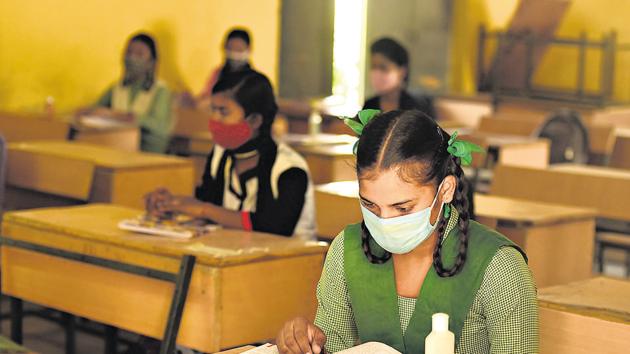
Make no mistake, even with students returning to schools, the post-COVID classroom will look very different to what it did before the pandemic upset the established order.
Schools cannot go back to the pre-pandemic normal if they are to keep students safe and earn the trust of parents enough to convince them to send their children back to physical classrooms.
But there is a way they can combine technology, ergonomics and space management to strike an ideal balance between the virtual and real world.
Social distancing is going to have to be maintained in any classroom setting going forward. But Indian classrooms typically tend to have as many as 50 or 60 students which makes it difficult to follow social distancing. The obvious solution would be to cut down the student count but you can’t just suspend kids from school. Luckily, technology means there are several innovative ways all 50 or 60 students can be taught while still keeping the classroom count low.
One such method is split scheduling and blended learning. Students can be divided into groups. These different groups can alternate between the physical and virtual classroom. For instance on Mondays you can have Group I in the physical classroom while Groups 2 and 3 attend virtually. On Tuesday Group 2 goes to school while Groups 1 and 3 attend virtually. This way nobody misses out, everyone spends an equal amount of time in a classroom setting while you also ensure social distancing.
Another way to ensure distancing is to reconfigure the classroom. Schools can make them more modular by using movable furniture with wheels that can be arranged in different configurations to ensure adequate separation. Other measures like seating one student per desk and so on can also be adopted to ensure distancing.
Schools can also repurpose larger areas such as halls, auditoriums and canteens and use them as classrooms. This will allow them to accommodate more students while still maintaining adequate distancing.
To guarantee further safety, schools can also install partitions between desks especially in libraries and computer labs as well as staff rooms and administration office. They can also use removable seat covers that are discarded after use.
COVID-19 is here to stay and we simply have to learn to live with it. We can’t keep our kids out of school forever. Yes, sending them back is going to require a massive leap of faith. But by taking adequate measures and precautions schools can make classrooms safe and keep them COVID-free.
(Author Sameer Joshi is Associate Vice President Marketing (B2B), Godrej Interio. Views expressed here are personal.)


