E-Paper



In Bengal, the battle for the Dalit vote
In many ways, Byapari and Balagarh mirror the tussle between the TMC and the BJP for the SC vote, and the contradictions and chinks in the plans of both parties for the community that makes up nearly a quarter of the eastern state’s population

 Prefer HTon Google


As Prime Minister Narendra Modi offered prayers at the famous Matua temple in Bangladesh’s Orakandi town on March 27, Manoranjan Byapari gingerly stepped on to an e-rickshaw decked with Trinamool Congress (TMC) flags and banners.
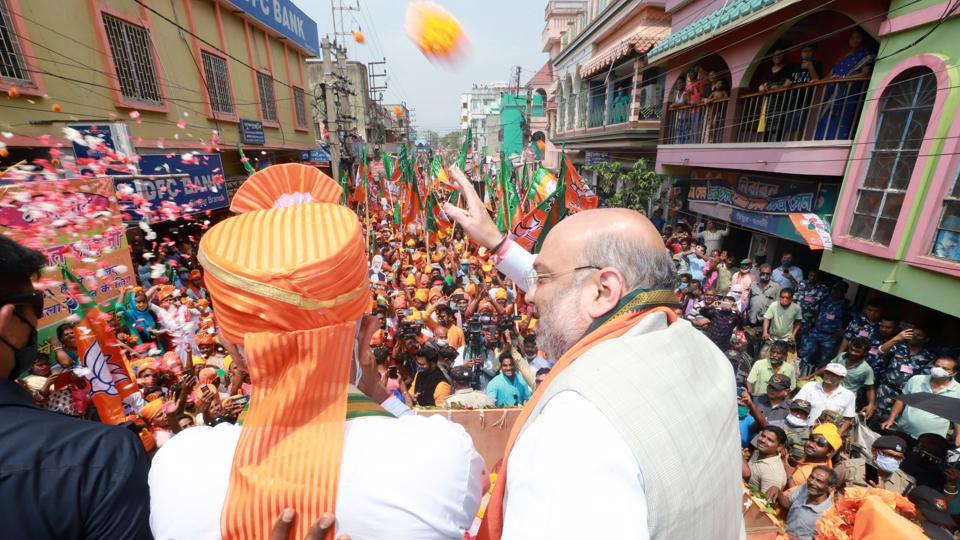
The sun blazed overhead and the 66-year-old was running late for an election rally. A piece of plywood wedged between the seats of the e-rickshaw acted as a platform for the candidate to stand and greet supporters.
With some difficulty, Byapari got on the vehicle and waved to his supporters on cycles, motorbikes and other e-rickshaws. “Rickshaw ebar bidhansabha-y” (rickshaw this time in the assembly)” the crowd chanted.
For two hours, the convoy of e-rickshaws — ubiquitous in the state as ‘totos’ — slowly made its way through the narrow lanes of Balagarh in south Bengal’s Hooghly district. Byapari remained standing, waving to supporters, wiping his sweat on the trademark gamcha and only stopping to offer prayers at the temple dedicated to Shitala, the mythical curer of diseases.
Also Read | ‘TMC wiped out in half of the election’, claims PM Modi in Bengal
“I am one of you. An ordinary man, who slept on a railway platform for years,” he told the crowd. One of the best-known Dalit voices in Bengal and former chief of the state Dalit Literature Academy, Byapari is a first-time TMC candidate from Balagarh, a seat reserved for scheduled castes (SC).
Byapari is well known in Bengal for reaching the pinnacle of literary accomplishments from nothing — a Partition refugee from the Namashudra caste who spent a life in crushing poverty as a manual labourer and then rickshaw puller, spending months in jail, before publishing his pathbreaking autobiography. “He is a very important man. I have brought him here,” said West Bengal chief minister Mamata Banerjee while announcing his nomination last month.
A staunch proponent of Banerjee, Byapari is a vocal opponent of the Bharatiya Janata Party (BJP) and its flagship Citizenship Amendment Act (CAA), which fast-tracks citizenship for refugees belonging to six non-Islamic faiths from Pakistan, Bangladesh and Afghanistan. “The CAA can destroy the Bengali refugees’ lives and make them stateless again,” he said.
Byapari is a refugee and a Namashudra, two communities which Banerjee is hoping to bring back into the TMC fold after sections drifted to the BJP in the 2019 elections. And, his stature helps the TMC signal to the large and diverse SC communities that it will promote Dalit leaders.
In many ways, Byapari and Balagarh mirror the tussle between the TMC and the BJP for the SC vote, and the contradictions and chinks in the plans of both parties for the community that makes up nearly a quarter of the eastern state’s population.
In Balagarh, for example, the TMC is well entrenched and has deep roots in the local Namashudra community that makes up the biggest voting bloc. Banerjee is popular and her image as didi is well-received. But the party is riven by factionalism after sitting MLA Ashim Kumar Manjhi was replaced by Byapari, though the ascendant BJP has acted as a salve. Local TMC operatives admitted that even in neighbourhood meetings, there was an undercurrent of tension.
Most of the people in the area are agricultural labourers, landless people or poor fishermen – communities that shifted en masse from the Left to TMC in 2011. But this time, the BJP has mounted a spirited campaign focused on TMC corruption at local level and its alleged patronage of a local syndicate and sand mafia.
“In 2013, our vote in many local booths was 0.5%. But we have grown due to the TMC corruption. Sand mafia runs with impunity and has links to the TMC; this is eroding the hooghly’s banks,” said Subhash Chandra Halder, the local BJP candidate.
The scale, diversity and importance of SC vote
Scheduled castes are an important voting bloc in Bengal but their incredible diversity and geographical spread ensures that only a few large communities get noticed – such as the Rajbangshis in north Bengal and the Namashudras in the south.
For decades, large sections of the SC backed the Left, which groomed local level leadership, especially in south Bengal, even if it didn’t overtly mention these communities in its election campaign.
Before the 2011 elections, Banerjee broke the trend when she publicly courted the Matua Mahasangha, a centralised body that controlled the influential Matua community — many of whom were refugees from Bangladesh and hailed (not exclusively) from the Namashudra caste. The CM travelled to Thakurnagar, the seat of the Matuas in India, and paid her respects to Boroma Binapani Devi, or elder mother, who was the head of the Mahasangha at the time.
This time, much of the spotlight has been on the Matuas, because after Devi’s death, the Mahasangha split into two factions — one headed by TMC leader Mamatabala Thakur and the other by BJP MP Santanu Thakur — and large chunks of the community backed the BJP in the 2019 polls, hoping the CAA will end to their crisis of citizenship documentation. For political parties, this is an important vote base because unlike other groups, there is a degree of centralisation in the way Matuas vote.
“This division has been dangerous for the anti-caste movement and has led to a loss of the strength of the sangha,” said Saradindu Biswas, an Ambedkarite activist.
Click here for complete coverage of West Bengal assembly elections
But SC communities are spread across the state, from the jagged hills of the Purulia to the lush fields abutting the Hooghly and the swampy marshlands of the Sunderbans. Their issues revolve not only around citizenship, but also questions of employment, reservation benefits, basic amenities and communal polarisation. And, experts say the election may be shaped by the decision and churn in smaller SC communities, and how bigger castes such as the Namashudras are increasingly fractured and localised in their political support. There are 66 seats reserved for SC in the state.
“There are so many Dalit communities in Bengal, such as Dom, Bauri, Bagdi, Poundra. The Namashudras have prominence in south Bengal but this time, the political parties are eager to tap even smaller communities,” said Jaydeep Sarangi, principal of Kolkata’s Alipore College. “Moreover, internal economic migration has upended old political equations, and this will be important.”
The competing narratives on the ground
Kalabati Bauri is one of them.
A resident of Lagda village in Purulia district, Bauri manages a home of nine people who share a one-room mud house. The men in the house travel to Purulia town every day for manual labour and the women work as helps in people’s houses. “But it is barely enough. We make ₹500-600 working as maids. There is no work here,” said Bauri.
Her children had to drop out of school, and the family doesn’t have caste certificates because the process is cumbersome and needs the help of local politicians. “The only good thing is the ration we get; our family survives on phena-bhat,” she said.
Her neighbour Koyel Bauri is older, and says the grind of poverty is made worse by caste discrimination. “We have to walk two kilometres every day for water and other amenities. The Brahmins in the village don’t let us use their well; they say you’re Bauri, is this your place to drink water,” said the 55-year-old. No one in the village holds a permanent government job.
It is this sense of deprivation that drove sections of the community towards the BJP in 2019. “We fight everyday discrimination here, and don’t even get the full protection of reservation because of poverty. We want a sub-quota within SC because otherwise, the bigger communities will corner the benefits,” said Bablu Bauri, a community activist.
Rupa Bagdi agrees. A resident of Birbhum district, Bagdi had problems for years with her caste documentation but was helped by the government last year during its Duare Sarkar (government at your doorstep) initiative, and thinks Banerjee is still better for SCs and especially women than the BJP. “Citizenship is not my issue. Jobs and education are my issues. I didn’t vote for the TMC earlier but its initiative really helped me because I didn’t have to go to the local dadas,” she said.
In this election, for the first time, the BJP has enough members in rural areas to appeal to smaller communities and attempt to repeat its tested strategy of coalescing smaller communities on the perception of deprivation – as it did in UP with the Pasis and Balmikis against the Jatavs, the largest SC caste in the northern state. To be sure, when compared to the TMC, the BJP still suffers from organisational deficiency, especially in rural south Bengal.
“We are focusing on smaller communities this time. The TMC government has engaged in corruption in giving caste certificates and didn’t give space to many SC ministers,” said Dulal Das, president of the BJP’s SC morcha. Unlike in other states where the BJP has to fight charges of being anti-reservation, the party has largely been able to avoid this tag in Bengal.
The TMC admits that local factionalism and high-handedness by its leaders led to some losses in the 2019 elections but hopes that its deep connect in rural areas – even in the Lok Sabha elections, the BJP couldn’t penetrate its rural SC base in south Bengal – and welfare schemes will see it through.
Soon after the 2019 elections, Banerjee reorganised the party’s SC and ST cells, organised a bunch of development boards for specific communities, the government distributed around a million caste certificates in Duare Sarkar and promised a guaranteed income of ₹1,000 per month for SC and ST families in its election manifesto. Still, party insiders admit that north Bengal seats remain a worry.
“Look at what they did to Dalits in UP, look at the Hathras case. Bengal government has given away bicycles to SC youth. In north Bengal, they said they will create a Narayani sena, and promote the Rajbangshi language. Have they fulfilled even one promise?” asked Binay Krishna Barman, state minister for backward class welfare.
The politics of religion and citizenship
Two issues important to many Dalit communities in south Bengal are that of citizenship and religious polarisation – though at a pitch lower than in the 2019 Lok Sabha elections.
“Among many, religion continues to be important because the memory of Bangladesh riots persists. This time, both parties are trying to capitalise on this and polarize the voters,” said Biswas.
For Ratul Thakur, the issues are intertwined. The 37-year-old was born in a family that fled from then east Pakistan during religious riots in the 1950s and feels that his refugee status was the result of the TMC government’s alleged appeasement of Muslims. “Why did the state government not resolve our problems and instead help the Muslims?” he asked.
He thinks that the BJP can change his citizenship status, but is unsure if he wants to apply as a refugee and surrender his current documentation, such as a ration card. His friend Sagar is also not certain if the BJP can generate more jobs. “But it will teach the TMC a lesson for appeasing Muslims and not helping us,” he said.
This refrain is common across many Dalit communities. In Purulia, Pintu Bauri admits that his friends are voting on religious lines to “save” Hinduism, not corruption or development. In Namkhana, Tapan Mondal is angry because he feels Muslims in his area are unduly getting the benefits of OBC reservation. In north 24 parganas, Ratan Hazra says his family has turned from the TMC to the BJP because they think the Muslims have cornered government jobs. “In our locality, there are Jai Sri Ram slogans every evening, and groups of boys have started a Hanuman mandir,” he said.
The BJP has fanned this polarisation by highlighting the deaths of some its workers, and painting the TMC as anti-SC in corner meetings and road shows. “Look at Tapas Barman and Rajesh Sarkar who died in 2018 [in Islampur]. Or [Hemtabad MLA] Debendranath Roy who was killed last year. We are highlighting how the TMC killed these SC people and favoured Muslims,” said Das.
The TMC hopes to gain from the anti-CAA protests that swept the state after the 2019 elections, and the fact that millions of Bengali-speaking Hindus were left out of the National Register of Citizens in Assam. The party thinks this anti-CAA mobilisation, which reached every corner of the state in November-December 2019, is why citizenship has been blunted as an electoral issue.
“Education, jobs and political consciousness are important issues for the marginalised communities. This time, citizenship is not as big an issue,” said Biswas.
A new chapter in Dalit politics in Bengal
Whatever the outcome of the elections, it has marked an important break in the politics of the state and brought Dalit communities front and centre of the discourse, say experts. It has also heralded a new chapter in Dalit politics in the state, they add.
Dalit communities in Bengal have painful ties to Partition, which also split the strong anti-caste movement and devastated Dalit mobilisation in pre-independence Bengal. Among the worst affected was the Namashudra political movement.
One section was led by Congress stalwart PR Thakur, who set up Thakurnagar in West Bengal, and the other by Jogendranath Mandal, who chose to go to erstwhile east Pakistan, before he resigned as Pakistan’s first law minister and returned to India in protest against violence on his community.
“Partition polarised the state’s population and adversely affected both the Namashudras and the Rajbangshis. The migration happened in two waves: first by the upper-caste gentry and landed communities in 1946-47 and then by Dalit peasants from 1950,” said historian Sekhar Bandyopadhyay.
Soon after Partition, in the face of hostility, Dalit mobilisation had to focus on rehabilitation and refugee benefits. “The political movement became about resettlement. Caste-based politics almost completely disappeared in two or three decades after Partition,” said Bandyopadhyay.
Once mobilisation restarted, Dalit communities often extended strategic support to parties, instead of acting as loyal vote banks, he added. The experience of discrimination during this time continues to animate Dalit politics in the state to this date. Community leaders like Biswas say that the everyday experience of SCs is more layered discrimination, and not violence like it is seen in northern India. For them, the bigger battle is to ensure political power for these marginalised communities, not mere freebies and political sops.
“Earlier, there would be some focus on Matuas but no one else. But I have never seen this kind of mobilisation before. This can be the birth of a new kind of Dalit politics in Bengal,” said Sarangi.