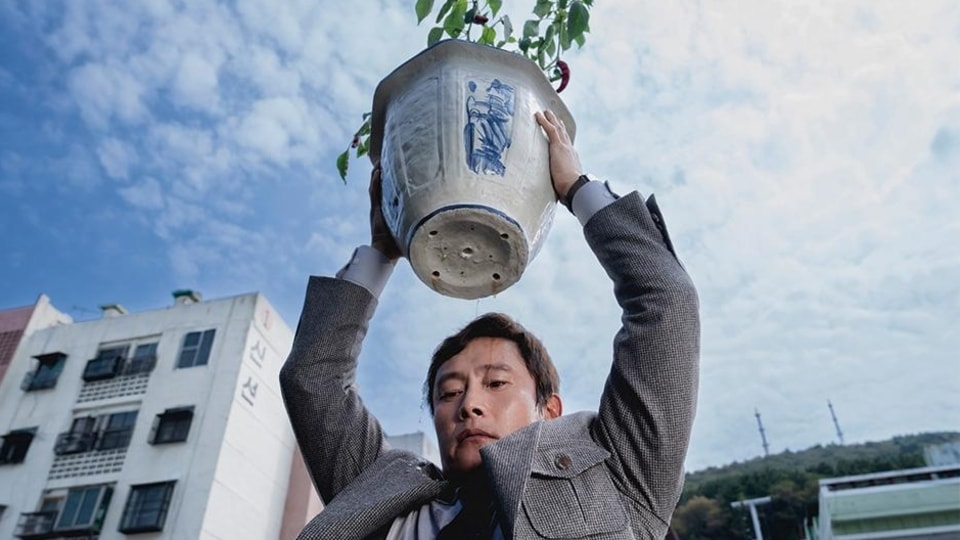
No Other Choice review: Capitalism is the masked villain in Park Chan-wook's terrific and bleak thriller
Park Chan-wook is at the height of his powers in this deceptively simple but intricately stylish black comedy-thriller. It is one of his very best films
Cast: Lee Byung-hun, Son Ye-jin, Park Hee-soon, Lee Sung-min, Yeom Hye-ran, Cha Seung-won
Language: Korean
Director: Park Chan-wook
Rating: ★★★★
South Korean auteur Park Chan-wook might have made his bleakest film yet with No Other Choice, which takes an acidic shot at a society where capitalism has pervasively altered the way human beings co-exist. Everyone thinks for themselves, competes against one another, and strives to be successful. But at the cost of what? The director behind films like Oldboy and The Handmaiden has adapted the 1997 Donald E. Westlake novel, The Ax, about a man's violent search for a job. This was previously adapted by Costa-Gavras, but in Park's hands, it turns into some sort of untameable beast.
No Other Choice played at the International Film Festival of Kerala.
The premise
The amorality is the film's jolting vacuum, as Park goes rogue with his biting satire on how selfish and vengeful the world has turned its pupils into. There is no conscience at the core, and the hyperrealization of this seeps in gradually. The film's first few scenes depict an Eden-like setting, where everything appears picture-perfect. This is the last time the film remains peaceful, as hell breaks loose soon.
Lee Byung-hun plays You Man-soo, who has been working devotedly at the paper company for more than two decades. He lives in a lavish home with wife Miri (a tremendous performance from Son Yejin), teen son Si-one (Kim Woo Seung), daughter Ri-one (Choi So Yul) and two Golden Retrievers. When Man-soo is suddenly shown the door from the job, Miri decides it is better that they cut down on the unnecessary expenditure. No Netflix, and even the pets are sent away.
It is a matter of dignity, of life and death for Man-soo, who is forced to find himself in the overpopulated job market. He tells his wife that he has got everything in control, as he vows to find a new job within the next three months for the sake of his family. But how? Who will bother if his competitors disappear? Man-soo plans to eliminate them one by one, and he has no other choice.
A visual treat from Park Chan-wook
However, he is so nasty in it, and the film sticks to images of slick violence, along with residues of pitch-black comedy. Moving with breathtaking rhythm and tonal balance, where one moment of concern turns into something utterly sinister, Park hits it out of the park in the construction of the scenes. He has assembled a team of masterful technical crew.
Kim Woo-hyung's camera is kinetic and agile, shifting from a slouch with Man-soo to staying right inside the glass, where he slugs down beer. The film is quite a trip, and Park allows room for digressions, flashbacks, and visual metaphors in one dazzling sweep. Kim Sang-beom and Kim Ho-bin make sure the film never loses the rhythm, even when the sequences become quite long in the latter half.
No Other Choice finds the filmmaker at his angriest. It is a film that doesn't lack heart, but yearns for it to find a place in a strictly corporate world. How will love grow amid this cruelty? Son Yejin's performance gives the film its beating heart, and this might be the performance of Lee Byung-hun's career. He plays the hurt and rage so feverishly, and carves a man devoid of any remorse. This is a film where capitalism is the real villain, the silent killer invisibly turning men into robots. No Other Choice is a film of acute sensibility and ambition, and further cements the status of Park Chan-wook as one of our greatest living filmmakers.
Santanu Das is a Senior Content Producer at Hindustan Times with over 5 years of experience, writing on films, pop culture and film festivals. He has a keen interest in writing about South Asian independent films and has covered several film festivals, including Sundance and CPH: Docx. He also brings a sharp perspective to the monthly column called The Fault in Our Stars, where he writes about a recent film/series and what stops the ‘good’ from becoming ‘great’.
A gold medalist from Banaras Hindu University, Santanu completed his postgraduate studies in English from Jadavpur University. He is also a Rotten Tomatoes-certified film critic. When not watching films or speaking to celebrities, Santanu can be found reading a book. Some of his favourite films are Aparajito, Ponyo and The Double Life of Veronique. His favourite books include The Corrections, The God of Small Things and A Room of One's Own.
Santanu continues to write passionately about films and celebrity culture. He brings a relatable, as well as critically informed, lens to entertainment and culture for a wide audience.
Find him on LinkedIn: santanudasfilm
Instagram: @santupechaRead More

 E-Paper