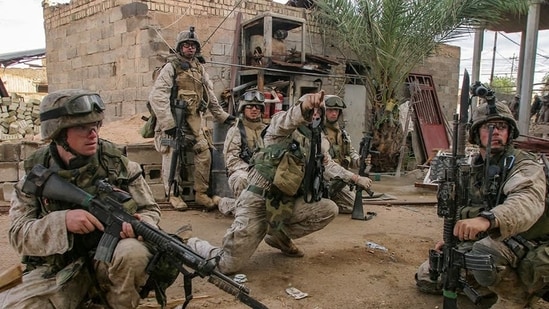
The interviews for “The Last 600 Meters,” which commemorates the Iraq War battles of Fallujah and Najaf, were conducted in 2007, “while memories were still fresh.” Given what’s recollected in director Michael Pack’s documentary, it seems that very little will ever be forgotten, certainly not by those who fought the battles. Nor, it is very likely, by those who watch the film.
Soldiers in a 2004 battle of Fallujah.
The biggest engagements fought by Americans since the Vietnam conflict, Fallujah and Najaf were fierce, frustrating, and part of a war that was neither warmly embraced by Americans nor understood very well by them. Mr. Pack remedies the latter, at least in terms of where and why combat was undertaken in certain places, and what those places meant in terms of both the strategic and political aspects of the war. The effect, if not necessarily the intent, is thrilling.
This week’s death of former Vice President Dick Cheney, one of the architects of the conflict, was a reminder of the complicated motives behind the U.S. engagement in Iraq, but it also highlights the core strength of Mr. Pack’s film: None of the combatants interviewed argue the politics of the war. Or question the mission. As is said more than once, the concern of the fighting men wasn’t about making policy, only enforcing it across “the last 600 meters.”
The people whom Mr. Pack interviews include some familiar faces—current Massachusetts Rep. Seth Moulton, for instance, and the ubiquitous historian Max Boot—but they are a uniformly articulate group. Any differences they have with the war are not about its motivations but its conduct. When Blackwater contractors were mutilated and hanged from a Fallujah bridge in March 2004, the decision of Gen. James Mattis was to hunt down those responsible and arrest or kill them—the murderers had been rash enough to pose for pictures and the Marines had about 24 targets, according to Marine officer John Toolan. But the orders from on high, says military historian Bing West, were instead to “take the city.” At which point the siege began.
The soldiers explain what they did, and why; how they cared for one another and how the military decisions sent down to them often thwarted the efforts they were making, against both Sunni and Shia insurgents, at the same time there was an uprising in the south. Mr. Boot and Thomas E. Ricks, the journalist, help put the political picture in place, the ground-level situation vs. the “happy talk” of members of the Bush administration. (“I thought it was bad,” says Mr. Ricks. “I hadn’t thought it was going to be this bad.”) But this is for historical context. The actual fighting is recalled in a rather purist fashion, the emphasis on strategy, bravery, near-tragedy and the occasional miracle: Cpl. Jan Bender, a combat correspondent—his footage is among the stunning battle sequences in Mr. Pack’s film—recalls quite nearly shooting a fellow Marine who had entered his space having put on an Iraqi “man-dress” and head scarf, because he thought it was funny. (“He just wasn’t a very deep thinker, I guess.”) Fellow Marine Matthew Piano took a bullet to his helmet, which is described as having traveled through the Kevlar before exiting to the rear. It “rang his bell,” but he lived, despite a margin that was breathtakingly close.
“You feel as if you failed,” Mr. Piano tells Mr. Pack about being wounded, and leaving his comrades, which is as representative a moment as anything else in “The Last 600 Meters.” It is militarily, politically and even intellectually enlightening, but is more deliberately about selflessness and valor, not an inappropriate offering for Veterans Day.

 E-Paper