
 E-Paper



Chap, a friend and a fierce competitor
Debabrata Sarkar, an East Bengal official, and one of those who had derailed Chapman’s plans, said ‘Chap’–everyone called him that—was a ‘mastaan’. It does not translate easily, but in this context, it means a player who wasn’t overawed.


Former India football captain Carlton Chapman, who had formed a deadly trio in club football with Bhaichung Bhutia and IM Vijayan in the 1990s, died on Monday following a heart attack in Bengaluru. He was 49. Chapman was admitted on Sunday night at a hospital in Bengaluru and passed away early this morning.
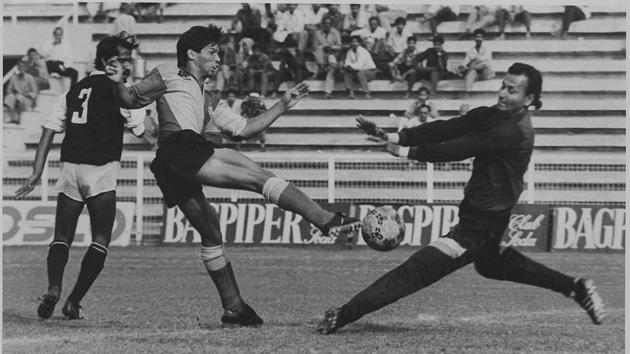
An attacking midfielder, Chapman played for India between 1995 and 2001 and the country won the 1997 SAFF Cup under his captaincy. A product of the Tata Football Academy in early 1990s, Chapman joined East Bengal in 1993. East Bengal officials recount how Chapman was intercepted at the Kolkata’s Howrah Station by them, so that they could get him before rivals Mohun Bagan did. Chapman’s career took him to JCT—where he enjoyed his greatest success—and FC Kochin before returning to East Bengal, but he never crossed the road to Mohun Bagan.
Debabrata Sarkar, an East Bengal official, and one of those who had derailed Chapman’s plans, said ‘Chap’–everyone called him that—was a ‘mastaan’. It does not translate easily, but in this context, it means a player who wasn’t overawed.
Iraqi club Al Zawra’a found out in October 1993, when Chapman scored a hat-trick in East Bengal’s 6-2 win in a first round match at the Asian Cup Winners Cup.
“Our focus was to avoid a humiliation (against a team used to winning Iraq’s league and cup competitions). Only Chap said, ‘we too can win’,” said Sarkar.
With that Chapman, then a thin, fair-complexioned buck-toothed rookie, became part of Indian football’s folklore.
Prior to the semi-final in the 1997 Nehru Cup, an official of the Iraq team said he remembered Chapman’s goals from that Asian Cup Winners’ Cup tie in 1993. Next evening, Chapman put India ahead but Iraq won on penalties.
Off the field, Chap was all smiles, high-fives and, often, hugs. “Such a wonderful fun guy, great teammate,” said Bhaichung Bhutia, who also joined East Bengal in 1993. Bruno Coutinho, under whose captaincy Chapman made his debut for India, said he “played with a smile.”
“We were like brothers,” said former India captain Renedy Singh. “He was my senior at TFA (Tata Football Academy). He was a leader who led not by talking but showing how good he was on the ground.”
“He was one of the fastest players I have played with,” said Bhutia. It was Chapman’s speed that had taken
Al Zawra’a apart and Chap ghosting into the penalty area sparked chaos in many teams in India and abroad. Bhutia remembered a goal he scored off a Chapman assist; “a flying header in Sri Lanka (1995 SAARC Gold Cup.”
Chap came from Austin Town in Bengaluru, a football pocket that has produced internationals beginning with players who represented India at the 1948 Olympics, to Chapman’s cousin Noel Wilson. Including three Santosh Trophy titles, Chapman won nearly everything in the domestic circuit and played 39 times for India, scoring six goals.


