
 E-Paper



AAP leaders Arvind Kejriwal, Manish Sisodia visit Rajghat, reaffirm commitment to satyagraha
AAP leaders Arvind Kejriwal and Manish Sisodia visited Rajghat to pay homage to Mahatma Gandhi and reaffirm their commitment to the path of satyagraha.

 Prefer HTon Google


Aam Aadmi Party (AAP) national convener Arvind Kejriwal and senior leader Manish Sisodia on Tuesday visited Rajghat in New Delhi, where they paid homage to Mahatma Gandhi and reiterated their commitment to the path of satyagraha. They were accompanied by party MLAs and a large number of workers during the visit.
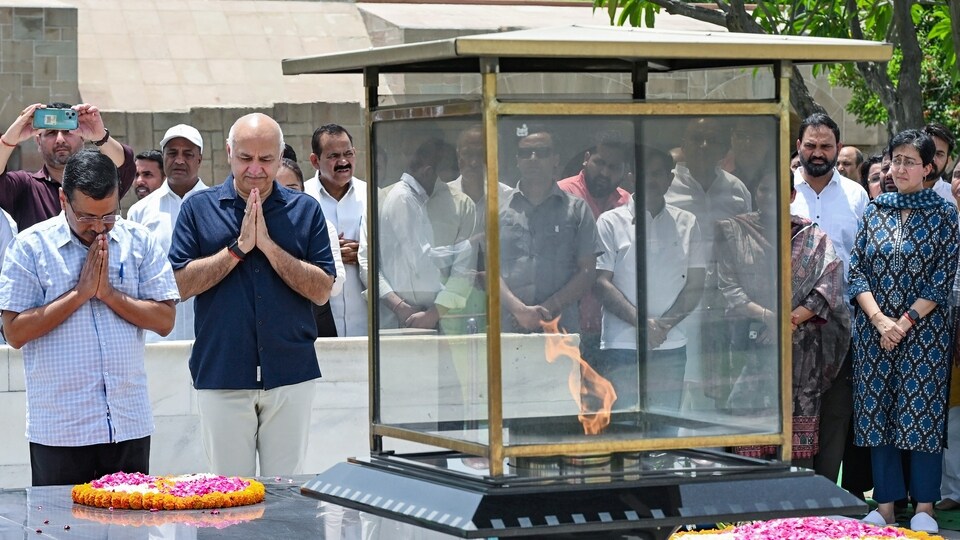
Kejriwal said the party respects the judiciary but was compelled to take the path of satyagraha due to certain circumstances. Kejriwal noted that it is because of this judicial system that they are free today. However, he added that certain circumstances have arisen that have compelled them to adopt satyagraha, and these concerns have been outlined in a letter addressed to the judge.
In a post on X, Kejriwal said he prayed for strength to remain steadfast on the path of truth shown by Mahatma Gandhi. He expressed confidence that with Gandhi’s blessings, the party would remain committed to the difficult path of satyagraha with full dedication.
Sisodia also echoed similar sentiments, saying Gandhi’s teachings continue to inspire adherence to truth and moral strength. In a post on X, he said the visit to Rajghat had further strengthened their resolve to follow the path of satyagraha.
Kejriwal’s earlier stand before the high court
Arvind Kejriwal had informed the Delhi High Court earlier that he would neither appear in person nor be represented by a lawyer in proceedings before Justice Swarana Kanta Sharma in the ongoing excise policy case. According to a PTI report, Kejriwal took this step after his plea seeking the judge’s recusal was rejected on April 20. In his communication to the court, he cited concerns over continuing with the proceedings under the present circumstances and indicated that he would instead adopt the path of satyagraha.
Sisodia follows suit
Following Kejriwal, senior AAP leader and former Delhi deputy chief minister Manish Sisodia also declined to pursue his case before the same bench. Sisodia, in a letter to Justice Sharma, said he would not appear either personally or through counsel, expressing that he did not expect justice and would follow satyagraha. He referred to concerns raised earlier by Kejriwal and said he was in agreement with that position, drawing from Mahatma Gandhi’s teachings.
Sisodia’s letter raised specific issues, including the judge’s public association with a lawyers’ body and the professional engagements of her children with Union government panels, as per the PTI report. He questioned whether such circumstances should have been disclosed at the outset and said these factors contributed to his apprehension about the appearance of impartial justice. Sisodia added that continuing in the proceedings despite such doubts would go against his conscience.
Pushback against Kejriwal’s letter: BJP questions allegations against judiciary
BJP spokesperson Prakash Reddy criticised Arvind Kejriwal’s decision to write to the Delhi High Court judge and refuse to appear in the excise policy case, saying that while a litigant has the right to seek a change of judge, attributing mala fide intent to the judiciary is not appropriate. Speaking to ANI, Reddy said such allegations go against constitutional values and the interests of the country, adding that justice is determined on the merits of a case rather than ideological leanings. He also stressed that a former chief minister should exercise restraint while raising concerns about judges.
Court ruling rejects apprehension of bias
The Delhi High Court had earlier dismissed Kejriwal’s plea seeking the recusal of Justice Swarana Kanta Sharma, observing that the allegations did not meet the legal threshold for establishing a reasonable apprehension of bias. According to ANI, the court said the claims were based on conjecture rather than evidence and cautioned against turning court proceedings into a matter of perception. It further noted that participation in public or professional events does not compromise judicial impartiality and that such pleas, if entertained without substantive material, could undermine institutional credibility.
Legal experts flag procedural concerns
Several legal experts also criticised Kejriwal’s approach. Former Uttarakhand High Court judge Justice Lok Pal Singh told ANI that making allegations against a judge and refusing to participate in proceedings could set a problematic precedent, allowing litigants to delay hearings. Senior advocate Siddharth Luthra said the appropriate course of action was to challenge the order through legal remedies rather than writing a letter, noting that courts have mechanisms to ensure representation even if a party refuses to appear.
Senior advocates Vaibhav Gaggar and Adish C Aggarwala echoed similar concerns. Gaggar warned that allowing litigants to question judges through personal letters after an adverse order could weaken institutional sanctity. Aggarwala said that while legal remedies are available, non-cooperation by a litigant, particularly a public figure, raises concerns, adding that dissatisfied parties can always approach higher courts.
Political criticism sharpens
Political reactions also intensified, with Haryana chief minister Nayab Singh Saini accusing Kejriwal of repeatedly disrespecting constitutional institutions. As per ANI, Saini alleged that Kejriwal’s stance reflected a lack of faith in the judiciary and was aimed at diverting attention from internal issues within his party. He further claimed that questioning court decisions selectively, accepting favourable rulings while criticising others, undermines the credibility of democratic institutions.
(With PTI and ANI inputs)


