
 E-Paper



India–UK trade deal: Good bargain, but not without risks
Authored by- Rahul K Poonia, research scholar, Centre for Economic Study and Planning (CESP), School of Social Sciences, Jawaharlal Nehru University, New Delhi.

 Prefer HTon Google


The India–UK Comprehensive Economic and Trade Agreement (CETA) was implemented on July 15, after five years of negotiations, 14 rounds of talks, and a formal signing in London in July 2025. Both governments hailed it as “historic” and “mutually beneficial.” But the real question is whether India can truly benefit from this deal, and where caution is required.
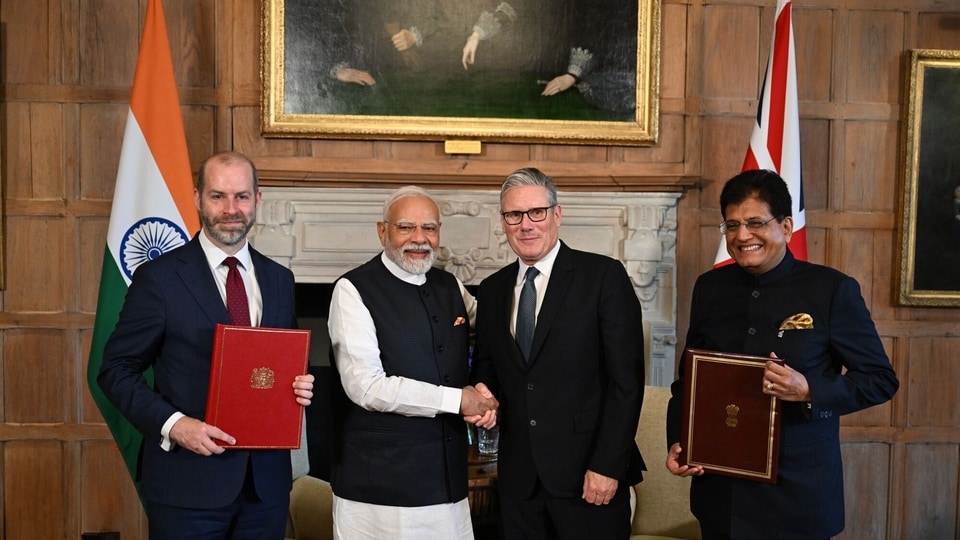
India’s Atmanirbhar Bharat campaign and the broader India–UK Vision 2035 roadmap have been woven into the agreement. Nearly 99% of India’s exports to the UK, almost the entire trade value, will now be duty-free. Tariffs of 4–16% on textiles, leather, footwear, gems, jewellery, and marine products have been removed, potentially creating new employment opportunities. Sensitive sectors such as dairy, cereals, edible oils, apples, and certain automobile segments remain protected through exclusions or phased liberalisation.
India has shared by opening 89.5% of its tariff lines, covering 91% of UK exports. About a quarter of these gain immediate duty-free access, while the rest will be phased in over five–10 years.
Indian exporters stand to benefit in several areas. Textile and garment producers, previously subject to UK import duties of 4–16%, will now compete on equal terms with Bangladesh and Cambodia, who already enjoy duty-free access. Leather and footwear exporters, currently earning nearly $500 million annually from UK sales, are expected to see significant growth.
Seafood exporters, particularly shrimp producers, will gain directly as UK duties of 4–8% are eliminated. Coastal states are likely to feel the impact most strongly.
Indian IT professionals also benefit. Previously, they had to pay nearly 23% of their salary into UK social security with no return. Under the agreement’s social security provisions, often referred to internationally as a ‘totalisation agreement,’ those payments are waived for five years, saving Indian firms and workers an estimated $600 million annually.
Farmers are expected to access new high-value markets without facing fresh competition at home. The government projects agricultural exports to the UK could rise by more than 50% in three years.
Overall, bilateral trade is expected to double to $120 billion by 2030, with further growth projected by 2040. The UK, however, also anticipates gains of £4.8 billion annually, a reminder that “mutually beneficial” means both sides profit.
The first concern lies in tariff asymmetry. India’s average import tax before the deal was 13%, compared to the UK’s 3%. Eliminating tariffs benefits UK exporters more in real terms. Scotch whisky duties will fall from 150% to 40% over a decade, while British cars will enter India at just 10% duty within a quota of 37,000 vehicles. UK consumer goods will become cheaper in India long before Indian exporters fully exploit their new access to the UK market.
India’s trade history also raises red flags. After agreements with ASEAN, Japan, and South Korea, India’s trade deficit with those partners grew faster than its overall deficit. Between FY2019 and FY2024, imports from FTA partners, including the UAE, South Korea, and Australia, rose 38%, consistently outpacing export growth. Economists warn that CETA could repeat this pattern.
Another risk is the UK’s Carbon Border Adjustment Mechanism, due in January 2027. It will impose tariffs on steel, aluminium, cement, and fertilisers, sectors central to India’s manufacturing push but left outside the CETA text. This could claw back some of the market access India has just gained.
Finally, even where tariffs disappear, Indian exporters must still meet the UK’s non-tariff barriers, safety, environmental, and intellectual-property standards. For smaller exporters, these can be as challenging as duties.
CETA is neither a clear win nor a loss. It is a trade-off, typical of negotiations with wealthier partners. India has secured preferential access in autos, public procurement, textiles, leather, marine products, engineering goods, and services mobility, achievements worth noting.
The challenge now lies in execution. For India to truly benefit, MSMEs and rural exporters must be supported with compliance infrastructure, certification systems, and quality assurance. Sensitive sectors such as dairy, processed food, and plastics require phased protection, while linking CETA to domestic manufacturing schemes like PLI will be critical.
Ultimately, the success of this deal depends on how India leverages the opportunities and on whether issues such as the UK’s carbon tax are resolved before 2027.
(The views expressed are personal)
This article is authored by Rahul K Poonia, research scholar, Centre for Economic Study and Planning (CESP), School of Social Sciences, Jawaharlal Nehru University, New Delhi.


